Leverage Trading in Crypto: How It Works, Risks, and Examples
Quick Summary: Leverage trading uses borrowed funds or derivatives to open a larger position than the capital committed. It magnifies gains and losses relative to that capital, while margin requirements can force a position to close. Understanding position size, costs, and liquidation rules matters before entering a trade.
Key Takeaways
- Leverage trading refers to using borrowed funds to open a trading position, which can amplify potential gains and losses.
- The main crypto leverage methods are margin, futures, options, and CFDs.
- There are several risks associated with leverage trading, including volatility, liquidation, and counterparty risk.
- Proper risk management, such as selecting low leverage and using stop-loss orders, is essential when leveraging cryptocurrencies.
Leverage trading lets crypto traders control larger positions using borrowed funds or derivatives. A small price movement can produce a substantial gain or loss relative to the margin committed. Therefore, risk management can help limit exposure, but it cannot prevent every loss.
This guide answers what leverage trading is, shows how it works, and explains how to approach it with care.
What is Leverage Trading?
Leverage trading is a strategy in which traders control a larger position with less starting capital, using borrowing or derivatives. In margin trading, a platform extends funds or assets to support the trade. In futures trading, traders post collateral to obtain exposure through a contract rather than borrowing the remaining position value.
Leverage is expressed as a multiple. There are different leverage ratios, such as 2x, 5x, or 10x, depending on the platform and asset.
At 5x leverage, $1,000 supports a $5,000 position. At 10x, the same initial margin supports $10,000.
Leverage reduces the initial capital required for a given position, but increases the impact of price movements on that capital. If equity falls below maintenance requirements, the platform may forcibly close some or all of the position.
Your $30,000 bonus + 10% discount are waiting on Bybit! Sign up and claim these rewards before they’re gone. Time’s ticking!
How Leverage Trading Works: A BTC Example
A leveraged trade usually follows four steps:
- Deposit collateral, known as margin.
- Choose a leverage multiple, such as 5x.
- Open a long position if you expect a rise, or a short if you expect a fall.
- Close the position voluntarily, or face automatic liquidation if account equity falls below the platform’s maintenance requirement.
Now take an example.
Assume you have $1,000 and use 10 times (10x) leverage to open a long Bitcoin (BTC) position at a BTC entry price of $70,000. With 10x leverage, you control a position worth $10,000 (10x investment). This simplified dollar-based example excludes trading fees, funding payments, interest, and slippage.
In this example, a 1% BTC price move results in approximately a 10% gain or loss on initial margin before costs.
Initial Capital: $1,000
Leverage: 10x (controlling a $10,000 position)
BTC Price: $70,000 per coin.
Profit Scenario: If BTC rises 1% to $70,700, profit is $100 (1% x $10,000), meaning a 10% gain on initial capital of $1,000.
Loss Scenario: If BTC drops 1% to $69,300, the loss is $100 (1% of $10,000), meaning a 10% loss on initial capital of $1,000.
Types of Leverage Trading
Leverage trading covers several products. Their mechanics differ, so understanding the instrument matters as much as choosing a multiplier.
1. Margin Trading
Margin trading lets crypto traders borrow funds from a crypto exchange to open leveraged spot positions. Traders deposit collateral as margin, which allows them to open larger positions than their initial capital would allow. Initial margin is required to open a position, while maintenance margin is the minimum equity required to keep it open. If equity falls below that threshold, the platform may liquidate the position. Price changes create unrealized gains or losses while the position remains open. Closing or settling the position realizes those gains or losses.
Important Read: Margin Trading for Beginners: Leverage, Risks, and Examples
2. Futures Trading
Crypto futures contracts let traders speculate on price movements, going long or short, without taking ownership of the underlying asset. Dated futures expire on a specified date, while perpetual futures have no fixed expiry and use funding payments. Traders post margin, and liquidation can occur if equity falls below maintenance requirements. Profit-and-loss accounting and settlement schedules depend on the contract and platform.
Important Read: Understanding Crypto Derivatives Trading: A 2026 Guide
3. Options Trading
Crypto options contracts give the buyer the right, without the obligation, to buy or sell an asset at a predetermined strike price before or on its expiration date. In exchange, the option seller (or writer) is required to fulfill the contract if the buyer decides to exercise the option. Traders gain leverage because the upfront cost (the premium) is significantly lower than the total value of the position opened.
Important Read: The Ultimate Guide to Emotionless Options Trading
4. Contracts for Difference (CFDs)
Contracts for Difference (CFDs) are financial instruments that allow traders to speculate on cryptocurrency price movements without owning the underlying asset. Leveraged CFDs require margin and may incur financing charges. Product delivery depends on local rules and the broker’s eligibility requirements.
Key Risks You Should Know
With leverage trading, traders can magnify potential profits or losses. There are also other risks.
| Risk | What it means |
| Volatility | Rapid price changes can produce large losses relative to margin and trigger liquidation |
| Liquidation | The platform might automatically close some or all of a position when equity falls below maintenance requirements |
| Margin calls | Some platforms request additional collateral or send margin alerts, while others might liquidate automatically without a prior request |
| Trading and financing costs | Trading fees, borrowing charges, funding payments, and other product-specific costs affect net returns |
| Counterparty risk | Platform failures, hacks, or insolvency can lead to lost funds |
Common Mistakes
When leveraging cryptocurrencies, traders can make the following mistakes:
- Choosing a leverage multiple without calculating position size, potential loss, and the distance to liquidation.
- Ignoring interest and funding costs, which can erode profit over time.
- Entering without an exit plan or assuming a stop-loss guarantees execution.
- Overlooking counterparty risk when picking a platform.
How to Minimize Risk When Trading With Leverage?
Trading cryptocurrencies with leverage requires careful risk management to avoid unnecessary losses.
Listed below are some key strategies:
- Start with low leverage: Use low leverage and limit position size. For a given position size, higher leverage requires less initial margin and leaves less room for adverse price moves. Increasing exposure can increase total trading and funding costs, but the leverage setting does not automatically raise the applicable rates.
- Understand funding rates: Always check whether your position pays or receives funding, the current rate, and the payment schedule.
- Monitor margin requirements: Track equity, maintenance requirements, and liquidation estimates. Reducing or closing exposure can limit risk, and adding collateral also puts additional funds at risk.
- Use stop-loss orders: Properly place stop-loss orders to help limit losses. However, execution depends on order type, trigger settings, and market liquidity. It cannot guarantee a particular exit price or prevent every liquidation.
Quick Glossary
| Term | Plain meaning |
| Margin | The collateral you post to open a leveraged position |
| Leverage multiple | The ratio of total position size relative to deposited margin (e.g., 10x = 10 times collateral value) |
| Long/short | Positions that generally benefit from rising or falling prices, respectively |
| Margin call | A request for extra funds as a position nears liquidation |
| Liquidation | Forced reduction or closure when equity no longer meets maintenance requirements |
| Funding rate | Periodic payment between traders on perpetual futures |
How to Start Leverage Trading on WEEX?
WEEX is a centralized crypto exchange that offers leverage trading. It supports over 600 cryptocurrencies and a diverse futures market with more than 700 USDT-margined perpetual contracts. Traders can trade leading pairs, such as BTC/USDT and ETH/USDT perpetuals, with up to 400x leverage.
Important Read: WEEX Exchange Review 2026: High Leverage, No KYC, But Is It Worth the Trade-Offs?
Listed below are the steps to start leverage trading on WEEX:
1. Create an Account and Make a Deposit
Log in to your WEEX account, complete the identity verification required for your account and location, and make a deposit.
Remember, KYC verification is optional on WEEX, but it is required for higher withdrawals and fiat deposits.
If you don’t already have an account, follow this step-by-step guide on creating an account on WEEX.
2. Open Your Position
Head to the Futures tab on the homepage, tap USDT-M Futures, and select the trading pair, such as the BTC/USDT perpetual contract.
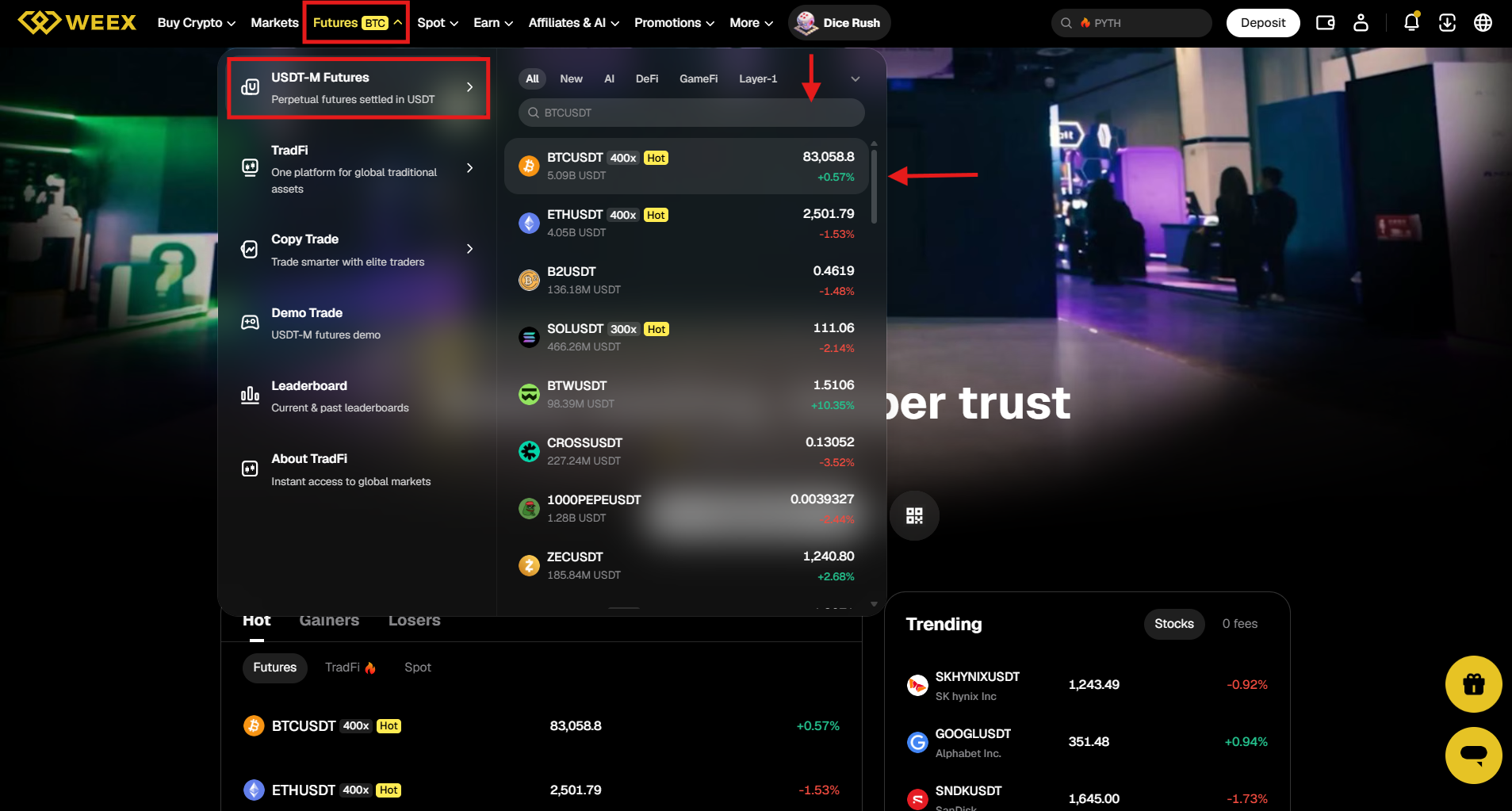
(WEEX homepage)
WEEX offers an advanced trading interface for trading perpetual contracts. Adjust the trading chart according to your strategy, such as by changing the time frame, switching between candlesticks or adding an indicator to the chart.
Navigate to the order panel to open a position:
- In the order panel, select the margin mode between cross and isolated. Cross Margin shares your total account balance across all open trades to prevent liquidation, while Isolated Margin limits risk by restricting potential losses on a specific position to the collateral allocated to it.
- Tap the leverage tab to select the leverage ratio. WEEX offers up to 400x leverage to control larger positions than your initial capital would allow. However, don’t forget that selecting a higher leverage increases the risk of liquidation.
- Select the order type, such as a Limit Order. Enter the order amount, and you can also add Take-Profit (TP) and Stop-Loss (SL) values for better risk management.
- Tap either “Open Long” if you expect the asset’s price to increase or “Open Short” if you speculate the asset’s price will fall.
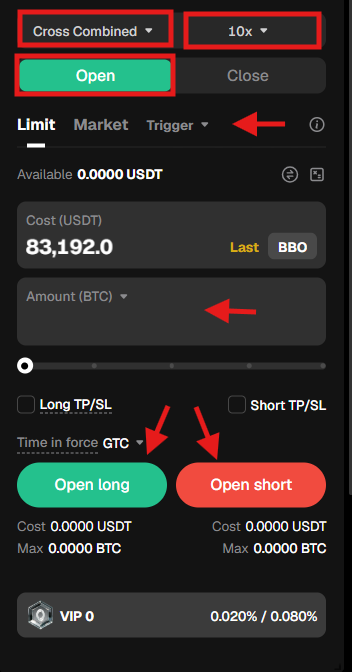
(WEEX order panel)
3. Monitor Your Position
Head to the “Positions” tab at the bottom of the trading interface to check the details of your position. You can see crucial data related to your position here, including position size, unrealized PnL (Profit and Loss), realized PnL, liquidation price, and more.
4. Close Your Position
Tap “Close” in the order panel to close a position. Select the order type and enter the amount at which you want to close your position. Review the details and click either “Close Short” or “Close Long” to close the position. Alternatively, tap “Close” in the positions tab to automatically execute the trade at the current market price.
Final Thoughts
Leverage trading changes the size of exposure and amplifies both gains and losses. Before selecting a leverage ratio, understand the product, collateral rules, costs and liquidation mechanism. A clear calculation helps explain the risk; it cannot remove it.
FAQs
What is leverage trading in crypto?
Leverage trading in crypto means using borrowed funds or derivatives to control a position larger than your initial capital, which magnifies both profits and losses.
What does 10x leverage mean?
It means exposure is ten times the initial margin. In a simple dollar-measured position, a 1% favorable move produces approximately a 10% return on initial margin before costs.
Is leverage trading safe?
Leverage trading carries amplified risk from volatility, liquidation, fees, and counterparty exposure, which make risk management essential.
Is leverage trading suitable for beginners?
It adds liquidation risk and costs that ordinary unleveraged spot purchases do not have. Beginners need to understand margin requirements, position sizing, and execution rules before considering it.
Does a stop-loss prevent liquidation?
It can help, but it does not guarantee prevention. Trigger conditions, liquidity, and execution constraints can affect whether the order closes the position in time.
Get started on WEEX with a simple 40 USDT reward. Deposit 100 USDT, make your trade, and claim the bonus.
Disclaimer: All content on The Moon Show is for informational and educational purposes only. The opinions expressed do not constitute financial advice or recommendations to buy, sell, or trade cryptocurrencies. Trading involves significant risk and may result in substantial losses. Always seek independent financial advice before making investment decisions. The Moon Show is not responsible for any financial losses or decisions made based on the information provided.
Please view the full disclaimer at: https://themoonshow.com/disclaimer
Margin Trading for Beginners: Leverage, Risks, and Examples
Margin trading for beginners starts with understanding how borrowed funds change risk. A small ...

Find Lost Crypto Wallets – A Step-by-Step Recovery Guide
Losing a crypto wallet does not always mean losing access to assets. Recovery may be possible i...

How to Buy Bitcoin for Beginners – A Step-by-Step Guide
When you are new to crypto, buying Bitcoin (BTC) can feel complicated. In practice, the process...