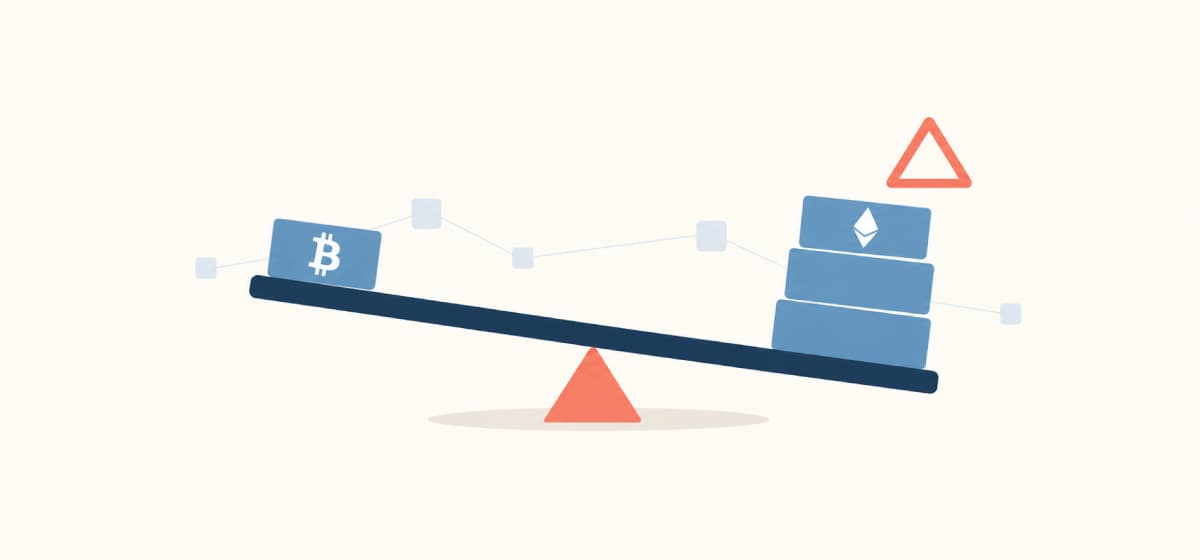
Margin Trading for Beginners: Leverage, Risks, and Examples
Quick summary: Margin trading uses collateral to access borrowed funds and open larger positions than your capital alone allows. This increases exposure to gains and losses. Understanding position size, costs, and liquidations is essential before considering a leveraged trade.
Key Takeaways
- Crypto margin trading allows you to borrow funds to trade the spot market with leverage.
- You can open long positions (if you expect prices to rise) or short positions (if you expect prices to fall), but leverage amplifies both profits and losses.
- Insufficient collateral can trigger liquidation, and a margin-call warning is not guaranteed.
Margin trading for beginners starts with understanding how borrowed funds change risk. A small price move can produce a much larger gain or loss relative to your collateral.
This guide on margin trading for beginners explains what it is, how it works, and why it carries more risk than buying and holding. You will learn the key terms, follow a simple example, and see how to judge whether leverage fits your goals.
What is Crypto Margin Trading?
Margin trading is the practice of borrowing funds to trade spot assets, using the existing capital as collateral. An exchange lends you funds so you can open a larger position than your own balance would allow. Eligible assets in your account serve as collateral for the trade.
With margin, traders can:
- Open long positions that aim to benefit from rising prices.
- Open short positions that aim to benefit from falling prices.
- Use leverage ratios such as 2x, 5x or 10x.
- Increase capital efficiency while amplifying risk.
A key distinction helps: margin is the collateral you deposit, while margin trading is using that collateral to borrow funds and trade with leverage, including interest costs and liquidation risk.
How Margin Trading Works: A Simple Example
Consider this simple example to understand how margin trading works.
For instance, a trader deposits $1,000 into a margin account and chooses 5x leverage on Bitcoin (BTC). This $1,000 is the initial margin. Using leverage, the trader borrows another $4,000 from the exchange, creating a $5,000 position. The trader opens a long position, expecting BTC’s price to rise.
| Component | What happens |
| Initial margin | $1,000 |
| Leverage | 5x |
| Borrowed funds | $4,000 |
| Position size | $5,000 |
Now, if Bitcoin rises by 10%, the position gains roughly $500, minus interest and fees. On the flip side, a 10% drop would mean a loss of roughly $500 on a $1,000 deposit, before interest and fees.
As losses reduce account equity, the position approaches the platform’s risk thresholds. Depending on its rules, the exchange may issue a warning or liquidate positions without guaranteed prior notification.
The trade ends when the trader closes it, or the exchange does. This is the core lesson of any margin trading guide: leverage magnifies both gains and losses.
Key Terms Every Beginner Should Know
Understanding the following key concepts can help beginners become familiar with margin trading.
1. Initial Margin
The amount of capital required to open a margin position. For instance, with 5x leverage, a trader must provide initial margin equal to 20% of the total position value.
2. Maintenance Margin
The minimum equity required to keep a position open. Equity falling below this level increases liquidation risk. Equity is the value of eligible collateral plus or minus unrealized trading profits and losses, subject to the platform’s adjustments.
3. Margin Call
A margin call is a warning from the exchange that account equity is approaching or has breached a platform’s risk threshold. Depending on the rules, you might need to add collateral, reduce exposure, or close positions.
4. Liquidation
It is an estimated price level at which a position would meet the platform’s liquidation conditions. When margin trading, traders should not rely on alerts before liquidation, as margin-call notifications are not guaranteed.
For instance, in the above-mentioned example, a 20% drop in Bitcoin’s price would wipe out the trader’s $1,000 initial margin before fees and borrowing costs. However, that is not an exact liquidation threshold.
Maintenance requirements can trigger closure earlier. Other positions, fees, and collateral values also matter. Using crypto as collateral adds another variable: its dollar value can fall while your trade loses money.
5. Long Margin Position
You can open a long position when you expect the cryptocurrency price to rise. You borrow funds to buy more of the asset and sell later at a higher price.
6. Short Margin Position
You can open a short position when you expect the crypto price to fall. You borrow the asset, sell it immediately, and repurchase it later at a lower price.
Isolated vs. Cross Margin Trading
Understanding the account structure is another part of margin trading for beginners. These modes describe how collateral supports positions; availability and implementation vary.
Isolated Margin
It limits collateral to a specific position, generally separating its risk from other positions. Additional collateral settings and platform rules can change the amount exposed.
Best for:
- Risk control
- Independent trades
Cross Margin
It shares margin across positions within the relevant cross-margin account, and losses in one can affect all.
Best for:
- Capital efficiency
- Using shared eligible collateral to support positions during adverse price moves
Remember, cross margin can use available collateral to support a struggling position. This exposes more funds. Isolated margin separates collateral allocation, but it does not remove liquidation risk. So, before you open a position, check automatic collateral additions and account terms.
Difference Between Margin, Spot, and Futures Trading
A useful distinction in margin trading for beginners is the difference between leveraged spot transactions and derivatives.
| Feature | Margin | Spot | Futures |
| Uses borrowed funds | Yes | No | No (Contracts) |
| Own the asset | Yes | Yes | No |
| Can short | Yes | No | Yes |
| Interest or funding | Interest on borrowed funds | None | Funding payments for perpetuals; no perpetual-style funding for dated futures |
| Liquidation risk | High | No leverage-related liquidation | High |
| Contract expiry | No | Not applicable | Yes (except perpetuals) |
| Suitable for beginners | No | Yes (still requires risk management) | No |
Spot trading involves buying and selling digital assets without using leverage. Margin trading adds leverage to spot trading by borrowing funds, while futures trading involves contracts that track price movements without owning the underlying asset.
Margin Trading Strategies
Traders should always approach margin trading with proper risk management. The following margin trading strategies can be helpful:
1. Short Selling in Declining Markets
With margin trading, you can open short positions by borrowing an asset and selling it at the current market price. Traders use this strategy commonly when they expect prices to fall or when the market turns bearish.
2. Hedging Existing Spot Positions
Traders can use margin trading to hedge spot holdings. For instance, you might hold Bitcoin long term and open a short margin position to offset potential short-term downside without selling your underlying asset.
3. Increasing Capital Efficiency
With leverage, you can allocate less capital to a position while leaving additional collateral available. Experienced traders often use this strategy to manage multiple positions simultaneously across different assets.
4. Pair Trading and Market-neutral Strategies
Traders can go long on one asset and short another simultaneously with margin trading. This strategy aims to benefit from relative price changes between assets, but both positions can lose money.
5. Tactical Short-term Positioning
Short-term traders can use margin trading to capture small price movements with limited capital available. However, it requires precise entry and exit timing and strict loss limits.
6. Risk Management
Margin trading involves liquidation risk, interest costs, and greater exposure to volatility. Stop-loss orders can help limit losses, but execution is not guaranteed at the trigger price. A stop-market order might fill at a worse price during volatile conditions.
Costs and Risk Controls
Costs may include trading fees, borrowing interest, and liquidation charges. Rates depend on the platform and asset, while outstanding borrowing can continue generating interest.
Therefore, before opening a position using margin, consider the following:
- Calculate the dollar loss from an adverse price move.
- Check eligible collateral and liquidation rules.
- Include entry, exit, and financing charges.
- Understand how your chosen order works.
How to Start Margin Trading on Bybit?
The following steps help you place a margin trade on Bybit.
Create an Account
First, create a Bybit account:
- Visit Bybit.com and click on Sign Up.
- Enter your email or mobile number, then create a strong password based on uppercase and lowercase letters, numbers, and symbols.
- Agree to the terms of service and privacy policy.
- Once done, tap Create Account, and you will receive a message via email or phone with a unique code that you need to provide to confirm your account.
- Set up Google Authenticator (2FA) for added security (optional but recommended).
- Bybit requires at least standard identity verification (KYC) for its products and services. Required documents depend on the verification level and region.
Make a Deposit
Next, fund your account. Bybit supports several deposit methods, such as crypto, fiat, P2P trading, and credit and debit card deposits. Available funding methods depend on your region and account.
To review all these methods in detail, read our Bybit tutorial.
Place a Trade
After funding the account, you can place a margin trade on Bybit. Follow these steps:
- On the homepage, click Trade in the menu bar, go to Spot, and select the trading pair, such as BTC/USDT. Bybit offers up to 10x leverage in margin trading.
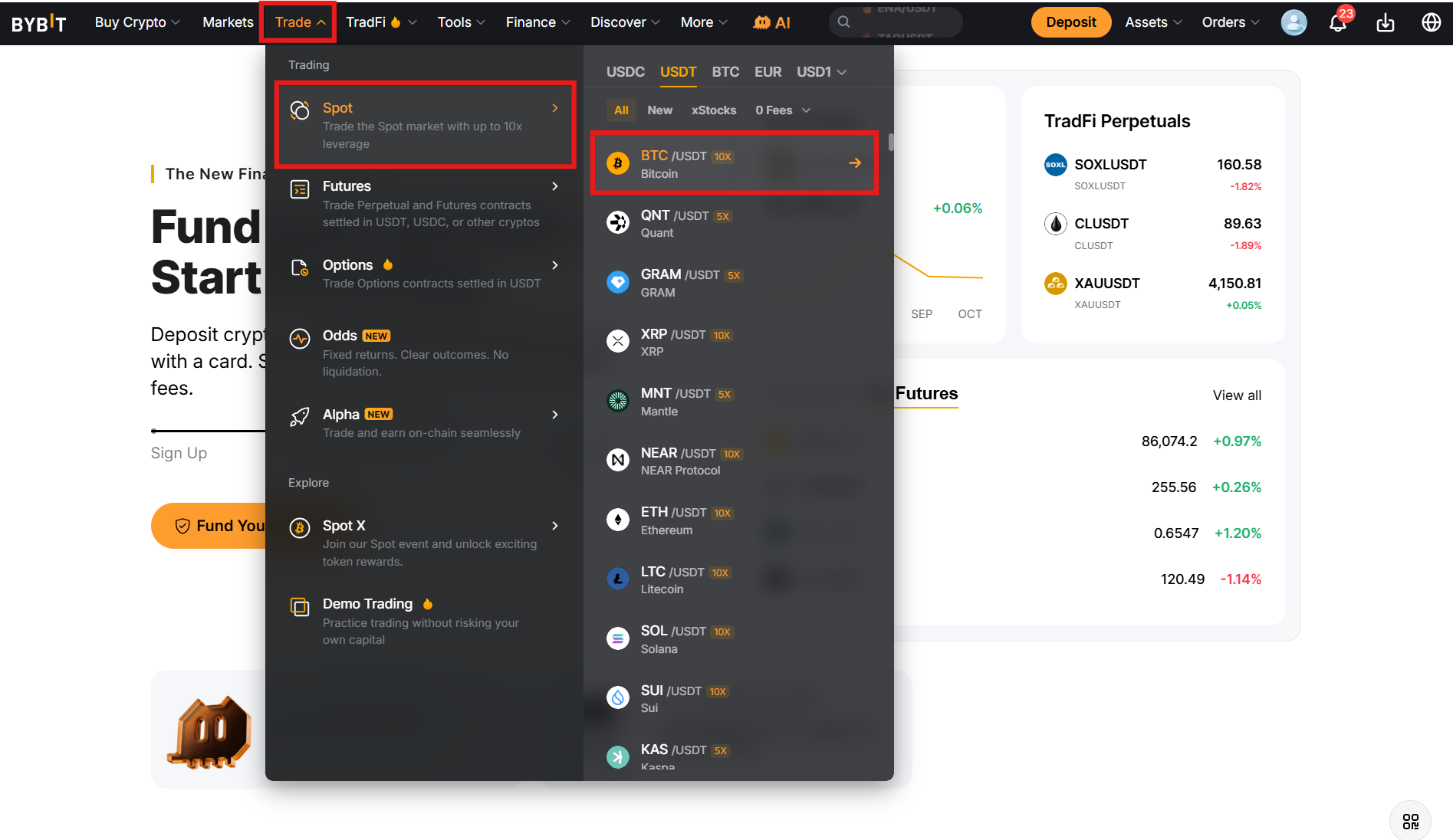
( Bybit homepage )
2. In the order panel :
- Enable margin trading.
- Click either Buy or Sell, confirm the leverage (e.g., 10x), and select the order type (e.g., a limit order ).
- Enter the order quantity.
- You can tap the TP/SL tab to enter take-profit and stop-loss prices, which is optional.
- Confirm the order details and click either Margin Buy or Margin Sell to place the order.
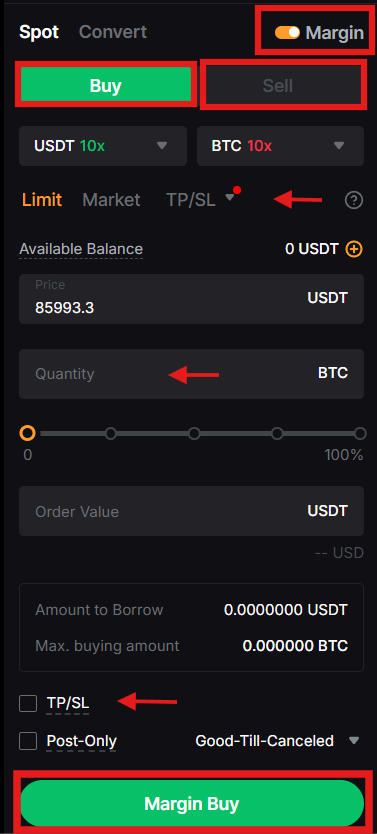
(Bybit order panel)
After exiting the trade, check outstanding borrowing and complete repayment. Selling the purchased asset does not automatically settle the spot borrowing.
Why Beginners Should Be Careful
Margin trading carries high liquidation risk and complexity. Beginners should understand position size, collateral requirements, and borrowing costs before considering leverage.
Margin trading also depends on eligibility, jurisdiction, and account verification. So, if you are exploring margin trading as a beginner, confirm that the crypto exchange you use offers it.
Final Thoughts
Margin trading can increase exposure and open long and short opportunities, but borrowed funds add repayment obligations, extra costs, and liquidation risk.
As a beginner, prioritize understanding collateral, liquidation, and costs before using borrowed money.
FAQs
Is margin trading suitable for beginners?
Margin trading is complex and carries liquidation risk. Beginners should approach it with a solid understanding and proper risk management.
What does 5x leverage mean?
It means $1 of required margin can support $5 of position exposure. Actual risk also depends on position size and total collateral.
What triggers liquidation?
Liquidation occurs when available equity or collateral breaches the platform’s risk thresholds. Collateral values and unrealized losses affect those calculations.
Can you lose more than your initial margin?
Yes, depending on account structure and platform terms. Cross margin can expose additional eligible account collateral. Check platform terms rather than assuming losses are capped.
Is cross margin safer than isolated margin?
Cross shares collateral; isolated separates allocation. The tradeoff depends on exposure, settings, and platform rules.
Are margin and futures trading the same?
No. Leveraged spot trades use borrowed funds or assets, while futures provide exposure through contracts. Both can use leverage.
Get started on WEEX with a simple 40 USDT reward. Deposit 100 USDT, make your trade, and claim the bonus.
Disclaimer: All content on The Moon Show is for informational and educational purposes only. The opinions expressed do not constitute financial advice or recommendations to buy, sell, or trade cryptocurrencies. Trading involves significant risk and may result in substantial losses. Always seek independent financial advice before making investment decisions. The Moon Show is not responsible for any financial losses or decisions made based on the information provided.
Please view the full disclaimer at: https://themoonshow.com/disclaimer
Find Lost Crypto Wallets – A Step-by-Step Recovery Guide
Losing a crypto wallet does not always mean losing access to assets. Recovery may be possible i...

How to Buy Bitcoin for Beginners – A Step-by-Step Guide
When you are new to crypto, buying Bitcoin (BTC) can feel complicated. In practice, the process...

How to Choose a Crypto Exchange in 2026: Fees, Security, Regulation
Over the years, cryptocurrency exchanges have evolved considerably. What first began as simple ...