Understanding Crypto Derivatives Trading: A 2026 Guide
Crypto derivatives trading is the practice of buying or selling financial contracts that obtain their value from an underlying crypto asset (e.g. BTC or ETH). These financial tools, primarily options, futures and perpetual swaps, enable traders to speculate on the price movement of an asset, hedge their risk and use leverage to increase their purchasing power without necessarily owning the crypto asset itself.
Who is this for: Crypto traders who want to maximize their capital efficiency through leverage, profit in both scenarios where the market is rising or falling (without owning the underlying asset) and hedge against market volatility.
Key Takeaways
- Crypto derivatives trading allows a trader to predict or hedge on the price of an underlying asset like Bitcoin or Ethereum through contracts without actually owning it.
- Leverage is a powerful tool allowing traders to increase their buying power and their profit. However, when and how to use the tool is crucial to avoid capital loss and liquidation.
- The market offers various tools for different trading strategies, such as options contracts, perpetual swaps and more and traders should understand them to make informed decisions.
What is Crypto Derivatives Trading?
In the crypto space, if one wants to have advanced market exposure, trade with leverage and hedge risks, they must learn about crypto derivatives trading.
Unlike spot trading, where you can simply buy any asset or coin in exchange for immediate payment, crypto derivatives involve an agreement to trade if a specific condition is met in the future or at a specific price.
How Crypto Derivatives Work?
Consider crypto derivatives as a betting slip at a horse race, where the horse is Bitcoin. Now when someone holds that betting slip, they do not own the horse, but the value of slip is entirely dependant on the performance of the horse during the race. In case the horse wins, the slip they own becomes valuable and vice versa if the horse doesn't.
Similarly, if the price of Bitcoin goes up you benefit from it.
However, crypto derivatives trading allows traders to profit even if the price of an asset they are interested in, is falling. This is called “shorting”, where short sellers open a contract, selling the crypto asset at its current higher price. The traders still do not own the crypto asset when they open the contract, but the goal is to buy back the asset later, at a lower price. Once the market does fall as predicted, the short seller buys the asset at the lower price and keeps the difference (as profit) between the price they bought it at and the original higher sell price.
Important Reads: How to Short Bitcoin
Start trading on Bybit today and get 10% off fees PLUS up to $30,000 in bonuses! Sign up today and start saving while you earn. This exclusive offer won't last - claim yours now!
Purpose of Derivatives: Hedging, Speculation & Leverage
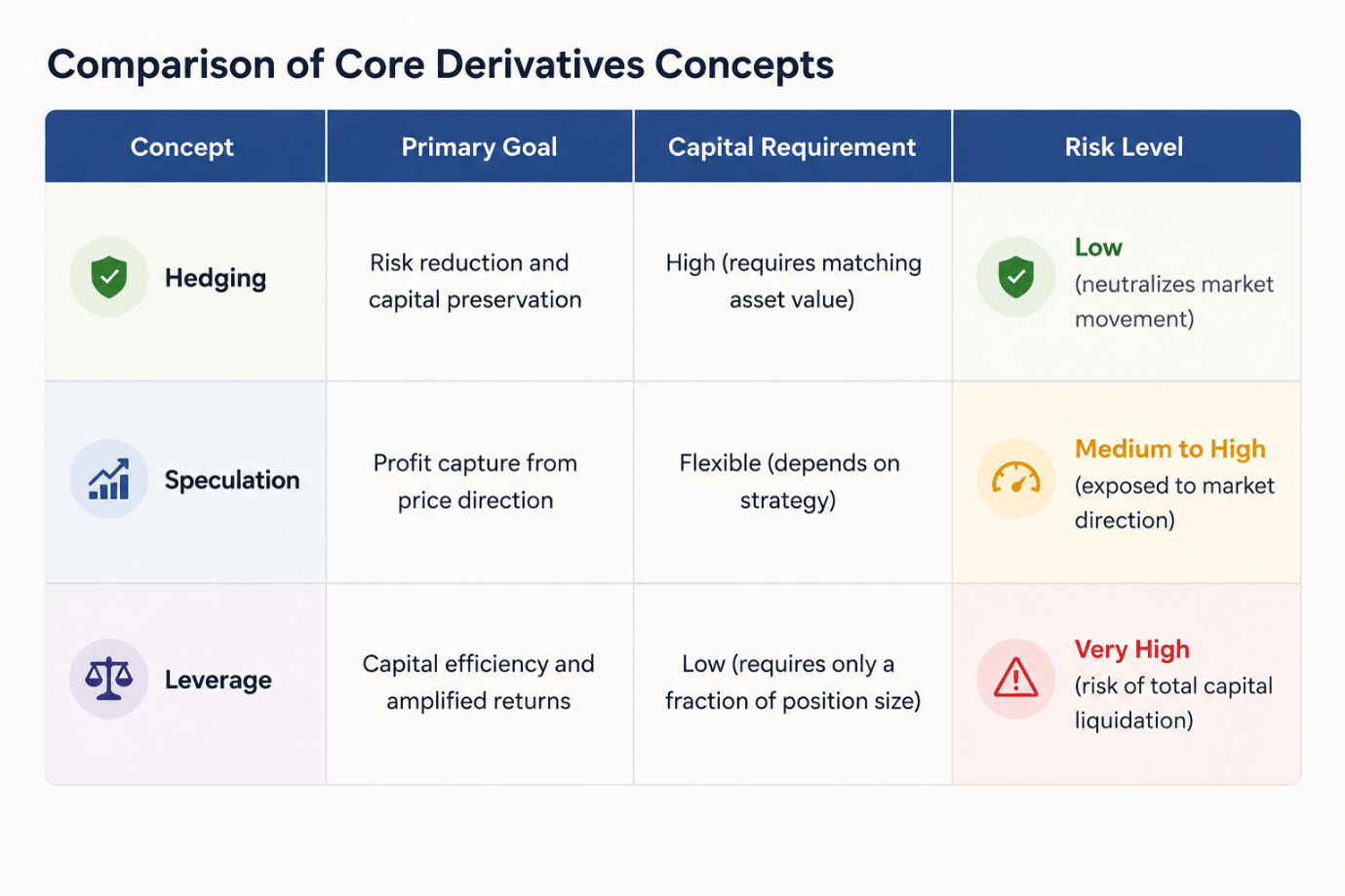
The crypto derivatives market serves three main functions: hedging, speculation and leverage. All three of these involve trading financial contracts instead of the actual asset. However, they vary in terms of the capital requirements, intent and risk management styles.
Hedging
Hedging is fundamentally like an “insurance policy” for your asset. This is the practice of using derivatives to decrease or completely erase the risk of price movement in your portfolio.
Example: You own 1 Bitcoin and you are worried about a potential price drop in the short term. To reduce that risk, you can open a short position in the futures contract for the same amount. When the price of BTC does fall, the profit from your short position will help cover the loss on the BTC you were holding. This enables big investors to keep their assets and profits safe during market volatility without having to sell them.
Speculation
Hedging aims to reduce the risk, whereas speculation embraces the risk. It is the act of trading derivatives to profit from an asset’s price fluctuations.
Speculators do not fundamentally own the underlying asset, but they simply bet whether the price of the asset will go up (long) or down (short). This is where leverage comes in and is a crucial tool to be mindful of.
With leverage, traders can borrow a big capital from the exchange they use and open/control huge positions without spending too much money. If the market moves in favour of whatever the speculators have bet on, they can get massive gains. However, the downside of trading with leverage is complete liquidation. This means if the bet doesn’t go as planned and the losses exceed the provided collateral, the exchange automatically closes the position, and the speculators end up losing all their initial investment.
Leverage
Leverage allows traders to borrow a capital from the crypto exchange, based on the actual funds they have that act as collateral. This is known as margin, and with that traders can open bigger trading positions. Leverage trading attracts many high-volume traders; however, it is a double-edged sword.
Leverage is expressed as 5x, 10x, 20x, 50x and so on. Let’s suppose you have $1,000 in your account and you trade with a 5x leverage. Now the size of your position will become $5,000. If the price of the underlying asset moves up 5% you will gain a 25% profit ($250) on your $1,000 leveraged position, instead of a 5% profit of $50.
While leverage trading amplifies profits, it also amplifies loss. If the market does not move in favour of your leveraged position, you can get liquidated. Higher leverage means your position can get wiped out even if the market moves 5%.
Important Reads: Top 8 100x Leverage Crypto Trading Platforms
Types of Crypto Derivatives
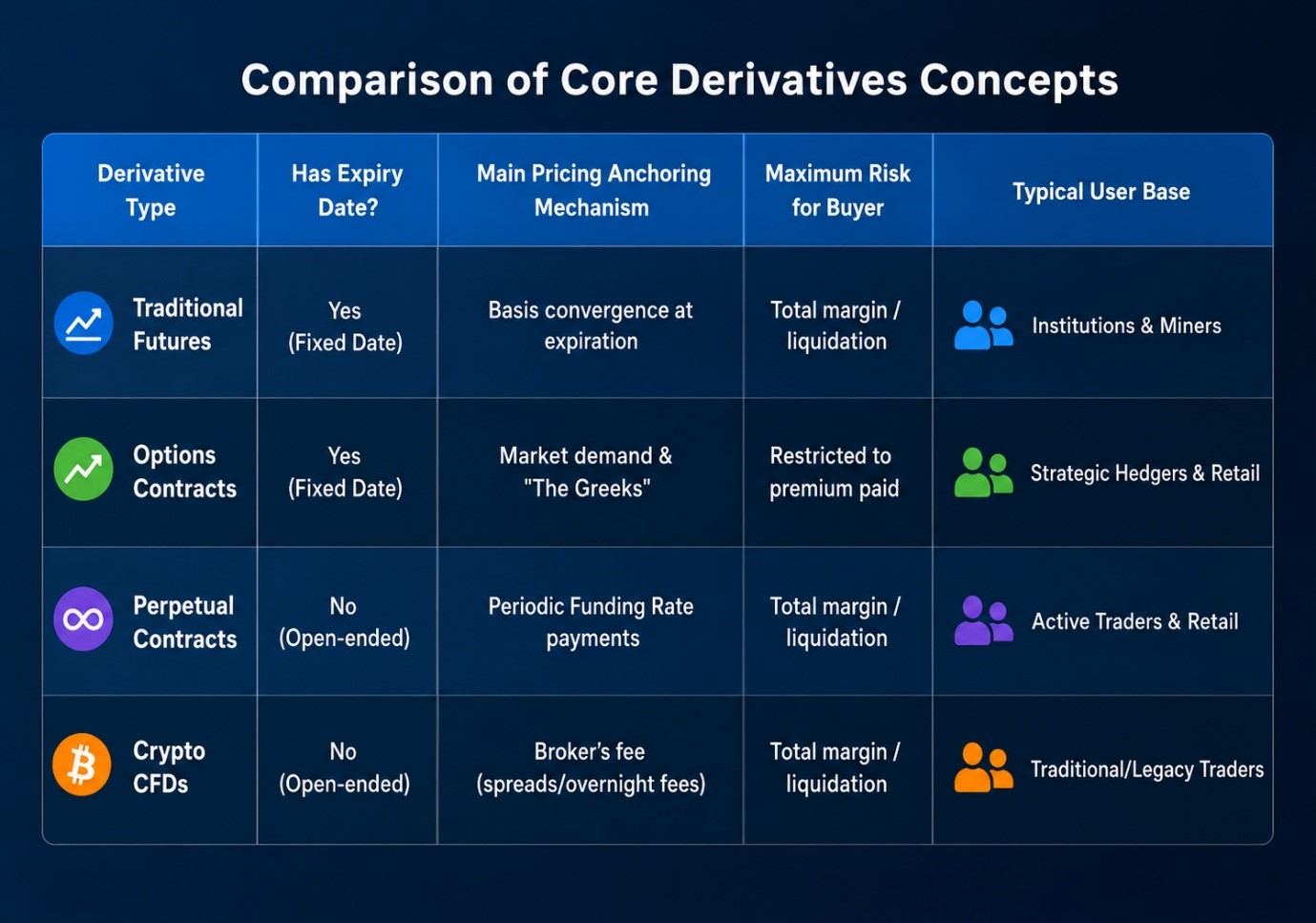
The crypto derivatives market offers various instruments that are suitable for institutional hedgers, retail traders and algorithmic systems.
Bitcoin and Crypto Futures Contract
Crypto futures contracts are best for big investors or corporate treasuries looking to lock in predictable price of an asset months in advance so they can hedge long-term risk. This is a regulated agreement between buyers and sellers to purchase or sell a crypto asset at a pre-decided time and price. These are commonly known as expiry or dated futures.
For example: if you purchase a November Bitcoin futures contract at $80,000, you are obligated to buy BTC at that price when the futures contract expires, even if the actual price is above or below $80K.
Options Contracts
Options contracts are different from futures contracts in terms of the obligation placed on the buyer to execute a trade. With options contract, a buyer is not obligated but has the right to buy or sell an asset at a predetermined price and time. However, buyers have to pay a fee upfront to the sellers, called Premium, to adjust this.
- Put options: buyers get the right to sell and can buy a Put if they want to safeguard their portfolio from a market crash or downward trend.
- Call options: buyers get the right to buy and can buy a Call if they expect the price of an asset to rise above the predetermined price and the paid Premium amount.
Perpetual Contracts
Perpetual contracts are also known as perpetual swaps. They are specially designed for the crypto markets and are now one of the most widely traded financial instruments.
They are best for retail and algorithmic traders who want to seize short-to-medium term price movements, as perpetual contracts never expire. This means, as a trader you can hold your leveraged short or long position without end, as long as you can manage enough margin to keep your trade active.
How it works: crypto exchanges use a tool called funding rate, since there is no expiry date that would force the contract price to meet the spot price. Payments are automatically exchanged between the long and short traders, typically after every 8 hours. If the perpetual price is higher than the spot price, longs pay the shorts, which incites people to short and push an asset’s price downwards. However, it is vice versa if the perpetual price is lower than the spot price.
Crypto Swaps and CFDs
Crypto Swaps and Contracts for Difference (CFDs) are used in institutional markets or offered by brokers.
Crypto CFDs are contracts between a trader and a centralized broker, instead of an exchange. As a trader, you trade the difference of a coin’s price from the time you opened the trade to the time you close it. However, you do not own the crypto asset. These are used by equity traders as they are able to gain crypto exposure using their brokerage accounts instead of setting up a crypto wallet.
Crypto Swaps, on the other hand, are a little more complex. As the term ‘swaps’ suggests, these contracts are agreements between two parties where the cash flow is exchanged based on different assets. For example, an institution might exchange Ethereum staking returns for fixed payments in USD. With crypto swaps, institutions can get exposure without directly holding any asset.
Risks of Crypto Derivatives Trading
Crypto derivatives offer incomparable opportunities to benefit financially and to hedge. However, these are very complex financial instruments and using them without proper knowledge can cause a lot of financial loss as well.
Dangers of Leverage and Liquidation Risks
In spot trading, when an asset’s price falls, traders incur unrealized loss but still hold their coins. This gives them a chance to wait for when the market recovers, an opportunity not available in leverage derivatives trading.
Therefore, you must be careful while leverage trading and generally avoid high leverage if you are an inexperienced trader. If you open a position with 20x leverage, even minor price movements of 5% can cause a complete loss of your position’s margin.
Slippage and Volatility
Slippage occurs when your trade is filled at a different price from what you originally set. This happens, most commonly, with market orders during fast-moving or low liquidity markets. If there are a lot of liquidations happening simultaneously, the prices of the assets can move faster than expected and your order may get executed at a bad price.
Derivatives exchanges use external oracle price feeds to set the liquidation prices. Therefore, in some instances a short-term movement in an asset’s price (up or down) triggers the liquidations, even if the overall market price does not move much.
Platform and Counterparty Risks
When you trade derivatives, you completely rely on the transparency, technical infrastructure and financial competence of the exchange that is hosting you, which introduces structural risk.
During market rallies or crashes, derivatives exchanges get a huge influx of traffic and transaction volume. So much so, that it may cause a system error, API failures and the centralized exchange may start lagging severely. Hence, if the platform is inaccessible, your position will also be inaccessible, and you won’t be able to add margin or adjust your leverage to close your position and avoid liquidation.
In decentralized derivatives, the risk moves to the code where bugs in smart contracts may be exploited and the liquidity from the platform is drained.
Double your advantage on Bybit: 10% off trades + $30,000 up for grabs! Sign up now and claim these exclusive rewards. Offer expires soon!
Crypto Derivatives Regulatory Environment in 2026
After years of legal uncertainty and restrictions around leveraged crypto products globally, there is now a significant shift in crypto regulatory and how these products are accessed. Governments are aiming to provide clear guidelines for the crypto industry.
Regularity Developments in the USA
One of the most prominent advancements that has occurred for the crypto space is the proposed Clarity Act in the USA. With this Act, the regulatory authorities SEC and CFTC will have specified roles and authority over securities and digital commodities, respectively. It will also eliminate any legal ambiguity for crypto operations in the USA, making it a crypto-friendly destination for many.
EU’s MiCA
The European Union has one of the clearest crypto regulatory systems, after it’s MiCA (Markets in Crypto Assets) became active this year. Under this, all crypto platforms (including derivatives platforms) are required to follow the same rules in all EU member countries.
This brings accountability for exchanges and their actions, legal rights for the users and stronger protections for the investors. It also implements mandatory tax reporting, complete and stricter KYC and monitoring of full transactions.
Asia-Pacific Region
The crypto regulations vary from country to country in the Asia-Pacific region currently.
For example: Australia has stricter licensing requirements for big trading platforms. China still has heavy restrictions over crypto operations. Hong Kong has been developing a licensing system for institutional crypto businesses and Singapore encourages innovation but enforces regulation of crypto companies through central bank.
UAE and Dubai
Dubai is one of the most crypto-friendly regions in the world right now, where crypto enthusiasts have clear rules and guidelines, easier-to-follow compliance requirements and is a tax-free haven for all.
Final Thoughts
The best way for traders, especially inexperienced traders, to navigate the crypto derivatives market is to learn about essential tools and strategies before diving in. Having a good understanding of these concepts can help you get the most out of your trading opportunities and manage risk efficiently. Tools like options trading and perpetual swaps do increase chances for traders to make more profit, but they also increase chances of financial loss if not used correctly. Therefore, you should not only be able to predict the price of an asset, but also learn how leverage works, how you can protect your capital and the role exchanges play in this.
Disclaimer: All content on The Moon Show is for informational and educational purposes only. The opinions expressed do not constitute financial advice or recommendations to buy, sell, or trade cryptocurrencies. Trading involves significant risk and may result in substantial losses. Always seek independent financial advice before making investment decisions. The Moon Show is not responsible for any financial losses or decisions made based on the information provided.
Please view the full disclaimer at: https://themoonshow.com/disclaimer
Margin Trading for Beginners: Leverage, Risks, and Examples
Margin trading for beginners starts with understanding how borrowed funds change risk. A small ...
Find Lost Crypto Wallets – A Step-by-Step Recovery Guide
Losing a crypto wallet does not always mean losing access to assets. Recovery may be possible i...

How to Buy Bitcoin for Beginners – A Step-by-Step Guide
When you are new to crypto, buying Bitcoin (BTC) can feel complicated. In practice, the process...