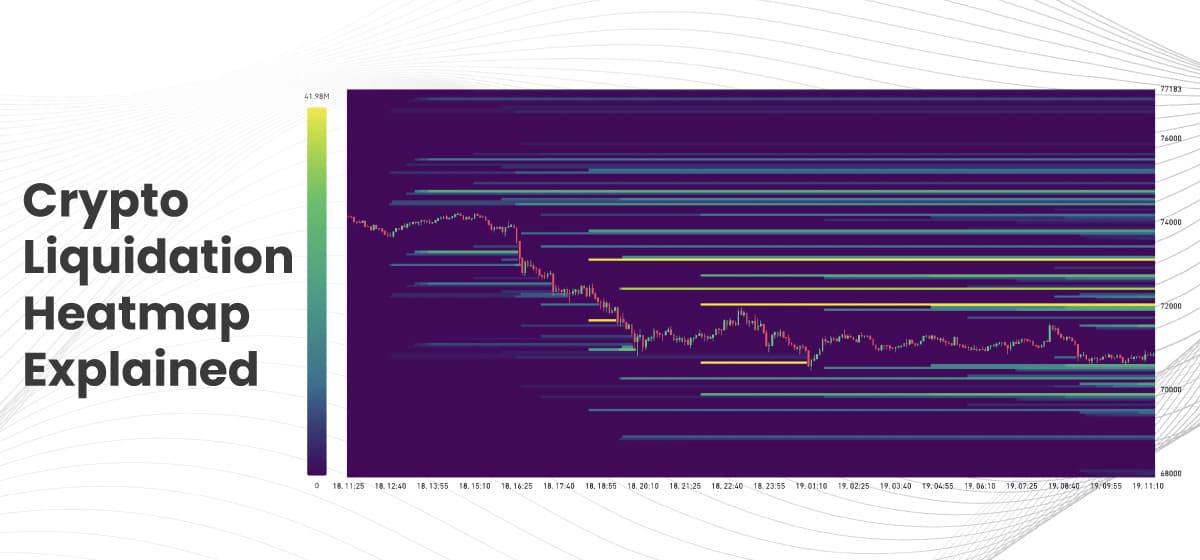
Crypto Liquidation Heatmap Explained: What It Is and How to Read It
If you have ever watched Bitcoin drop sharply out of nowhere and wondered what just happened, there is a good chance a liquidation cascade was involved. Leveraged traders got caught on the wrong side of a move, their positions were force-closed, and that selling pressure drove the price down even further. It is a cycle that plays out constantly in crypto, and the liquidation heatmap is one of the few tools that lets you see it coming.
In this article, we will break down what a crypto liquidation heatmap is, how to read one, and how traders use it to make better decisions. Let’s take a look:
What Is a Crypto Liquidation Heatmap?
A crypto liquidation heatmap is a visual tool that shows where clusters of leveraged positions are likely to be force-closed if the price reaches certain levels. It aggregates data across major derivatives exchanges like Binance and Bybit, mapping out where long and short positions are concentrated and at what price those positions would get wiped out.
The heatmap displays this using a color scale, typically ranging from blue to yellow. Blue zones indicate areas with little liquidation activity. Yellow zones, the bright and intense ones, show where a large number of positions are stacked up and would be wiped out if the price moves into that range. The brighter the color, the more significant that level is likely to be.
To understand why this matters, you need to understand what a liquidation is. When a trader opens a leveraged position, they are only putting up a fraction of the total trade value as margin. If the market moves against them far enough to deplete that margin, the exchange automatically closes the position to prevent the account from going negative. That forced closure hits the market like a market order, adding immediate buying or selling pressure depending on the direction.
Start trading on Bybit today and get 10% off fees PLUS up to $30,000 in bonuses! Sign up today and start saving while you earn. This exclusive offer won't last - claim yours now!
Why Liquidation Zones Attract Price
One of the more counterintuitive things about liquidation heatmaps is that the zones they highlight often act as magnets for price. When a large amount of liquidity is concentrated at a specific level, the market has a natural tendency to move toward it.
Large institutional traders and algorithms are constantly looking for liquidity, areas where they can execute big orders without moving the market against themselves. Dense liquidation zones offer exactly that. When price reaches those zones and triggers mass liquidations, a flood of forced market orders hits the exchange, giving large players the liquidity they need to fill their positions.
When a cluster of liquidations gets triggered, each forced closure adds more selling or buying pressure, pushing the price deeper into the zone and triggering even more liquidations. This chain reaction is called a liquidation cascade, and it is what causes those sudden, sharp moves that feel unexplainable to traders not watching the leverage data.
How to Read a Liquidation Heatmap
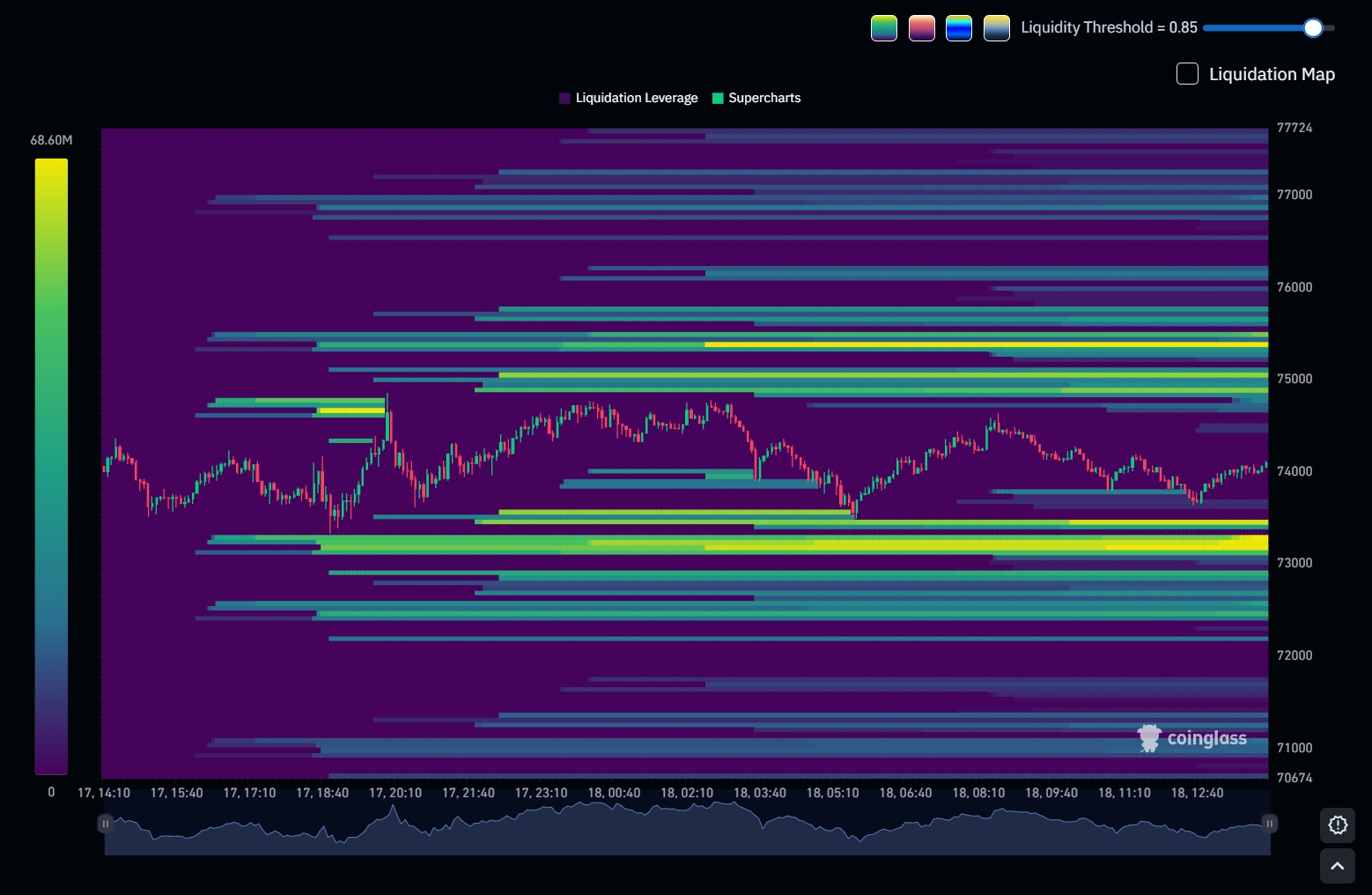
Reading a liquidation heatmap is more intuitive than it might look at first. The vertical axis represents price levels, the horizontal axis represents time, and the color intensity at any point tells you how much liquidation volume is concentrated there.
The first thing to do is identify the yellow zones. A bright cluster sitting just below the current price tells you that a large number of long positions have their liquidation levels there. If the price drops into that zone, those longs get wiped out, adding selling pressure and accelerating the move downward. A yellow cluster sitting above the current price signals the opposite. Short positions are stacked there, and a move into that range would trigger a short squeeze, forcing short sellers to buy back their positions and pushing the price higher.
From there, ask yourself which side of the market is more exposed. If the heavy clusters are below the current price, most leveraged traders are long. If they are above it, more traders are short. This gives you a read on positioning that a standard crypto price chart cannot provide. Most platforms also let you adjust heatmap sensitivity to reveal smaller clusters, which is worth doing since those secondary zones often matter on shorter timeframes.
How Traders Use Liquidation Heatmaps
Identifying Potential Support and Resistance
Liquidation clusters frequently line up with areas where price stalls, reverses, or accelerates. A yellow zone below the market often acts as a magnet, and once the price reaches it and those liquidations are absorbed, the area can flip into a support level. Factoring this into your analysis can lead to better entries and exits than relying purely on historical price action alone.
Anticipating Squeezes
When a large block of short positions is clustered above the current price, and the market begins pushing upward, traders watching the heatmap can anticipate a short squeeze before it develops. As price moves into that zone, forced buybacks from liquidated shorts add momentum to the move. The same applies in reverse for long squeezes, and getting ahead of these setups can give traders a real edge.
Managing Risk Around Dense Zones
One practical use that often gets overlooked is stop-loss placement. If your stop sits inside a dense liquidation cluster, price is more likely to push into that area to trigger those liquidations, taking you out even if the broader trend is intact. Knowing where those clusters sit before placing a trade lets you keep your stops clear of them and avoid getting shaken out by leverage mechanics rather than a real trend shift.
Combining With Other Indicators
A liquidation heatmap works best alongside other tools. Open interest tells you how much total leverage is in the market, giving context to how significant a zone actually is. Funding rates reveal whether longs or shorts are paying a premium to hold, which reflects overall sentiment. When the heatmap, open interest, and funding rate all point in the same direction, the setup becomes considerably stronger than any one signal on its own.
Important Reads: Best Indicators for Crypto Trading
A Practical Example
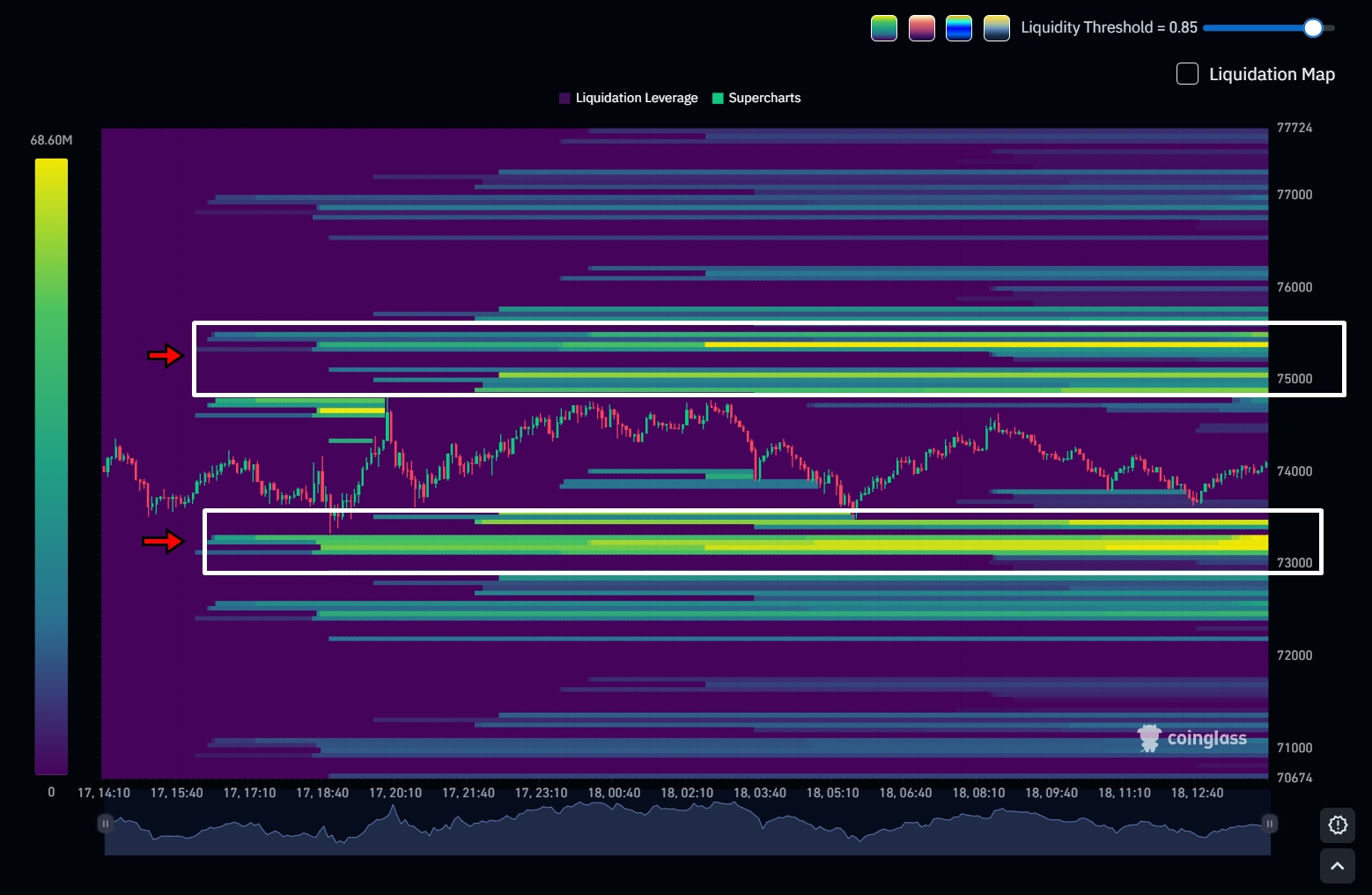
Say Bitcoin is currently trading around $74,000. The heatmap shows a dense yellow band sitting below at roughly $73,000, indicating a heavy concentration of long liquidation levels in that zone. Above the current price, there is an even brighter and more dominant yellow cluster between $75,000 and $75,500, where short positions are heavily stacked.
If price slips below $73,800 with conviction, a sweep of that long liquidation zone around $73,000 becomes a realistic scenario. Traders watching this can either wait for that flush to complete and look for a long entry once the zone is cleared, or reduce exposure ahead of it to avoid getting caught in the cascade. On the other side, if buyers defend the current range and price pushes above $74,500, that short liquidation cluster between $75,000 and $75,500 becomes the magnet, and a squeeze through that area could drive a sharp move higher as those shorts get forced out.
Who Should Use a Liquidation Heatmap?
Liquidation heatmaps are most useful for active traders dealing with derivatives or trading often enough that short-term market mechanics matter. Day traders looking for volatility setups, swing traders building positions around key levels, and leverage traders who need to know where crowded trades sit will all find genuine value here.
For long-term holders, the data adds little practical value. If your horizon is measured in years rather than days, your time is better spent on fundamentals.
Final Takeaway
Liquidation heatmaps give traders visibility that standard charts cannot provide. Knowing where leveraged positions are concentrated and how price tends to behave around those zones makes a real difference in how you plan entries, set stops, and manage risk. It is not a standalone signal, but combined with solid price analysis, it becomes one of the more useful tools available to active crypto traders.
Platforms like CoinGlass offer free access to real-time heatmap data across multiple exchanges and trading pairs. Spending time watching how price interacts with the zones it highlights is the fastest way to build a genuine feel for how leverage influences the market.
Double your advantage on Bybit: 10% off trades + $30,000 up for grabs! Sign up now and claim these exclusive rewards. Offer expires soon!
Frequently Asked Questions
What is a crypto liquidation heatmap?
A visual tool that shows where clusters of leveraged positions are likely to be force-closed if the price reaches certain levels.
What do the colors on a liquidation heatmap mean?
Yellow indicates high liquidation concentration at a price level, while blue indicates relatively little liquidation activity.
Why does price often move toward liquidation zones?
Dense liquidation zones attract large traders and algorithms seeking liquidity, making them natural targets for price movement.
What is a liquidation cascade?
A chain reaction where one wave of liquidations adds enough price pressure to trigger another, causing sharp and rapid market moves.
Can I use a liquidation heatmap for any cryptocurrency?
Yes, heatmaps are available for most major trading pairs, including Bitcoin, Ethereum, XRP, and Solana, on platforms like CoinGlass.
Where can I access a crypto liquidation heatmap?
CoinGlass offers free real-time liquidation heatmaps across multiple exchanges and can be filtered by trading pair and timeframe.
Should I use a liquidation heatmap as my only trading signal?
No, it works best alongside other tools like open interest, funding rates, and price action analysis for a more complete picture.
Is a liquidation heatmap useful for long-term investors?
Not really, as the data is most relevant for short-term trading and loses its significance over longer investment horizons.
Disclaimer: All content on The Moon Show is for informational and educational purposes only. The opinions expressed do not constitute financial advice or recommendations to buy, sell, or trade cryptocurrencies. Trading involves significant risk and may result in substantial losses. Always seek independent financial advice before making investment decisions. The Moon Show is not responsible for any financial losses or decisions made based on the information provided.
Please view the full disclaimer at: https://themoonshow.com/disclaimer

How to Buy Bitcoin for Beginners – A Step-by-Step Guide
When you are new to crypto, buying Bitcoin (BTC) can feel complicated. In practice, the process...

How to Choose a Crypto Exchange in 2026: Fees, Security, Regulation
Over the years, cryptocurrency exchanges have evolved considerably. What first began as simple ...

All-time Highs: A Detailed Guide for Crypto Traders
All-time high is the highest price an asset hits since it starts trading. To learn more about A...