The Ultimate Guide to Emotionless Options Trading
Key Takeaways:
- Emotionless options trading is about executing a predefined, rules-based strategy without any emotional interference.
- Tools such as stop-loss orders ensure discipline automatically, even when the market is volatile.
- Traders who control emotions tend to achieve more consistent risk management and long-term performance.
- Strategies and automation are critical tools for removing emotional bias from trades.
- Traders who define entry and exit points before a trade begins remove the need for high-pressure, real-time emotional discipline.
Options trading is a high-stakes financial activity in which traders get the right to buy (call) or sell (put) an asset at a set price within a specific timeframe. While technical knowledge and strategy are essential, controlling emotions, such as fear, greed, overconfidence, and impatience, is necessary to reduce risk and impulsive trading. This is where emotionless options trading comes in.
Emotionless options trading is not about eliminating emotions, but about ensuring that emotions do not influence trading decisions. In this guide, we will talk about what emotionless options trading is, how it works, the role of emotions in trading, how to trade without emotions, and more.
Start trading on Bybit today and get 10% off fees PLUS up to $30,000 in bonuses! Sign up today and start saving while you earn. This exclusive offer won't last - claim yours now!
Let's begin!
Different Trading Models
Trading models are structured approaches that help traders decide when to enter or exit a position based on strategy, time, and risk tolerance. Each model reflects a different way of interpreting price movements and market behavior.
Let’s take a look at some of the most common trading models.
Trend Trading
Trend trading focuses on identifying and following the overall direction of the market. Traders analyze charts and indicators to determine whether an asset is moving upward, downward, or sideways, and then place trades in the direction of that trend. The goal is to ride the trend for as long as it continues.
Position Trading
Position trading is a long-term strategy where traders hold assets for weeks, months, or even years. Instead of reacting to short-term fluctuations, position traders rely on fundamental analysis and major market trends to make decisions, aiming for substantial gains over time.
Arbitrage
Arbitrage involves exploiting the price difference of the same asset on different exchanges. Traders buy an asset at a lower price in one market and simultaneously sell it at a higher price in another, profiting from the difference. This strategy requires speed, precision, and access to multiple cryptocurrency exchanges.
Scalping
Scalping is a short-term trading method where traders aim to make small profits from minute price changes throughout the day. Scalpers execute numerous trades within minutes or even seconds, relying on high liquidity and quick decision-making.
Day Traders
Day trading involves buying and selling assets on the same trading day (24 hours), closing all positions before the market closes. Day traders take advantage of short-term price fluctuations and avoid overnight risks, often using technical analysis and real-time data.
Range Trading
Range trading is based on identifying price levels where an asset consistently moves between a high (resistance) and a low (support). Traders buy near support and sell near resistance, assuming the price will continue to stay within that range.
Swing Trading
Swing trading captures short to medium price movements over several days or weeks. Traders look for “swings” or periods of upward or downward momentum in the market and aim to profit from these fluctuations.
Momentum Trading
Momentum trading focuses on assets that are moving strongly in one direction at a high volume. Traders enter positions when momentum builds and exit when it slows down.
What is Options Trading?
Options trading is a type of trading where you buy or sell contracts called options. In this trading method, you will get the right but not the obligation to buy or sell an asset at a fixed price (strike price) before a specific date (expiration). Key concepts of options trading include:
- Call Option: A contract that gives traders the right to buy stock at a set price, usually when the price is expected to increase (bullish).
- Put Option: A contract that gives traders the right to sell a stock at a set price, usually when the price is expected to decrease (bearish).
- Premium: It is the fee that buyers pay the sellers to acquire an options contract.
- Strike Price: It is the predetermined price at which the asset can be sold or bought.
- Expiration Date: It is the date by which the option to buy or sell must be used, or it will expire.
Traders often use options to speculate on price movements or to hedge (protect) their existing investments. This makes options riskier and more complex, since they can expire if the market doesn’t move as expected.
What is Emotionless Options Trading?
Emotionless options trading is a disciplined, rule-based approach in which trading decisions are made strictly according to predefined criteria instead of emotional reactions. This means entering and exiting trade positions is based on strategy, market signals, set risk parameters, and market trends.
Traders follow their plan regardless of recent losses or profits. Whether the market is volatile or calm, their decision-making process remains consistent and strategic. The approach often involves clearly defined entry positions, stop-loss levels, and profit targets. Once these rules are established, the trader just has to follow the plan, without letting the emotions sway them.
How Emotionless Options Trading Works?
Emotionless options trading works by proactively planning and sticking to that plan, without emotional decision-making. Before entering a trade, the trader defines every possible scenario and its response. This removes the need for real-time emotional judgment. For example, a trader may decide to:
- Enter a call option only if an asset breaks a resistance level with volume confirmation.
- Risk no more than 2% of total capital per trade.
- Exit immediately if the position loses a certain percentage of its value.
By setting such rules in advance, the trader avoids second-guessing or panic when making crucial decisions. Many traders prefer to use algorithmic tools or alerts to automate parts of the process. Tools such as Tradetron, Option Alpha, and FlowAlgo are popular among traders. Automation reduces human involvement, as this is where emotional errors occur.
Most cryptocurrency exchanges, such as Binance or Bybit, allow you to set a "One-Cancels-the-Other" (OCO) or Bracket order. This is a great tool for emotionless options trading because it covers both directions simultaneously. Here is an example of an automated stop-loss order and take-profit:
- You buy 1 Bitcoin at $90,000, expecting a breakout but wanting to protect your investment.
- For a take-profit order, you will set a sell limit at $95,000. If the price hits this, you get a $5,000 profit.
- For a stop-loss order, you will set a trigger at $87,000. If the price drops here, the system automatically sells the Bitcoin to prevent further loss.
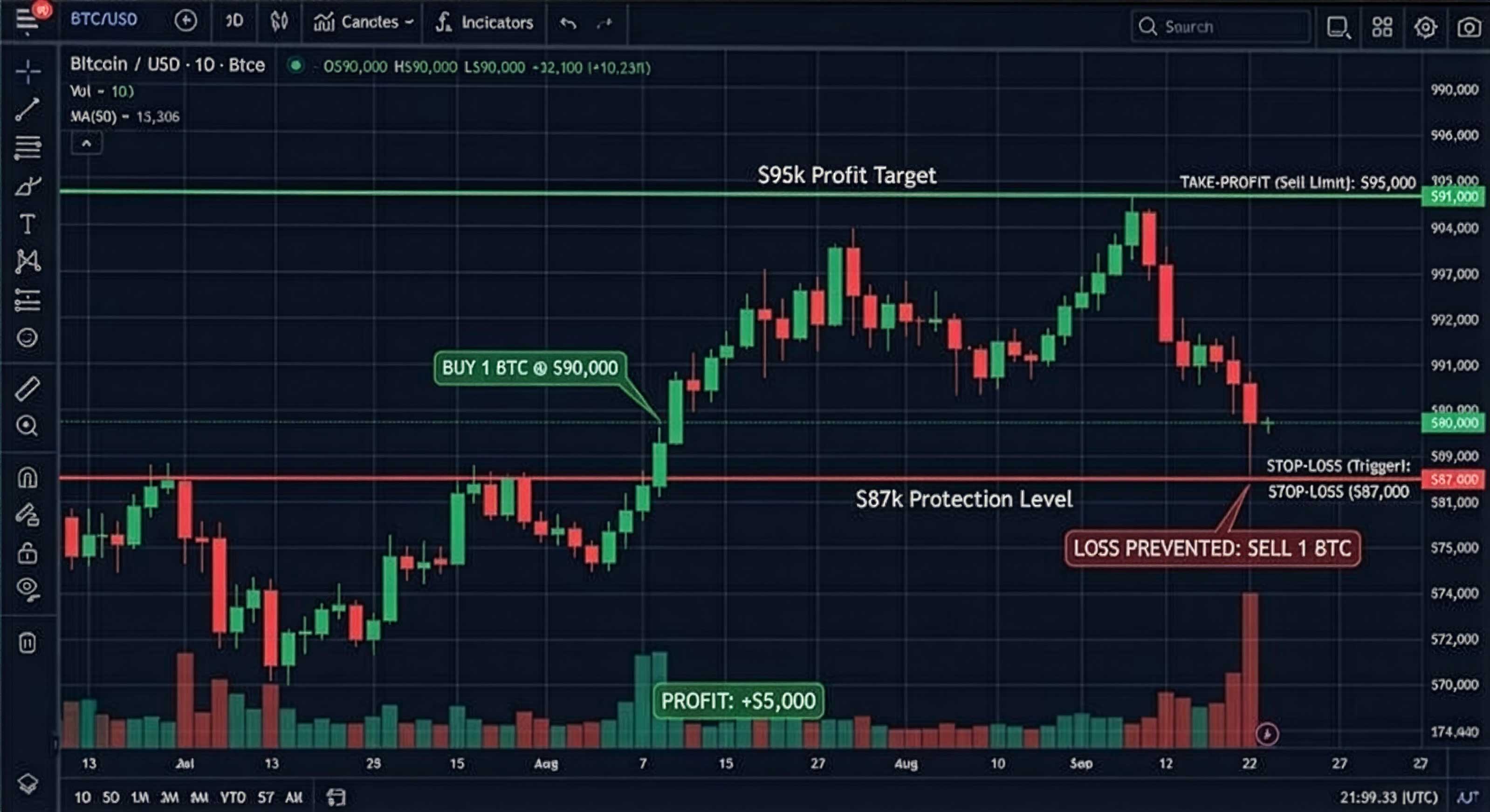
The system will take care of the trade for you and allow you not to become emotionally invested in a single trade. However, slippage can occur during high volatility periods, even when automated tools are used.
The Role of Emotions in Trading
Emotions run high in options trading, where leverage amplifies both gains and losses. There are several psychological factors that can impact your judgment and lead to poor outcomes. Such as:
- Fear of Missing Out: Fear of missing out (FOMO) often causes traders to exit profitable trades early or lose good opportunities. Greed can push traders to over-leverage, hold positions for too long, or jump into a position without a well-defined strategy. This can lead to impulsive decision-making and increase exposure to risk.
- Impatience or Overconfidence: Traders often become impatient or overconfident after a few successful trades. This can lead traders to take more risks than they can afford and may skip their preset risk management procedure and trading strategy. It increases their vulnerability to market volatility.
- Overtrading: Traders often get the urge to jump into a position just because the market is active and start overtrading. They feel compelled to always be entering or exiting a position without thinking about the consequences. It often leads to increased transaction costs and potential losses.
- Holding Positions for Too Long: In an effort to reduce their chances of a loss, traders often hold on to positions for too long and lose their opportunity for a bigger profit.
Understanding these emotional triggers is the first step towards controlling them. The goal is not to suppress emotions but to manage them, ensuring that emotions are acknowledged and not simply acted upon.
How to Trade Without Emotions?
Emotionless options trading requires discipline, strategy, and self-awareness. For this, you need to:
Create a Trading Plan
Creating a detailed trading plan must include different strategies for different market conditions. Understand that the cryptocurrency market is active 24/7, and the potential for rapid price changes is high in projects like NFTs or DeFi tokens. Your trading plan should outline your approach for various scenarios, such as rallies or market dumps. This allows you to trade without emotions and create a simple plan to follow through.
Set Clear Entry and Exit Position
Setting a clear entry and exit position means you need to set exact price levels where you will buy or sell a cryptocurrency. You must also consider past market behavior and the latest technical analysis. This strategy helps traders maintain discipline during volatile market conditions and not give in to their emotions.
Use Stop-Loss Orders
A stop-loss order is an automatic order to sell a cryptocurrency or token when it reaches a certain price. This order limits potential losses and ensures your capital stays intact. It is one of the most important orders in cryptocurrency trading. Stop-loss orders are essential if you want to protect your capital from major risks without emotional decision-making.
Adopt Risk Management Strategies
If you plan on trading frequently, you need to create a risk management strategy. Traders are less likely to panic buy or sell assets when they know the maximum risk is manageable. It also helps traders make decisions that are according to your investment, goals, and market conditions.
And lastly, traders should follow the plan without letting their emotions sway them. By doing this repeatedly, you will build confidence and start trading without letting your emotions affect your decision.
Tips and Techniques
- Develop a detailed trading plan with clear entry, exit, and risk rules.
- Use stop-loss orders to enforce discipline automatically.
- Maintain a trading journal to track decisions and emotional patterns.
- Limit screen time to avoid overtrading and emotional fatigue.
- Backtest strategies to build confidence in your system.
- Use position sizing formulas to control risk exposure.
Common Mistakes to Avoid
Here are some common mistakes traders make while emotionless options trading.
- Believing that emotions can be eliminated is one of the most common mistakes traders make. This unrealistic expectation often leads to frustration. Your goal should be to control your emotions, not ignore them.
- Traders often abandon their strategy after a few losses. Emotional reactions to short-term losses can disrupt long-term success.
- Over-optimizing and tweaking your strategies based on recent trends adds emotional bias into the system. Traders should always avoid that.
- Self-awareness is the key. Traders who do not analyze their behavior are more likely to repeat emotional mistakes.
Final Takeaways!
Emotionless options trading is not about becoming a robot, it is about becoming a disciplined trader. The cryptocurrency market rewards consistency, and by relying on strict risk management as well as continuous self-evaluation, traders can significantly improve their performance.
Double your advantage on Bybit: 10% off trades + $30,000 up for grabs! Sign up now and claim these exclusive rewards. Offer expires soon!
FAQs
Is it really possible to trade without emotions?
Emotionless trading is not about eliminating your emotions, but controlling them so that they don’t influence your decisions. Traders can do that by using predefined rules and implementing strategies.
Why are emotions more intense in options trading?
Options involve leverage, which amplifies gains and losses, making emotional reactions stronger as compared to regular trading.
Can beginners apply emotionless trading strategies?
Yes, beginners can benefit from emotions trading as well. They are less likely to make impulsive mistakes this way.
Does automation help in emotionless trading?
Automated tools and alerts can reduce human intervention and minimize emotional decision-making.
How long does it take to become disciplined in trading?
It varies, but consistent practice and adhering to the rules can significantly accelerate the process.
Disclaimer: All content on The Moon Show is for informational and educational purposes only. The opinions expressed do not constitute financial advice or recommendations to buy, sell, or trade cryptocurrencies. Trading involves significant risk and may result in substantial losses. Always seek independent financial advice before making investment decisions. The Moon Show is not responsible for any financial losses or decisions made based on the information provided.
Please view the full disclaimer at: https://themoonshow.com/disclaimer

How to Buy Bitcoin for Beginners – A Step-by-Step Guide
When you are new to crypto, buying Bitcoin (BTC) can feel complicated. In practice, the process...

How to Choose a Crypto Exchange in 2026: Fees, Security, Regulation
Over the years, cryptocurrency exchanges have evolved considerably. What first began as simple ...

All-time Highs: A Detailed Guide for Crypto Traders
All-time high is the highest price an asset hits since it starts trading. To learn more about A...