
SOL Holds Near $74 as Solana Burn and Disinflation Proposals Seek Stake Support
Solana's latest tokenomics push moved into stake-support signaling on August 4, with proposals targeting both fee-funded burns and future SOL issuance. One could lift estimated daily burns toward 7,500 to 9,000 SOL, while the other would accelerate the decline in inflation. SOL remains near $74, where a developing falling wedge is approaching an important breakout test.
Key Takeaways
- Solana proposals targeting higher fee burns and faster disinflation are seeking the 15% active-stake support required to advance toward a formal vote.
- SIMD-0553 could raise estimated daily SOL burns from roughly 648 to between 7,500 and 9,000.
- SIMD-0550 would double annual disinflation from 15% to 30% and reduce modeled emissions by 18.9 million SOL over six years.
- SOL is testing the upper side of a developing falling wedge, with $76 providing the stronger breakout confirmation.
Solana's Tokenomics Proposals Seek Validator Support
Helius CEO Mert Mumtaz said the burn and disinflation proposals would enter their initial support process on August 4, opening the path toward a formal network vote.
Google searches for cryptocurrencies are rising again in June.
— Alphractal (@Alphractal) Jun 12, 2026
This is a sign that retail investors are starting to search more about different crypto assets and catch up with the market again. Spikes in Google Trends are also often related to moments of euphoria and fear. Track more sentiment metrics at Alphractal.com. https://pbs.twimg.com/profile_images/2013066074397286400/IiikWGOw_400x400.jpg
Under Solana's onchain governance framework, a proposal must first receive support from at least 15% of active stake. Crossing that threshold does not approve the change. It moves the proposal through the remaining governance process before validators and delegators participate in a formal stake-weighted vote.
That distinction is important because neither tokenomics change has been approved or implemented. The current stage measures whether enough of the network wants the proposals put to a vote.
New Fee Model Could Lift SOL Burns Sharply
SIMD-0553 changes how Solana prices transaction resources by introducing a resource-based fee that would be burned.
Solana Compass' analysis of SIMD-0553 estimates that the proposal could increase daily SOL burns from roughly 648 SOL to between 7,500 and 9,000 SOL at current activity levels. Estimated daily issuance sits around 60,000 SOL.
That means the projected burn would offset roughly 12.5% to 15% of current daily issuance. It would materially reduce net supply growth, but the burn mechanism alone would still leave new issuance running well above the amount removed from supply.
Faster Disinflation Targets Future Issuance
SIMD-0550 tackles the other side of the equation by accelerating Solana's existing inflation schedule.
Helius' modeling of the proposal increases annual disinflation from 15% to 30%. Under those assumptions, Solana would reach its 1.5% terminal inflation rate in about 2.8 years instead of 5.7 years, cutting modeled issuance by 18.9 million SOL over six years.
The change also reduces staking rewards more quickly. Helius modeled nominal yields declining from a 5.84% starting point to approximately 4.34% after one year, 3.00% after two years and 2.25% after three years, assuming staking participation remains around 68%.
The proposals therefore tighten SOL supply through separate mechanisms. SIMD-0553 links more network activity to burns, while SIMD-0550 reduces the pace at which new SOL enters circulation.
Tokenomics Take Over from Last Week's Capacity Upgrade
The proposals follow another major Solana change only days earlier. Our July 30 analysis covered the network's 66% increase in block compute capacity and the limited price response that followed.
The latest proposals address a different part of the network's economics. Higher capacity determines how much activity Solana can process. The new tokenomics proposals determine how some of that activity could affect SOL burns and how quickly future issuance declines.
CoinGecko data showed SOL trading around $74 on August 4, with a 24-hour range of roughly $72.43 to $76.12 and about $1.8 billion in trading volume.
Price has yet to produce a decisive response, leaving the 4-hour structure at an important technical test.
Solana Technical Analysis on the 4-Hour Chart
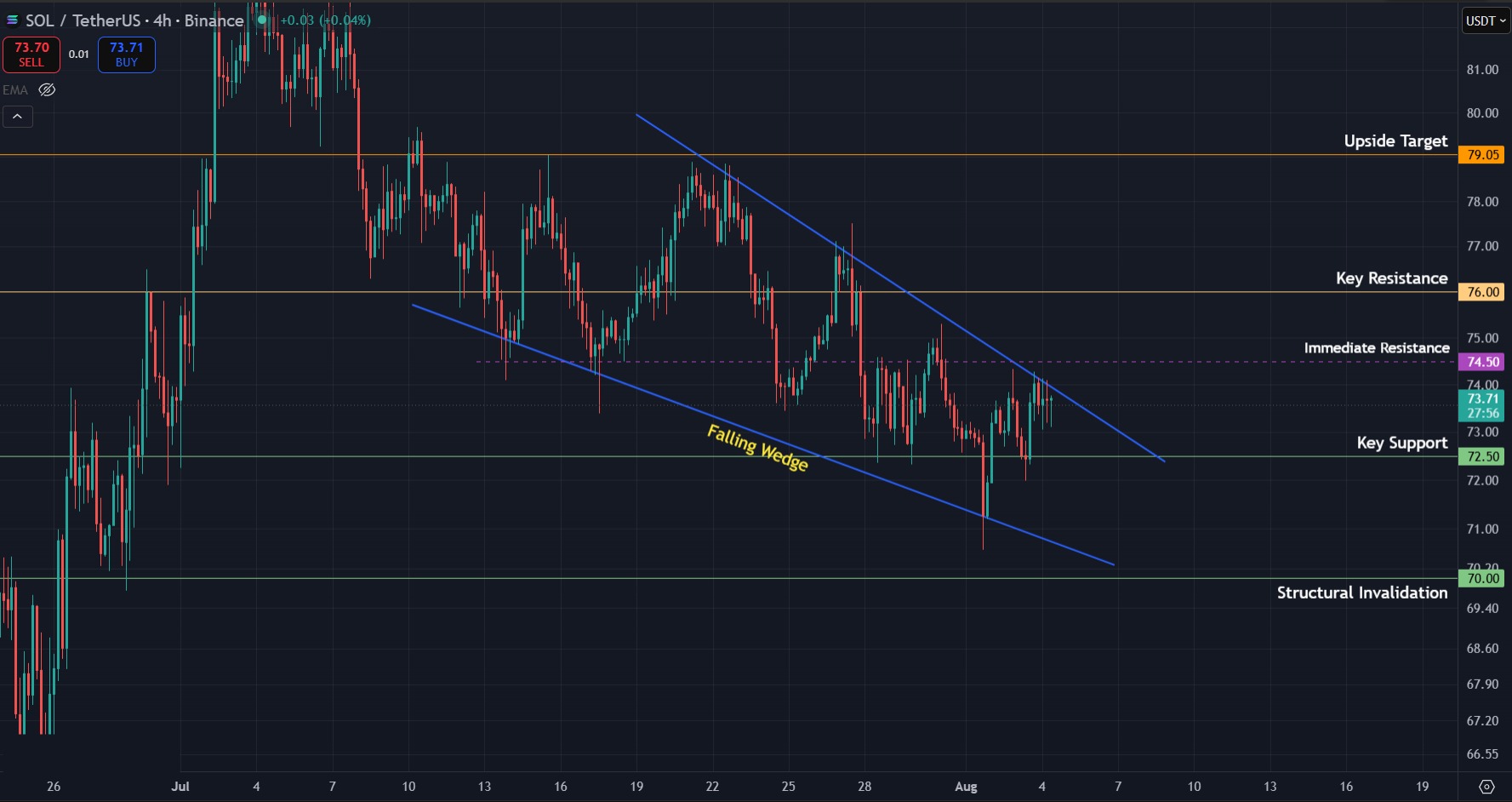
SOL has been forming a developing falling wedge since the late-July decline. The upper trendline connects a sequence of lower highs, while the lower boundary is also descending at a shallower angle. The two lines are gradually converging.
Price is now pressing close to the wedge's upper boundary near the $74 area. A completed 4-hour break above that trendline would be the first sign that the sequence of lower highs is weakening.
The stronger confirmation remains $76. SOL has repeatedly struggled around this level, and a 4-hour close above it would break horizontal resistance as well as improve the wider structure. That would put $79 back in focus, close to the late-July highs.
On the downside, $72.50 remains the key horizontal support. Losing it would push SOL deeper into the wedge and increase the risk of another test of its lower boundary.
The wider structure fails below $70, where the lower trendline and structural support converge. A completed 4-hour close beneath that area would invalidate the current recovery setup.
The falling wedge gives buyers a potential reversal structure, but the pattern remains unconfirmed while SOL trades below its descending upper boundary and $76 resistance.
What to Expect Next
- Bullish case: SOL breaks the wedge's upper boundary and closes above $76, opening another test of $79.
- Bearish case: Losing $72.50 keeps price inside the declining structure and shifts attention toward the lower boundary.
- Key catalyst: Whether the burn and disinflation proposals secure enough stake support to progress toward a formal vote.
- Invalidation: A completed 4-hour close below $70 invalidates the current recovery structure.
FAQs
What does the 15% stake threshold mean?
It determines whether a Solana Governance Proposal has enough network support to advance toward a formal vote. Reaching 15% does not approve the underlying changes.
Can SOL stakers participate in a formal governance vote?
Yes. Solana's governance system allows delegators to override their validator's position using their own staked SOL once a proposal reaches the voting stage.
Get started on WEEX with a simple 40 USDT reward. Deposit 100 USDT, make your trade, and claim the bonus
Disclaimer: All content on The Moon Show is for informational and educational purposes only. The opinions expressed do not constitute financial advice or recommendations to buy, sell, or trade cryptocurrencies. Trading involves significant risk and may result in substantial losses. Always seek independent financial advice before making investment decisions. The Moon Show is not responsible for any financial losses or decisions made based on the information provided.
Please view the full disclaimer at: https://themoonshow.com/disclaimer

Bitcoin and Ethereum Quarterly Returns 2026: Q1-Q3 Trends and Q4 Outlook
Quarterly returns for Bitcoin (BTC) and Ethereum (ETH) offer a simple way to measure how the tw...

LINK Breaks August High as Chainlink Expands Into Global Payments
LINK is holding above $13 on September 7 after gaining 9.9% in the previous session. The move c...

XRP ETF Inflow Streak Ends After $170M Run. Can Price Hold $1.31?
XRP is trading near $1.36 on September 3 after U.S. spot XRP ETFs recorded their first net outf...