
Bitcoin Tests $62.5K as Coldcard Widens Seed-Flaw Warning
Bitcoin traded around $62,700 on August 3 after last week's recovery failed near $65,000. Coinkite's latest Coldcard advisory widened the list of affected wallet models and confirmed that vulnerable seeds remain exposed even after a firmware update. BTC is now moving inside a falling wedge, with $62,500 providing the immediate support test.
Key Takeaways
- Coldcard says vulnerable seeds can affect Mk2, Mk3, Mk4, Mk5 and Q devices depending on the firmware used when the seed was generated.
- Updating an affected device prevents the same seed-generation problem going forward but does not repair an existing vulnerable seed.
- Bitcoin entered the weekend after US spot ETFs recorded $265.4 million in net outflows on July 31.
- BTC is trading near the lower side of a falling wedge, with $62,500 as key support and $63,200 as the first recovery level.
Coldcard Widens Its Warning to Newer Wallet Models
Coinkite expanded its Coldcard security advisory on August 1 after its investigation found that the entropy problem extends beyond older Mk2 and Mk3 devices.
Seeds generated on affected Mk4, Mk5 and Q firmware are also exposed. Coinkite estimates that those newer devices generated seeds with about 72 bits of entropy instead of the intended 128 bits. The company says the problem is more severe on affected Mk2 and Mk3 firmware.
Fixed releases are now available for every affected model and release track. However, exposure depends on the firmware used when the seed was created, so users cannot determine risk from the device model alone.
Existing Seeds Still Need to Be Replaced
The problem stems from Coldcard's random-number generation process. An integration error allowed wallet seed generation to reach a software random-number generator when the device was intended to use stronger hardware-generated randomness.
Block's independent technical investigation confirmed the RNG integration error and found that later Coldcard models added secure-element entropy but still fell short of their intended security level.
Installing corrected firmware fixes new seed generation. Existing seeds created on affected firmware remain vulnerable, so Coinkite advises users to generate a new seed and migrate their funds unless sufficient independent dice entropy was added during the original setup.
The vulnerability concerns Coldcard's implementation. There is no identified flaw in Bitcoin's blockchain or consensus rules so it’s not a blockchain security issue. Readers looking for more context on hardware storage can refer to The Moon Show's guide to hot and cold wallets.
Bitcoin Enters the Week With ETF Demand Still Uneven
Bitcoin was already coming off a weaker institutional session before the weekend. Farside Investors data shows US spot Bitcoin ETFs recorded $265.4 million in net outflows on Friday, July 31, the latest completed US trading session before August 3.
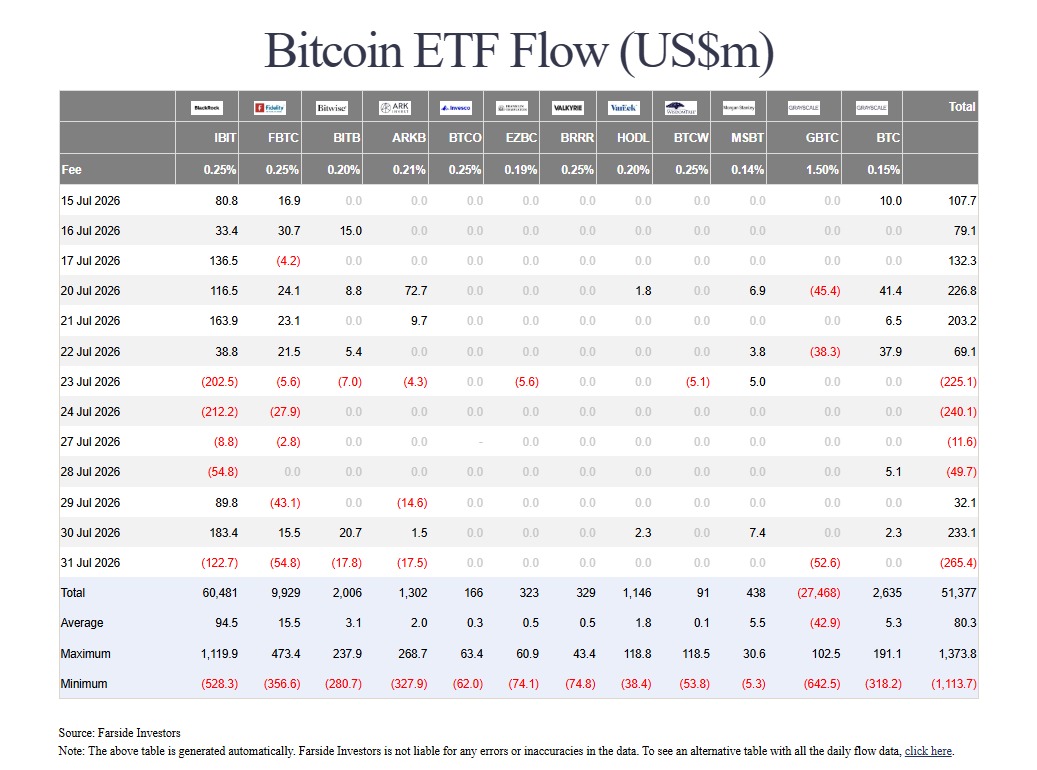
Those withdrawals followed $265.2 million of combined inflows on July 29 and July 30, effectively wiping out the two-session recovery.
That also marks a reversal from our July 30 Bitcoin analysis, when BTC had recovered toward $64,800 and ETF inflows had returned.
CoinGecko market data showed Bitcoin near $62,600 to $62,700 on August 3, with a 24-hour low around $62,241. There is no verified evidence that the Coldcard incident caused the price decline, but the security issue has become another active Bitcoin discussion while price remains under pressure.
Bitcoin Technical Analysis on the 4-Hour Chart
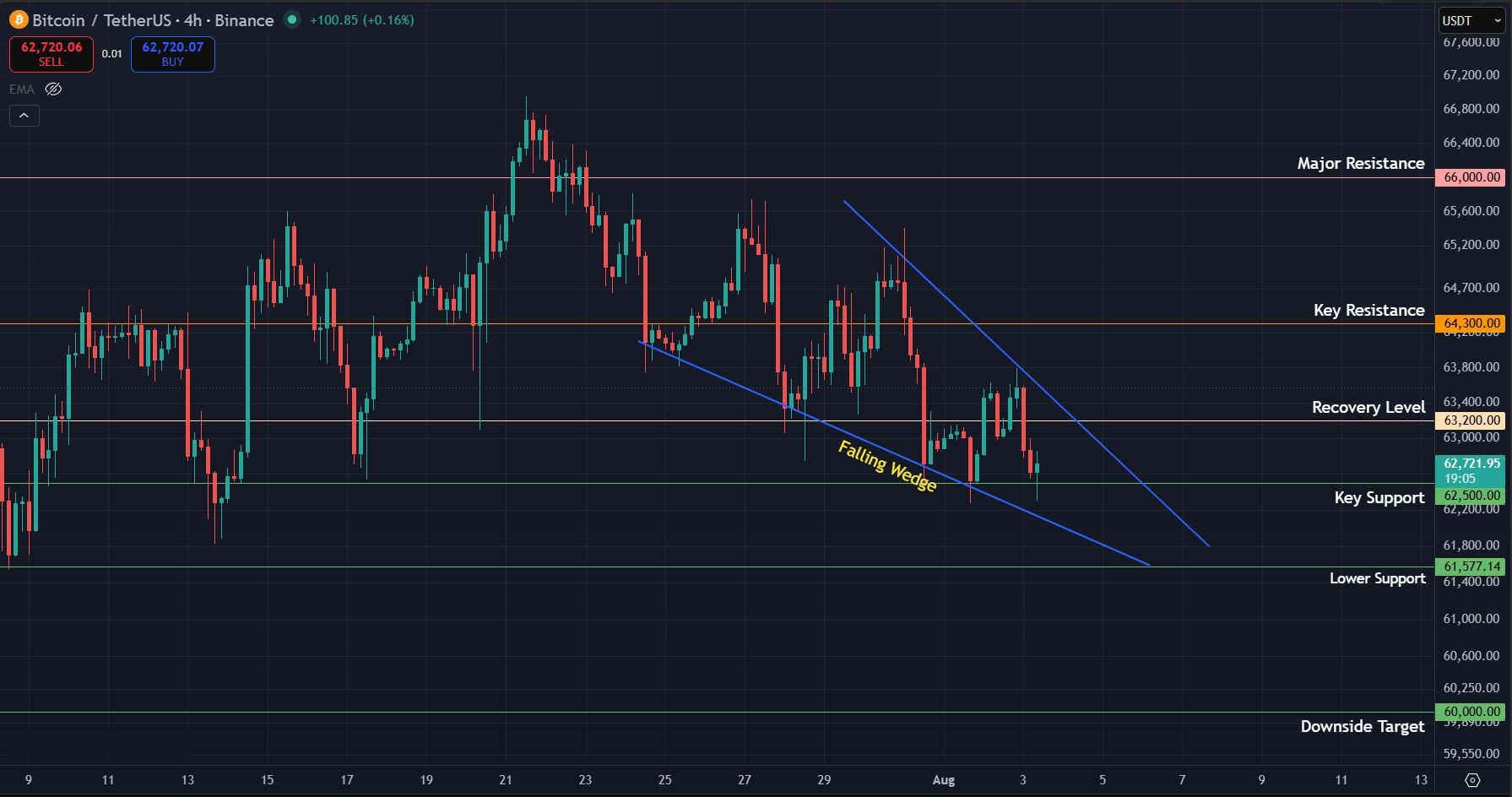
Bitcoin's latest decline has developed into a falling wedge on the 4-hour chart. The upper boundary connects a series of lower highs, while the lower trendline also slopes downward at a shallower angle. The two lines are gradually converging as price moves deeper into the formation.
BTC is currently trading near the lower side of the wedge, where the trendline approaches the $62,500 key support. That confluence gives the level more technical weight than a standalone horizontal support.
The first recovery level sits at $63,200. Reclaiming it would relieve some immediate pressure, but buyers still need a completed 4-hour break above the wedge's descending upper boundary before the pattern starts to resolve higher. A confirmed breakout would bring $64,300 back into focus, with $66,000 remaining the wider resistance above it.
The bearish scenario develops if BTC loses both the lower wedge boundary and $62,500 on a completed 4-hour close. That would invalidate the developing wedge recovery setup and expose the lower support around $61,500. Failure there would bring $60,000 into view as the wider downside target.
The falling wedge creates room for a recovery, but price has not confirmed one yet. BTC needs to defend the lower boundary and start recovering lost levels before buyers regain control of the short-term structure.
What to Expect Next
- Bullish case: BTC holds $62,500, reclaims $63,200 and breaks above the wedge's descending upper boundary, bringing $64,300 back into focus.
- Bearish case: A completed 4-hour break below $62,500 and the lower wedge boundary exposes $61,500.
- Key catalyst: Further developments around the Coldcard vulnerability and the next US spot Bitcoin ETF session.
- Invalidation: Losing $62,500 and the lower trendline invalidates the current wedge recovery setup, with $60,000 becoming the wider downside risk if $61,500 also fails.
FAQs
Does the Coldcard vulnerability affect Bitcoin itself?
No. The security problem concerns seeds generated by affected Coldcard firmware. Bitcoin's blockchain and consensus rules remain unaffected.
Is the falling wedge bullish for Bitcoin?
It can support a bullish reversal if BTC breaks its descending upper boundary. Until that happens, the pattern remains unconfirmed and price can still break below support.
Get started on WEEX with a simple 40 USDT reward. Deposit 100 USDT, make your trade, and claim the bonus
Disclaimer: All content on The Moon Show is for informational and educational purposes only. The opinions expressed do not constitute financial advice or recommendations to buy, sell, or trade cryptocurrencies. Trading involves significant risk and may result in substantial losses. Always seek independent financial advice before making investment decisions. The Moon Show is not responsible for any financial losses or decisions made based on the information provided.
Please view the full disclaimer at: https://themoonshow.com/disclaimer

Bitcoin and Ethereum Quarterly Returns 2026: Q1-Q3 Trends and Q4 Outlook
Quarterly returns for Bitcoin (BTC) and Ethereum (ETH) offer a simple way to measure how the tw...

LINK Breaks August High as Chainlink Expands Into Global Payments
LINK is holding above $13 on September 7 after gaining 9.9% in the previous session. The move c...

XRP ETF Inflow Streak Ends After $170M Run. Can Price Hold $1.31?
XRP is trading near $1.36 on September 3 after U.S. spot XRP ETFs recorded their first net outf...