


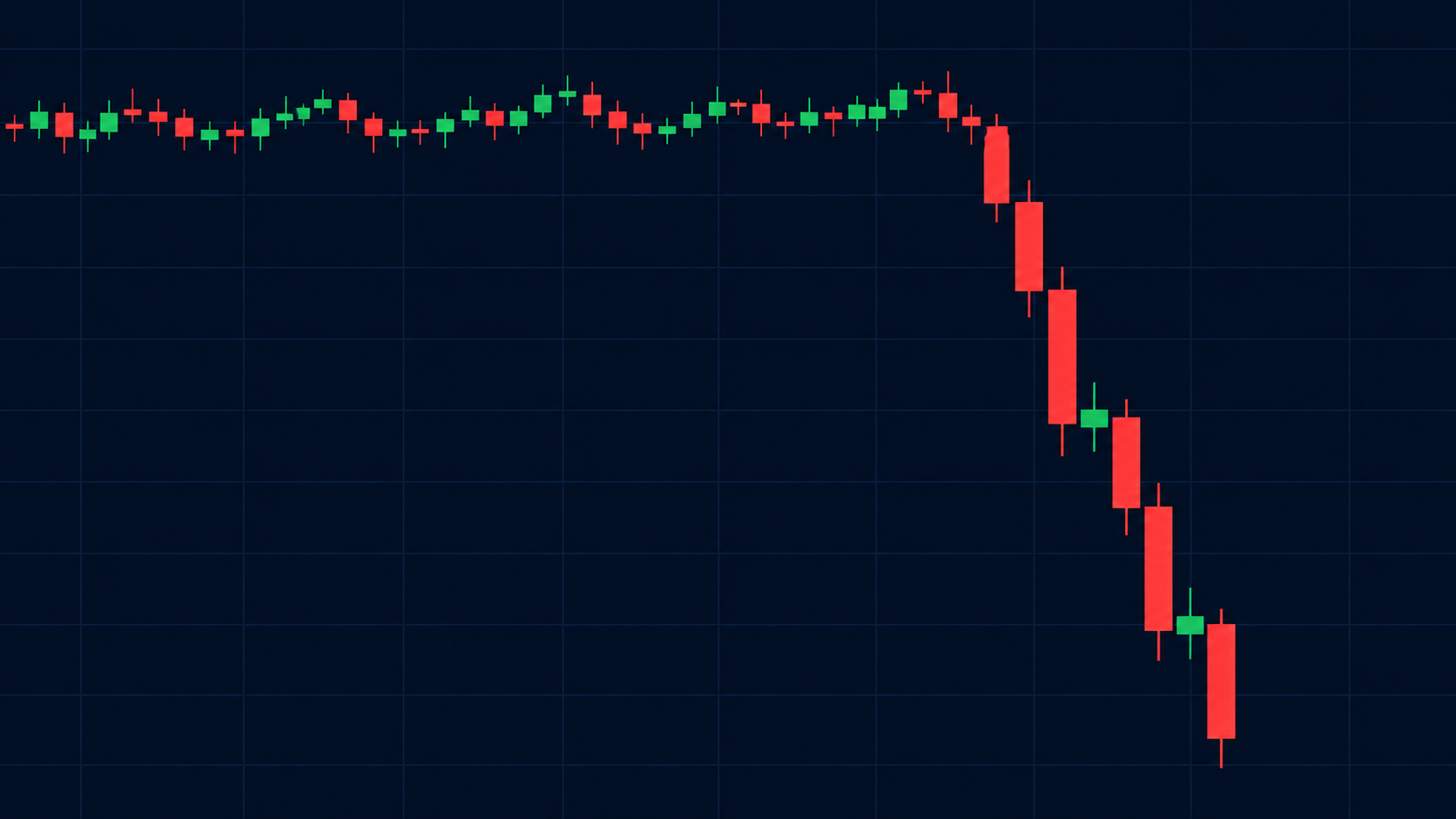
Quick Summary: A falling knife is a cryptocurrency experiencing a sharp price decline. Buying during the fall can be risky, as the price may keep dropping. Traders look for signs of stabilization and define their risk before entering, but no signal guarantees a reversal.
The price of a coin falls sharply, and its Relative Strength Index (RSI) shows it is oversold. Buying the coin may seem tempting because of the falling price, but the decline can continue. Understanding a falling knife can help beginners avoid assuming that a large drop should lead to a bounce.
What is a falling knife in crypto?
A falling knife in crypto refers to a coin whose price is dropping rapidly, often breaking through earlier support levels.
The full metaphor “catching a falling knife” is used to warn buyers who buy during that decline in the hope of profiting from a rebound. Buying when prices plummet can be extremely risky as the decline may continue.
The phrase describes price action rather than a formal pattern with a fixed number of candles. Selling pressure is strong relative to available buying interest, but buyers are still present. Brief pauses and bounces can occur during the fall.
Catching the true bottom price can be a tricky task for traders, but highly rewarding if they can.
Your $30,000 bonus + 10% discount are waiting on Bybit! Sign up and claim these rewards before they’re gone. Time’s ticking!
Why does a falling knife occur?
A falling knife occurs when the price of a cryptocurrency drops rapidly. This sharp decline can follow an exchange hack, a token exploit, a stablecoin losing its peg, unfavorable news, or a broader market sell-off.
Traders exiting their positions and forced liquidations can add to the selling pressure. Liquidation happens when an exchange closes a leveraged position because its collateral no longer meets the required level.
The cause matters: a damaged crypto project may not recover simply because its price has fallen.
Important Read: Rectangle pattern in crypto and how to trade it
How to identify a falling knife
To identify a falling knife, look at the price action and its context together. Common signals include:
- Sharp declines: A price decline creating several large bearish candles or repeated lower lows shows a fast drop, although short bounces can appear.
- Broken support: The price moves below support, a level where earlier declines slowed. It may later act as resistance, where a rise stalls, but this is not guaranteed.
- Volume: Rising volume during a price decline shows increased trading activity, not a guaranteed continuation. Compare volume on the same exchange, trading pair, and timeframe.
- Momentum: An RSI value below 30 is commonly considered oversold. RSI can stay oversold during a strong downtrend; it is not a buy signal by itself.
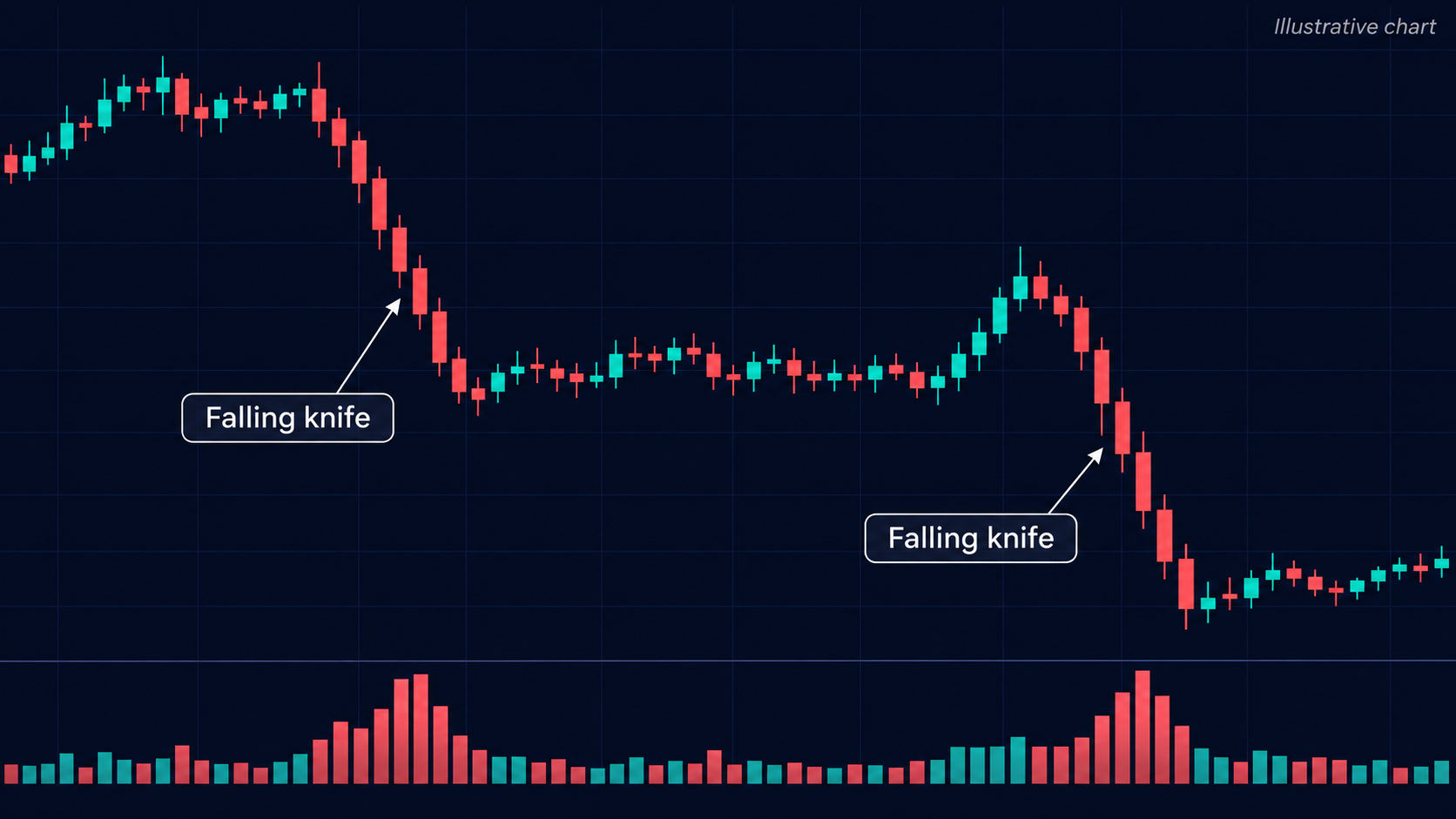
A falling knife can appear on a five-minute, hourly, or daily chart. Shorter timeframe charts can show faster price swings, while longer timeframe charts may show a wider view. There is no fixed duration or timeframe that guarantees a more reliable signal.
How beginners can manage risk
Inexperienced crypto traders may believe a falling knife offers an opportunity to buy a digital asset at a discount. A common mistake they can make is buying at the next immediate support line without watching the price action closely. This is essential because if the price breaks below support, it will likely continue falling until finding new support at lower levels.
Instead of buying without confirmation, first check why the asset is falling and whether the news affects its value or ability to trade. If you are unable to understand the risk, staying on the sidelines is an option.
Before considering a buy, traders may wait for the price to stabilize, form a higher low, where a new low is above the previous one, and close back above a relevant level. Some also watch for a retest, when the price returns to that level and attempts to hold it as support. These signs provide context, but the price can still fall again.
Before placing an order, choose an exit point and position size. A candle’s wick can cross a stop level even if the candle later closes back above it. Decide whether you exit based on a price trigger or a candle close, and understand how the exchange handles that order.
A stop-market order may fill at a worse price than its trigger during a fast move. A stop-limit order controls the acceptable price but may not fill. Fees, limited liquidity, and slippage, a difference between the expected and actual fall price, can increase the actual loss.
Important Read: Understanding the Falling Wedge Pattern in Crypto Trading
A trading example
This is a hypothetical short position example.
A short position aims to profit if the price of a crypto falls. Generally, it requires borrowing or a derivatives contract. Sudden rebounds can cause losses, and leverage can lead to liquidation, so beginners should understand the product before using it.
Suppose a token previously traded between $100 and $115, then broke below $100. It rebounds to $99 and falls to $95, where a trader opens a short position. The trader sets a stop-loss at $100, above the $99 retest high.
The earlier range was a $15 high. Projecting that distance below the $100 breakdown level gives a measured move target of $85. Remember, this is an estimate, not a promise that the price will reach it.
With a $1,000 account and a hypothetical planned risk of 1%, the risk budget is $10. The entry-to-stop distance is $5 per token, so the position size is 2 tokens, i.e., $10 ÷ $5. If filled at the stop, the planned loss is $10; at the target, the gross profit is $20. This is a 1:2 risk-to-reward ratio before fees, funding or borrowing costs, and slippage.
The actual loss can exceed the planned $10 if execution is worse than expected. Contract rules and liquidation can also affect the outcome.
Limitations of the falling knife
A falling knife investing strategy has its limitations. It can be difficult for traders to perfectly time the bottom, which is the lowest price a crypto will fall to before it moves upwards.
Even if traders identify all the criteria for falling knives, it still does not guarantee that the price will continue falling. This highlights the significance of properly placing stop-loss orders when using this strategy.
Another limitation is that the downward trend can take a longer time to reverse than expected. This can frustrate investors who are waiting for the price to move in the right direction.
What can weaken a bearish setup?
A higher low, a strong bounce, or bullish RSI divergence may signal a bearish setup is weakening. Bullish divergence occurs when the price makes a lower low while RSI makes a higher low.
None of these signs proves a reversal. If the price reaches your predefined exit condition, follow the plan rather than widening the stop to avoid a loss.
A falling knife may be followed by a bear flag or bear pennant, both of which include a pause after a sharp price decline. Neither pattern guarantees further downside.
FAQs
How is a falling knife different from a normal pullback?
A falling knife is a particularly sharp decline that may break several support levels, while a pullback is a broader term for a temporary move against an existing trend. Neither has a guaranteed outcome.
Does an oversold RSI mean the price will rise?
No. RSI can remain oversold while the price keeps falling. Use it alongside price action and a risk plan.
How long can a falling knife last?
There is no set duration for a falling knife. The decline may unfold over minutes, days, or longer, depending on the market and timeframe.
Can a falling crypto go to zero?
Yes. A token can lose nearly all or all of its value, especially if the underlying project fails. A previous high does not guarantee a recovery.
Is dollar-cost averaging safe during a falling knife?
Using dollar-cost averaging to buy in stages spreads purchases over time, but it does not prevent losses if the price continues to fall. Consider the asset’s risk and your total planned exposure first.
Sign up on WEEX and roll for a chance to win a share of the $1,000,000 prize pool.