
UNI Tests $4.35 as Uniswap Activates v4 Fees Across Seven Chains
Uniswap executed its first v4 protocol-fee activation on July 27, bringing selected pools across seven chains into the UNI burn system. UNI later rose 14.3% from the $4.00 breakout level to a July 31 high near $4.57 before easing to about $4.38 at around 11:45 UTC. The 4-hour structure remains constructive above $4.35, but buyers still need a completed close above $4.50 to confirm continuation.
Key Takeaways
- Proposal #100 activated v4 protocol fees on Ethereum, Arbitrum, Base, BNB Chain, Polygon, Optimism and Robinhood Chain.
- The rollout covers three pool families rather than every Uniswap v4 pool.
- Collected fees enter TokenJar contracts, where participants burn UNI to claim the accumulated assets.
- UNI needs to hold $4.35 and close above $4.50 before $4.80 becomes the next credible upside target.
Uniswap Executes Its First v4 Fee Activation
Uniswap governance executed proposal #100 on July 27 after it received 46.6 million votes in favor and 1.27 million against. The proposal activated v4 protocol fees on seven chains. Celo, Soneium, Worldchain, X Layer and Zora remain reserved for a separate proposal.
The change only applies to selected static-fee pools, Continuous Clearing Auction pools and aggregator-hook pools. Other v4 pool families remain outside the fee system. This narrower rollout gives governance room to monitor the effect on liquidity before applying fees more widely.
Uniswap v4 needed a different controller because hooks allow pool fees to change dynamically. The V4FeePolicy contract calculates the applicable protocol fee, while the V4FeeAdapter applies governance rules and directs collected assets to each chain’s TokenJar.
v4 Activity Can Now Feed the UNI Burn System
Uniswap’s protocol-fee system connects usage with UNI supply reduction. Fees collected from supported products enter TokenJar contracts. External participants can claim those assets through the Firepit system, but they must provide and permanently burn the required amount of UNI.
This can create transactional demand for UNI among participants seeking to release accumulated assets. It does not give UNI holders a direct claim on protocol revenue, and traders or liquidity providers do not need to hold UNI to use the affected pools.
Readers unfamiliar with the underlying model can see how automated market makers and liquidity pools work in The Moon Show’s guide to decentralized exchanges.
The Fee Switch Still Creates an LP Trade-Off
Protocol fees redirect part of the swap fee that would otherwise go to liquidity providers. Some governance participants warned that an aggressive rollout could push liquidity toward competing venues.
Uniswap Labs said the 25 largest fee-enabled v3 pools on Ethereum retained 98.5% of their pre-activation liquidity in token terms. However, the company acknowledged that v4 has a different structure and said the protocol would continue monitoring the effect.
The mechanism also differs from Aster’s recent fee-funded buyback upgrade. Uniswap relies on third parties burning UNI to release accumulated assets rather than directing protocol fees into automatic market purchases.
UNI Rally Developed After the Governance Vote
The July 27 execution did not produce an immediate rally. CoinGecko’s data shows UNI closed at $3.71 that day before rising to $3.90 on July 28, $3.99 on July 29 and $4.43 on July 30.
UNI then reached a July 31 high near $4.56. Measured from the $4.00 breakout point, the advance reached approximately 14%.
The delayed move means the vote and rally should not be presented as a direct one-day reaction. The fee activation strengthened UNI’s supply-reduction mechanism, but the price sequence alone does not establish it as the sole cause of the advance.
Uniswap Technical Analysis on the 4-Hour Chart
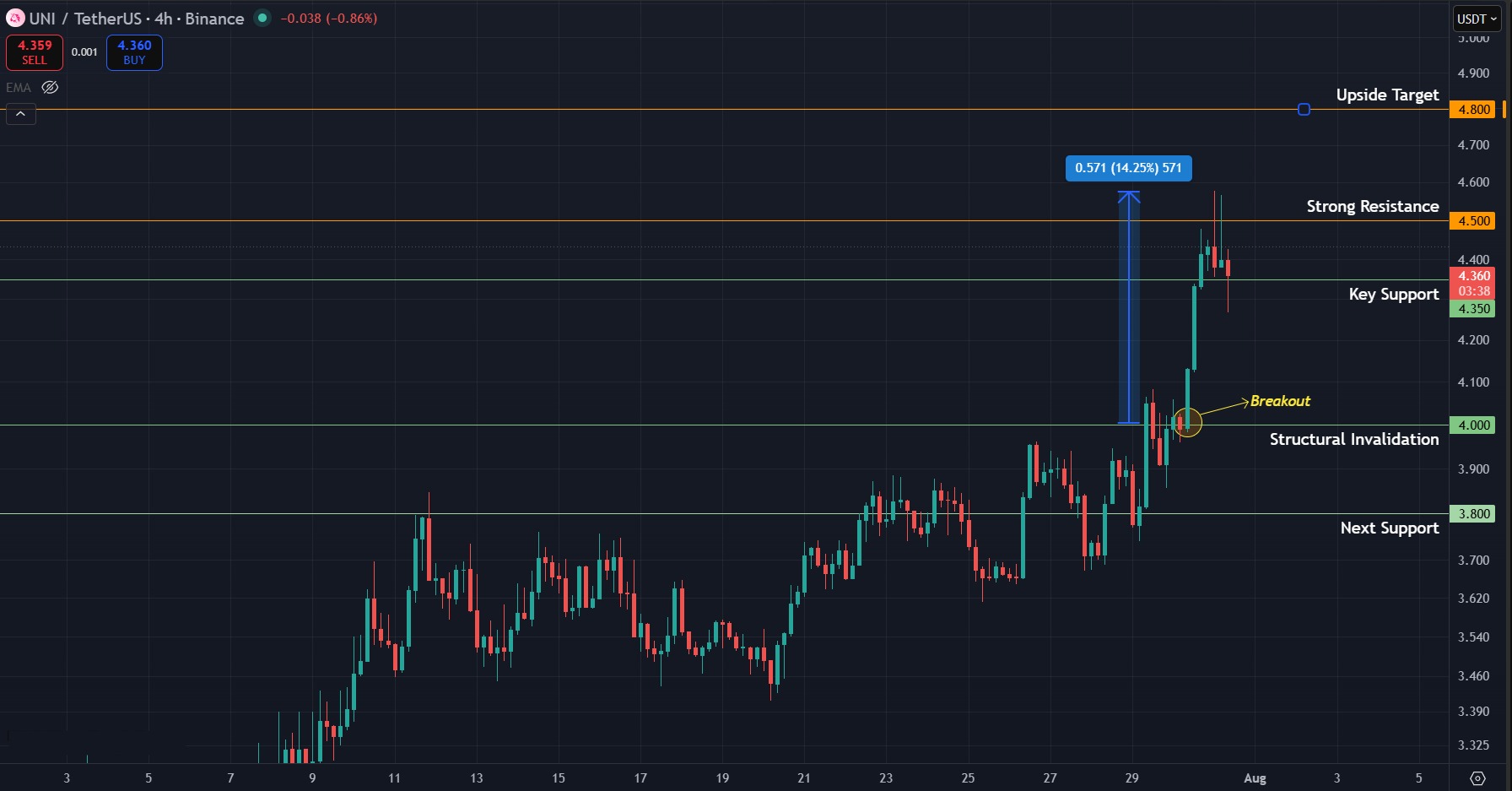
UNI/USDT 4-hour chart. Chart via TradingView.
The UNI/USDT 4-hour chart shows a breakout-and-retest structure rather than a confirmed continuation move. Price first cleared the $4.00 base, pushed through $4.35 and then reached $4.57 before sellers forced it back below $4.50.
The $4.35 level now carries the most immediate weight. It capped the earlier advance and has become the first support test following the breakout. Continued 4-hour closes above it would preserve the higher-low structure and show that buyers still control the former resistance.
A completed 4-hour close below $4.35 would place UNI back inside the previous range. That would weaken the breakout and increase the probability of a deeper retest toward $4.00, where the latest expansion move began.
The upside trigger remains $4.50. Although price traded above it intraday, buyers failed to hold the move. A completed 4-hour close above $4.50 would show acceptance beyond the latest rejection and strengthen the case for continuation toward $4.80.
The current structure remains bullish while UNI holds above $4.35, but the rejection from $4.57 shows that buyers have not secured full control. Price needs to defend the breakout first, then establish a close above $4.50 before the next leg higher becomes convincing.
What to Expect Next
- Bullish case: UNI holds $4.35 and completes a 4-hour close above $4.50, opening a move toward $4.80.
- Bearish case: A close below $4.35 weakens the breakout and brings $4.00 back into focus.
- Key catalyst: Early fee collection and UNI burn activity from the newly activated v4 pools.
- Invalidation: A completed 4-hour close below $4.00 invalidates the current recovery structure.
FAQs
Did Uniswap activate fees on every v4 pool?
No. The July 27 proposal covered three selected pool families across seven chains.
Do v4 protocol fees create direct value for UNI?
They reduce UNI supply through the burn mechanism, but holders do not receive protocol revenue directly.
What confirms further upside for UNI?
A completed 4-hour close above $4.50 would confirm the breakout more convincingly and put $4.80 in focus.
Get started on WEEX with a simple 40 USDT reward. Deposit 100 USDT, make your trade, and claim the bonus
Disclaimer: All content on The Moon Show is for informational and educational purposes only. The opinions expressed do not constitute financial advice or recommendations to buy, sell, or trade cryptocurrencies. Trading involves significant risk and may result in substantial losses. Always seek independent financial advice before making investment decisions. The Moon Show is not responsible for any financial losses or decisions made based on the information provided.
Please view the full disclaimer at: https://themoonshow.com/disclaimer

Bitcoin and Ethereum Quarterly Returns 2026: Q1-Q3 Trends and Q4 Outlook
Quarterly returns for Bitcoin (BTC) and Ethereum (ETH) offer a simple way to measure how the tw...

LINK Breaks August High as Chainlink Expands Into Global Payments
LINK is holding above $13 on September 7 after gaining 9.9% in the previous session. The move c...

XRP ETF Inflow Streak Ends After $170M Run. Can Price Hold $1.31?
XRP is trading near $1.36 on September 3 after U.S. spot XRP ETFs recorded their first net outf...