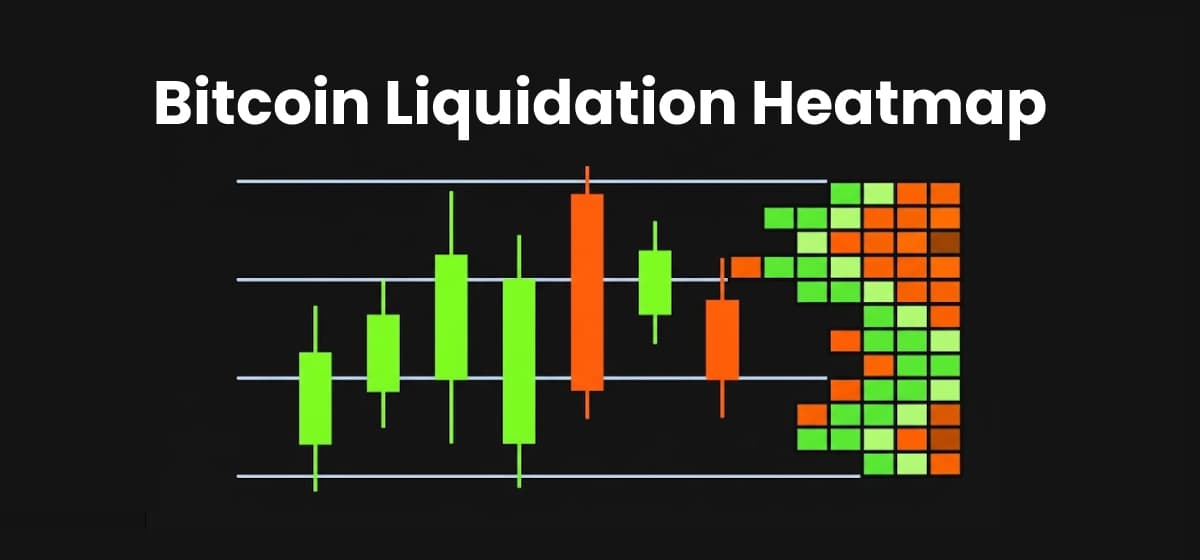
What Is the Bitcoin Liquidation Heatmap and How Do You Use It?
A Bitcoin liquidation heatmap is a color-coded chart that shows where leveraged positions are most likely to be force-closed if BTC reaches certain price levels. It pulls data from derivatives exchanges like Binance, Bybit, and OKX, displaying dense liquidation clusters as bright yellow zones and low-risk areas as cool blue zones. Traders use it to spot upcoming volatility, identify price levels that act as liquidity magnets, and place stops outside of danger zones. The tool works best when combined with funding rates and open interest, not as a standalone signal.
Who is this for: Crypto traders using leverage or trading BTC derivatives who want to understand where forced liquidations are concentrated and how to use that information for better entries, exits, and stop placement.
Key Takeaways
- Bright yellow zones on the BTC heatmap mark price levels where mass liquidations are likely. These zones often attract price rather than repel it because they contain concentrated liquidity.
- Place stops just beyond liquidation clusters, not inside them, to avoid getting swept out by liquidity hunts that quickly reverse.
- CoinGlass provides free real-time BTC heatmaps. Hyblock Capital and TensorCharts are paid alternatives with deeper order flow data.
- The heatmap is not a standalone trading system. It works best alongside open interest, funding rates, and price action for confirmation.
If you have ever watched Bitcoin, drop sharply and wondered what triggered it, there is a good chance the answer involves leveraged positions being force-closed. These events happen constantly in the Bitcoin derivatives market, and they tend to cluster at specific price levels in ways that are entirely predictable if you know where to look. The BTC liquidation heatmap is the tool that makes those clusters visible before they hit.
What Is the Bitcoin Liquidation Heatmap?
The BTC liquidation heatmap is a visual tool that maps out where clusters of leveraged positions are likely to be force-closed if the price moves into those areas. It pulls data from major crypto derivatives exchanges like Binance and Bybit aggregating open interest, leverage ratios, and position data to estimate where liquidations are concentrated across different price levels.
The output is a color-coded chart where intensity represents risk.
- Blue or cool-colored zones indicate relatively little liquidation activity.
- Yellow and bright zones indicate areas where a large number of leveraged positions would be wiped out if the price reaches them.
- The brighter the zone, the more significant that level is likely to be for price behavior.
If you have traded BTC futures for any length of time, you have probably noticed that sharp moves tend to cluster around specific levels rather than happening randomly. The heatmap is what makes those levels visible ahead of time.
It is worth being clear about what this tool is and is not. The heatmap does not show confirmed liquidation orders sitting on an exchange. It shows estimated liquidation levels calculated from publicly available derivatives data. The estimates are reliable enough to be genuinely useful, but they are not a perfect map of every position in the market.
How Bitcoin Liquidations Work?
When a trader opens a leveraged position on Bitcoin, whether long or short, they only put up a fraction of the total trade value as margin.
If the market moves against them far enough to deplete that margin, the exchange automatically closes the position to prevent the account from going negative. That forced closure hits the market like a market order. A liquidated long becomes a sell order. A liquidated short becomes a buy order.
On its own, a single liquidation is nothing too impressive. The problem is that thousands of traders are often positioned at similar levels with similar leverage. When the price moves into a cluster of these positions, the wave of forced closures adds enough pressure to push the price further in the same direction, triggering even more liquidations in what is known as a liquidation cascade.
Example: On November 21, 2025, $1.91 billion in leveraged positions were liquidated within 24 hours across 391,000 traders, with long positions accounting for $1.78 billion of that total. Bitcoin alone was responsible for around $960 million of those liquidations. That event happened because leverage was concentrated at levels the price eventually reached, and once the cascade started, the forced selling fed on itself. If you were watching the heatmap that week, the cluster that eventually triggered the cascade had been visible for days. The information was there and smarter traders took advantage of it.
Why BTC Price Gravitates Toward Liquidation Zones?
One of the more counterintuitive things about the BTC liquidation heatmap is that the zones it highlights often attract the price rather than repel it. That is because dense liquidation zones are also dense liquidity zones.
Large institutional traders and market-making algorithms need liquidity to execute significant orders without moving the market against themselves. When a cluster of liquidations gets triggered, the flood of forced market orders provides exactly that, creating conditions for large players to fill positions efficiently.
In practice, a bright yellow zone on the BTC heatmap sitting above or below the current price is often a price target, somewhere the market is likely to be pulled toward before reversing or continuing.
Once you start watching this pattern in live markets, it becomes hard to unsee. The price hits the cluster, the liquidations fire, and then the move either exhausts itself or accelerates depending on what is waiting on the other side. Experienced traders use this dynamic to anticipate moves rather than react to liquidations event.

How to Read the BTC Liquidation Heatmap
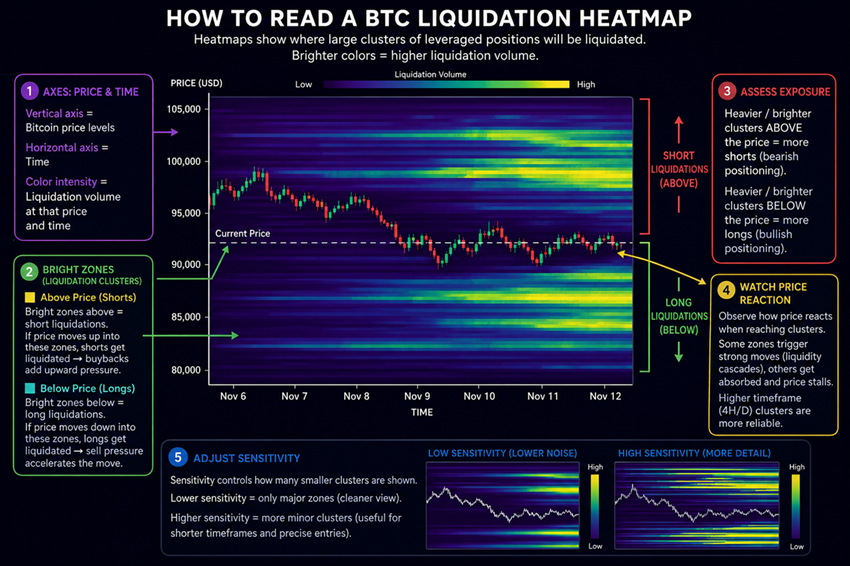
Reading the heatmap becomes intuitive quickly. The vertical axis represents Bitcoin price levels, the horizontal axis represents time, and the color intensity at any point tells you how much liquidation volume is concentrated at that price level at that moment.
Identify the Brightest Zones
Start by locating the yellow or bright zones above and below the current price. A bright cluster sitting above tells you that a large number of short positions have their liquidation levels in that range. If the price pushes up into that zone, those shorts get forced out, their buybacks add upward pressure, and the move can accelerate sharply. A bright cluster below signals the opposite. Long positions are stacked there, and a move down into that zone could trigger a rapid cascade of sell pressure.
Assess Which Side Is More Exposed
The distribution of clusters above and below the current price tells you about overall market positioning. If the heaviest zones are sitting below the price, most leveraged traders are long. If the bulk sits above, more traders are short. This gives you a read on where the market is crowded and where a squeeze is more likely to develop.
Watch How the Price Reacts to Zones
Not every liquidation cluster triggers a clean move. Sometimes the price approaches a zone, absorbs the liquidations without much momentum, and stalls. Other times it blows straight through.
Watching how the price behaves when it reaches these areas over time builds your intuition for which clusters are likely to produce significant moves and which are noise. Higher timeframe clusters, particularly on the four-hour and daily charts, tend to produce more reliable reactions than shorter timeframe micro-clusters.
Adjust the Sensitivity Settings
Most heatmap platforms let you adjust sensitivity, which controls how many smaller clusters are visible. At lower sensitivity only the most significant zones appear, which is useful when you want a clean read on major levels. At higher sensitivity more clusters become visible, which can help on shorter timeframes where smaller liquidity pockets matter for precise entries.
Liquidation Heatmap vs Order Book Heatmap
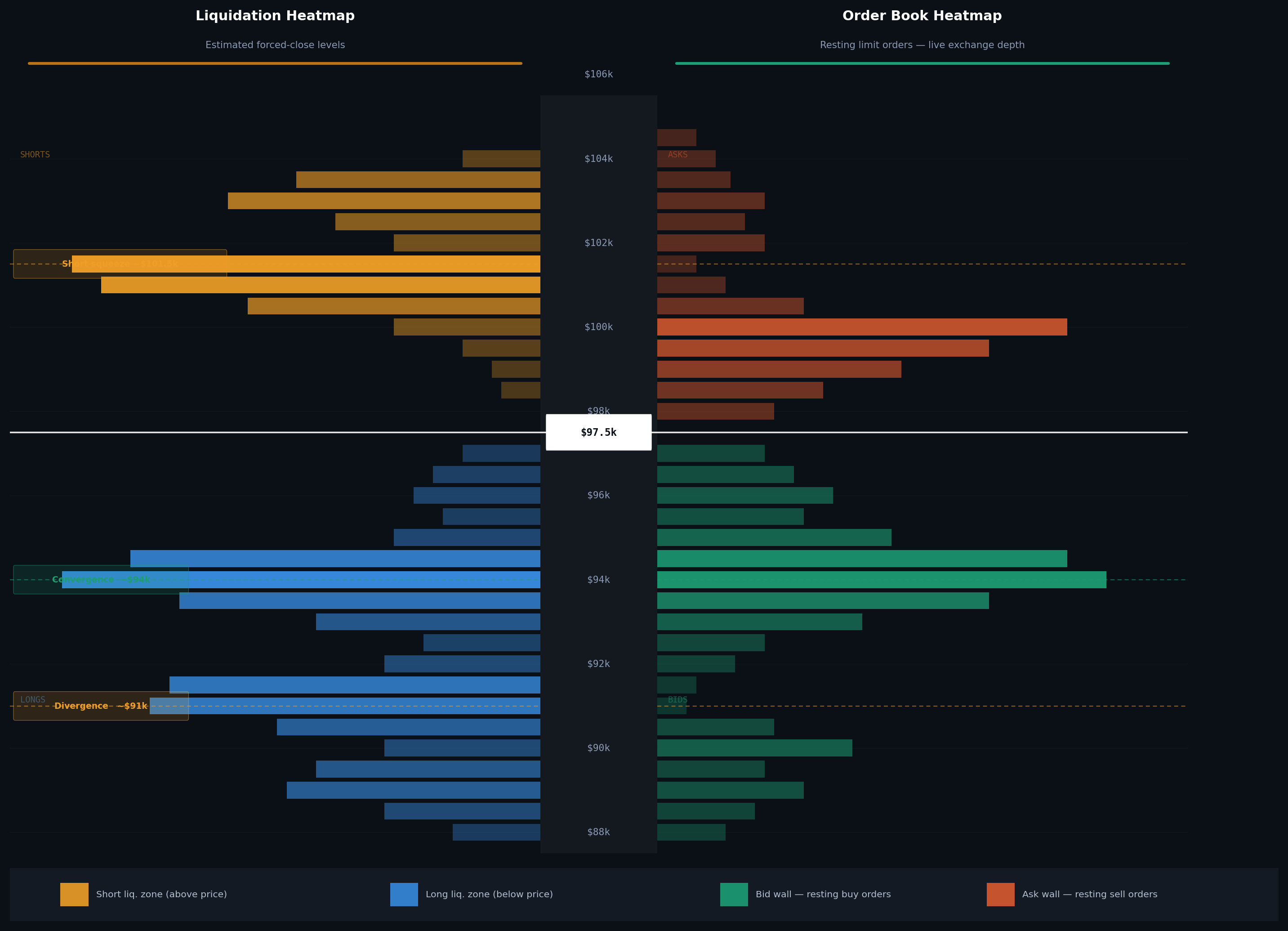
These two tools get confused constantly, and they are not the same thing. A liquidation heatmap shows estimated levels where leveraged positions will be force-closed if the price reaches them. An order book heatmap (sometimes called a liquidity heatmap) shows where resting limit orders are sitting on the exchange right now. One shows where forced orders will appear in the future. The other shows where voluntary orders already exist.
In practice, the two can point in the same direction. A liquidation cluster and a wall of resting buy orders at the same price level reinforces that level as significant. But they can also diverge. A liquidation cluster might sit at a level with almost no resting orders, meaning the market could slice through it fast with little resistance. Checking both gives you a fuller picture of what is actually waiting at a given price level than either tool provides alone.
How Traders Use the BTC Heatmap in Practice
Finding Price Targets
The most direct application is using liquidation clusters as price targets. If Bitcoin is at $85,000 and there is a dense cluster of short liquidations between $88,000 and $89,000, that zone becomes a logical upside target. A move into it would trigger forced short covering, adding buying pressure and potentially accelerating the move.
Stop-Loss Placement
Dense liquidation zones are stop-loss magnets, and this is something that catches newer traders off guard constantly. If your stop sits inside a heavy cluster, there is a meaningful probability the price will push into that area to trigger those liquidations, taking you out of a trade even if the broader trend you identified is correct. Placing stops just beyond a cluster rather than inside it significantly reduces the chance of being swept out by a liquidity hunt that quickly reverses.
Spotting Squeeze Setups
When a large concentration of shorts is stacked above the current price and Bitcoin begins pushing upward, the heatmap gives you advance notice of a potential short squeeze before it fully develops. As the price moves into that cluster, forced buybacks from liquidated shorts add momentum to the move. The same logic applies in reverse for long squeezes.
Combining With Other Indicators
The heatmap is powerful but not a complete trading system on its own. Open interest tells you how much total leverage is currently in the market, giving context to how significant a given cluster actually is. Funding rates reveal whether longs or shorts are paying a premium to hold their positions. Price action and volume help confirm whether a move toward a liquidation zone has enough momentum to follow through. When these signals align with what the heatmap shows, the setup becomes considerably more compelling than any single indicator alone.
Common Mistakes When Using the BTC Liquidation Heatmap
- Treating heatmap zones as guaranteed price targets
The heatmap shows estimated liquidation levels, not confirmed orders. The price is drawn toward these zones more often than not, but there is no guarantee it reaches them. Using heatmap zones as one input alongside other tools is the right approach. Treating them as certainties is how you get caught on the wrong side.
- Placing stops inside liquidation clusters
If your stop sits in the same zone where hundreds of other leveraged positions have their liquidation levels, the probability of a wick sweeping through that area is significantly higher. Place stops just beyond clusters, not inside them.
- Using the heatmap without checking funding rates
A dense cluster of liquidations means something very different when the funding rate is extreme versus when it is flat. High positive funding with a cluster of long liquidations below signals a crowded trade that is vulnerable. The same cluster with neutral funding carries less directional weight.
- Ignoring the timeframe
A cluster that shows up on the 15-minute heatmap is not the same as one visible on the daily chart. Shorter timeframe clusters produce noisier reactions. For meaningful setups, focus on the four-hour and daily heatmaps where the clusters represent more significant positioning.
Where to Access the BTC Liquidation Heatmap
CoinGlass, a crypto derivatives data platform, is the most widely used source for this data and offers free access to real-time BTC liquidation heatmaps across multiple exchanges. You can filter by trading pair, adjust the timeframe, and toggle between exchange-specific or consolidated views. Hyblock Capital and TensorCharts are paid alternatives with deeper order flow data for traders who want additional context beyond the heatmap itself.
|
Platform |
Free Access |
Key Features |
Best For |
|
CoinGlass |
Yes |
Multi-exchange data, adjustable sensitivity, real-time updates |
Most traders |
|
Hyblock Capital |
Limited |
Deeper order flow, positioning data, advanced analytics |
Experienced traders |
|
TensorCharts |
Paid |
Volume profile + heatmap overlay, DOM analysis |
Scalpers and day traders |
Closing Thoughts
The Bitcoin liquidation heatmap gives traders visibility that standard price charts cannot provide. A price chart shows you where Bitcoin has been. The BTC heatmap shows you where the leverage is concentrated and where the market has a structural reason to move next. That distinction matters in a market driven as much by derivatives positioning as by spot buying and selling.
However, it is important to note that it is not a crystal ball and should not be treated as one. But having spent years watching how BTC interacts with these zones, the pattern is consistent enough to be worth learning. The price respects liquidation clusters more often than it ignores them, and understanding why gives you a read on the market that most retail traders simply do not have.
Frequently Asked Questions - FAQs
What is the Bitcoin liquidation heatmap?
A visual tool that maps estimated liquidation levels across Bitcoin price ranges, showing where leveraged positions are most likely to be force-closed.
What does a bright yellow zone on the BTC heatmap mean?
A high concentration of leveraged positions at that price level that would be liquidated if the price reaches it.
Why does Bitcoin move toward liquidation zones?
Dense liquidation zones are also dense liquidity zones, attracting large players and algorithms that need liquidity to execute significant orders.
What is a liquidation cascade?
A chain reaction where one wave of forced closures adds enough price pressure to trigger another, causing sharp and rapid market moves.
Where can I access the BTC liquidation heatmap?
CoinGlass offers free real-time BTC liquidation heatmap data, with Hyblock Capital and TensorCharts as alternatives for more advanced analysis.
How is the BTC liquidation heatmap different from a regular price chart?
A price chart shows historical price movement, while the heatmap shows where current leverage is concentrated and where the market may move next.
Should I use the BTC heatmap as my only trading signal?
No, it works best alongside open interest, funding rates, and price action analysis for a more complete read of the market.
Does the heatmap work for altcoins too?
Yes, heatmaps are available for most major trading pairs, though the data is most reliable for Bitcoin given its derivatives market depth.
Disclaimer: All content on The Moon Show is for informational and educational purposes only. The opinions expressed do not constitute financial advice or recommendations to buy, sell, or trade cryptocurrencies. Trading involves significant risk and may result in substantial losses. Always seek independent financial advice before making investment decisions. The Moon Show is not responsible for any financial losses or decisions made based on the information provided.
Please view the full disclaimer at: https://themoonshow.com/disclaimer
Margin Trading for Beginners: Leverage, Risks, and Examples
Margin trading for beginners starts with understanding how borrowed funds change risk. A small ...
Find Lost Crypto Wallets – A Step-by-Step Recovery Guide
Losing a crypto wallet does not always mean losing access to assets. Recovery may be possible i...

How to Buy Bitcoin for Beginners – A Step-by-Step Guide
When you are new to crypto, buying Bitcoin (BTC) can feel complicated. In practice, the process...