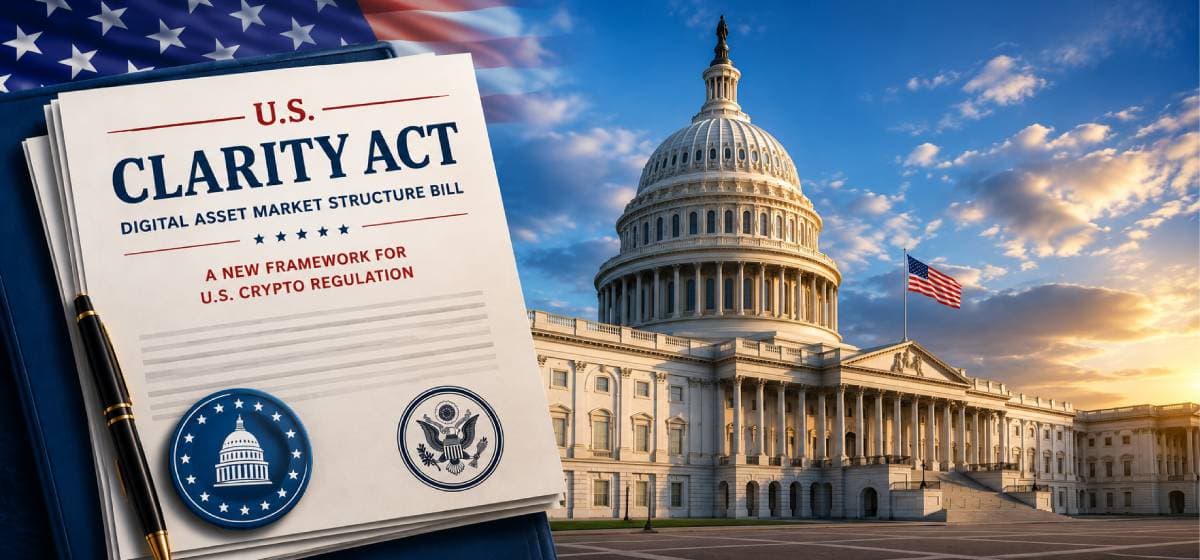
Why is the Clarity Act Stuck in the Senate and What Happens Next?
The Clarity Act remains stuck in the Senate as Republicans need 60 votes, disagreements remain over ethics and anti-money laundering provisions, and lawmakers still need to reconcile competing committee versions before the August recess. These political hurdles, not opposition to crypto itself, are delaying a final vote.
Key Takeaways
- The Clarity Act would split U.S. crypto regulation between the SEC and CFTC, replacing the enforcement-by-lawsuit approach with defined rules.
- The Act was passed by the House in July 2025; the Senate Banking Committee advanced its version in May 2026, but it still needs to pass the Senate.
- At the time of writing, the bill is not scheduled for a floor vote, and Congress has roughly three weeks before the August recess.
- Passage through the Senate would lower risk for institutions, allow exchanges to offer more products to U.S. residents, and add protections for software developers.
For years, the U.S. crypto industry has been subject to regulatory uncertainty, rather than clear legislation. This could finally change in 2026 if the Senate can get out of its own way. The Clarity Act is a significant attempt to establish a comprehensive legal framework for digital assets. It could redefine how cryptocurrencies, exchanges, investors, and regulators interact in the years ahead.
This article explores what the Clarity Act is, what hurdles it faces right now, and how it will affect the crypto market.
What Is the Clarity Act?
The Clarity Act (the Digital Asset Market Clarity Act) is a federal bill that would regulate the U.S. crypto market. The U.S. crypto market currently operates under a mix of court rulings, SEC enforcement actions, and regulatory uncertainty. If passed by the Senate, the Act would replace that guesswork with an actual rulebook.
The bill splits crypto into categories. According to the bill, “Digital Commodities” are tokens whose value derives from a functioning blockchain network. These tokens fall under the Commodity Futures Trading Commission (CFTC).
Tokens sold in a fundraising round are considered securities under the SEC. Once a token is sufficiently decentralized, it falls under the CFTC's jurisdiction. On the other hand, stablecoins are handled separately under the 2025 GENIUS Act.
Why is the Clarity Act Stuck in the Senate?
According to the General Orders on the Senate Legislative Calendar, the bill sits at Calendar No. 423. Republicans hold 53 seats in the Senate, and the bill needs 60 to clear the floor, meaning at least seven Democrats should vote in its favor.
When the bill cleared the Senate Banking Committee in May, two Democrats, Ruben Gallego (Arizona) and Angela Alsobrooks (Maryland), joined all 13 Republicans. It is also expected that Republicans Josh Hawley and Rand Paul might vote no on substantive grounds, leaving 51 reliable Republican votes.
On the Democratic side, Senators Chris Murphy, Chris Van Hollen, and Jeff Merkley opposed the merged Senate draft released in July. They argued that its revised ethics provisions failed to adequately address conflicts of interest related to senior government officials' cryptocurrency holdings and business interests.
Senate Majority Leader John Thune said he intends to bring the Clarity Act to the Senate floor before the August recess, although he has not committed to a specific date.
The Act Faces Three Blockers
The three major hurdles in the way of the Act’s passage include:
- The 60-vote threshold is the first challenge. The 15-9 approval from the Senate Banking Committee showed support at the committee level, but converting that into 60 floor votes has not yet been publicly secured.
- The second hurdle is deciding what ethics restrictions apply to officials, including the president, with personal crypto holdings.
- The third obstacle remains how to merge the Banking Committee's text with the Senate Agriculture Committee's companion bill, which cleared committee on a party-line 12-11 vote in January and takes a narrower approach to DeFi and custody than Banking's version.
How the Bill Got Here?
Since 2018, crypto regulations have faced multiple challenges. The SEC argued most tokens were unregistered securities. The CFTC wanted a bigger role, but it lacked legal authority to claim one.
The House passed the Clarity Act in July 2025 by a bipartisan 294-134 vote. The Senate Banking Committee rewrote large sections, adding provisions on DeFi and anti-money-laundering rules. The committee advanced its version in May 2026.
However, the committee's approval is not law. The bill still needs 60 votes on the Senate floor to become law. As of mid-July 2026, that threshold is not in sight.
When Is the Clarity Act Expected to Pass?
The Clarity Act not only has to clear the Senate floor but also survive fights over ethics rules and DeFi protections. As the August recess is closing in, the bill’s passage is far from locked in.
According to TD Cowen’s Washington Research Group managing director, Jaret Seiberg, “The political environment is getting worse for the Clarity Act.” He also said, “It is why we remain pessimistic that Clarity will become law this year.”
Timing is becoming one of the biggest risks for the bill. If it does not pass before the August recess, lawmakers could lose the narrow window created by Republican control of Congress and a more crypto-friendly White House.
Galaxy Digital researchers have also cut the bill’s odds of passing before year-end to approximately 60% from 75%.
One of the bill’s leading Republican backers, Sen. Cynthia Lummis, has warned that failure this year could delay crypto market legislation for years.
Lummis said in a post on X, “This is our last chance to pass the Clarity Act until at least 2030. We can’t afford to surrender America’s financial future.”
How Will the Clarity Act Affect Crypto?
The passage of the Clarity Act does not rewrite the market on day one, but its provisions activate 270 days after enactment.
If passed, the Act would become the most significant US crypto market structure law so far. It would replace years of guesswork and case-by-case enforcement with clearer rules for tokens, exchanges, market oversight, stablecoins, and disclosures.
Once active, both Bitcoin and Ethereum are expected to qualify as digital commodities, moving to CFTC oversight rather than the SEC. Exchanges, such as Coinbase and Kraken, would register with the CFTC as Digital Commodity Exchanges. It would replace today’s patchwork of state money-transmitter licenses and SEC enforcement exposure with one federal framework. This way, these exchanges can list a wider range of tokens without waiting years for individual no-action letters.
For altcoins, the Act is expected to reduce uncertainty, especially for active teams, early-stage networks, and foundations. Networks that meet the bill’s standards are expected to fall outside securities rules. Tokens linked to active projects or those that give holders a share of profits may still be classified as securities.
The latest draft of the bill also protects some non-custodial developers and decentralized protocols. This could be a significant win for wallets, DeFi infrastructure, and open-source projects.
The key question now is whether lawmakers can resolve their differences and hold a Senate vote before Congress breaks for recess.
Ji Hun Kim, CEO of the Crypto Council for Innovation, said, “The window is open; the only question is whether we will close it on our terms.”
Frequently Asked Questions (FAQs)
What does the Clarity Act do?
It creates a legal framework for classifying crypto assets as either securities (SEC-regulated) or digital commodities (CFTC-regulated), and sets rules for registration, custody, and disclosure for exchanges, brokers, and dealers that handle them.
Has the Clarity Act passed?
No, the House passed it in July 2025, and it is yet to receive a full Senate floor vote.
How is the Clarity Act different from the GENIUS Act?
Passed in 2025, the GENIUS Act specifically regulates stablecoins. The Clarity Act covers the broader digital asset market: how tokens get classified and which agencies regulate exchanges, brokers, and trading platforms.
Will the Clarity Act affect Bitcoin and Ethereum?
Both are expected to qualify as digital commodities under the bill's criteria, placing them under CFTC oversight rather than SEC jurisdiction.
Why is the Senate vote so difficult to secure?
The Clarity Act bill needs 60 votes to pass. Republicans hold 53 seats, so at least seven Democrats must join, and disputes over the scope of anti-money-laundering and conflict-of-interest rules have slowed the formation of that coalition.
Get started on WEEX with a simple 40 USDT reward. Deposit 100 USDT, make your trade, and claim the bonus
Disclaimer: All content on The Moon Show is for informational and educational purposes only. The opinions expressed do not constitute financial advice or recommendations to buy, sell, or trade cryptocurrencies. Trading involves significant risk and may result in substantial losses. Always seek independent financial advice before making investment decisions. The Moon Show is not responsible for any financial losses or decisions made based on the information provided.
Please view the full disclaimer at: https://themoonshow.com/disclaimer

USDC Becomes EU’s First Significant E-Money Token, With EBA Oversight Starting November 12
The European Banking Authority (EBA) has classified Circle’s USDC as the European Union’s first...

Bitcoin Falls Below $81,000 as U.S. Inflation Hits 3.7%
Bitcoin (BTC) fell below $80,000 in early Asian Trading on Thursday as accelerating U.S. inflat...

Solana Sets October 21 for Alpenglow Upgrade Targeting 150-Millisecond Finality
Solana has scheduled its Alpenglow consensus upgrade for Wednesday, October 21, a major upgrade...