Clarity Act Explained: Key Impacts on Crypto Assets and Why Today’s Markup Matters
Clarity Act is a major and comprehensive piece of U.S. legislation that is designed to provide a much-needed regulatory framework for the crypto market.
It passed the House of Representatives in July 2025, with a 294-134 vote and is currently the main point of debate among the U.S. Senate. If the Clarity Act passes, it can be a revolutionary step for the crypto industry as its main purpose is to end “regulation by enforcement” and introduce clear statutory rules for crypto companies, investors and developers.
Key Takeaways
- Clarity Act is a detailed piece of legislation that ends the “regulation by enforcement” era and offers regulatory framework to the crypto industry.
- Under the Clarity Act, the ambiguity regarding which government agency oversees which assets will end.
- With the clear statutory rules, big institutions can offer crypto services and bring in trillions of dollars in new capital.
- The Act offers protection to the developers and miners.
- Stablecoins will become more mainstream as payment instruments. They will be backed by real reserves and will be required to undergo regular audits.
Why the Clarity Act Is a Regulatory Turning Point?
The Clarity Act is formally known as the Digital Asset Market Clarity Act of 2025. It is the most detailed piece of document that defines how crypto assets are regulated. This regulatory framework sets clear rules for how tokens are identified (commodities or securities), registration processes for crypto companies/exchanges and it also clarifies a pathway for networks that move from securities regulation to commodity regulation as they become more decentralized with time.
It also separates regulatory control of the SEC and the CFTC over the matter.
Over the last decade in the USA, crypto was being regulated through enforcement instead of legislation. The SEC claimed that most tokens were securities, whereas the CFTC declared assets like Bitcoin and Ethereum were commodities. If the SEC wanted to move against a crypto company, it would file a lawsuit claiming whatever assets were involved were identified as securities. When crypto companies asked for clear rules, they were told to register, however, no clear registration pathway was created for them. There were no definitive lines drawn and the overlapping jurisdictions of both authorities created legal uncertainty.
Families, small businesses, investors, and innovators deserve clear rules of the road for digital assets.
— Senator Tim Scott (@SenatorTimScott) May 12, 2026
The Senate’s version of the CLARITY Act delivers certainty, safeguards, and accountability, while protecting Main Street, strengthening national security, and keeping… https://t.co/ShlphkNP8S
The Clarity Act aims to resolve this uncertainty and set clear statutory rules by turning them into law.
Start trading on Bybit today and get 10% off fees PLUS up to $30,000 in bonuses! Sign up today and start saving while you earn. This exclusive offer won't last - claim yours now!
Details of What the Clarity Act 2026 will Resolve
In 2026 alone, the Clarity Act markup by the Senate Banking Committee was delayed three times, due to disputes over stablecoin yield, DeFi provisions and other factors. However, the markup has now finally been scheduled for May 14, 2026.
Once passed, here are the main issues the Clarity Act will resolve.
Classification of Crypto Assets
Securities fall under the jurisdiction of the SEC. Digital commodities (digital assets that are connected to a blockchain and derive their value from how the blockchain is used) fall under the jurisdiction of the CFTC.
Stablecoins are a separate category and come under the combined authority of both the SEC and the CFTC.
Exclusive CFTC Regulatory Jurisdiction
The authority of the CFTC will significantly expand as currently it has anti-manipulation and anti-fraud authority over commodity spot markets. With the Clarity Act, all digital commodity dealers, brokers and exchanges will register with the CFTC and be answerable to it.
Provisional Registration Regime
Companies registering within the first 180 days get a temporary approval from the CFTC but they must keep their customer funds safe during this time. The CFTC will also get access to the records of the companies and finish finalizing its rules during this period, which will end after four years.
Protection of Decentralized Finance
The bill’s requirements do not include actions that do not involve the controlling of customer funds such as running nodes, validating transactions and more.
However, centralized companies that operate with DeFi protocols are required to follow cybersecurity, risk management and compliance rules based on how much control they have.
New Route to Raise Capital for Crypto Asset Projects
The current securities laws were not designed for blockchain fundraising. However, under the Clarity Act, new disclosure rules will be set for crypto assets, allowing crypto projects to practically raise money without having to go through the securities registration process that is in place for the traditional stock offerings.
Restricts the Federal Reserve
The Clarity Act restricts the Federal Reserve from issuing a CBDC (central bank digital currency) to any individual, whether directly or indirectly. This aspect of the Clarity Act is why it got its secondary name, the “Anti-CBDC Surveillance State Act”.
SEC vs. CFTC
The SEC has been more aggressively scrutinizing toward the crypto industry than the CFTC, especially under Gary Gensler.
Under Gensler, the SEC filed lawsuits against several major crypto exchanges including, Coinbase, Ripple, Kraken and Binance. This occurred due to the ambiguity of asset classification and, therefore, most tokens were qualified as securities.
The CFTC, on the other hand, deals with regulating commodities such as gold and oil.
However, the Clarity Act defined many blockchain-native tokens as commodities, shifting the regulatory authority over to the CFTC. The SEC maintains authority over market fundraising or over any crypto asset that fundamentally functions as an investment contract.
The Stablecoin Yield Dispute
The most argumentative part of the Senate version of the Clarity Act was supported by the banking industry. According to it, the crypto exchanges would not pay interest to users of their platforms who owned stablecoins.
The U.S. banking industry argued that a yield-paying stablecoin account is like a savings account. Banks offering savings accounts to their customers are subject to the federal banking regulations and must deposit capital requirements and insurance requirements. There, a crypto exchange is not on the same playing field if it offers yield on stablecoins but does not subject to these requirements.
The perspective of the crypto industry is that the stablecoin yield is not like a bank-style deposit, but is instead, shared revenue from interest on Treasury bills that are held in reserve. They argued that limiting it would not necessarily improve customer protection but can damage valid business models.
However, a stablecoin yield compromise was achieved and hence, the Senate Banking Committee will markup the Clarity Act on May 14th, 2026 i.e. today, at 10 A.M. ET.
What Does it Mean for Crypto if the Clarity Act is Passed?
The Clarity Act can be a huge game-changer for the crypto industry. If it passes, crypto assets will no longer be in a “grey area” of the law, instead will be categorized into formal asset classes that will have the same institutional validity as bonds and stocks. This may cause a lot of money to flow into assets that are closer to the decentralization rules and transparency offered by the Clarity Act.
Institutional Liquidity and ETF Wave
The Clarity Act could most instantly impact a rise in the altcoin spot ETFs. Up till now, the SEC was reluctant to approve products for crypto assets other than Bitcoin and Ethereum due to potential market manipulation. However, when decentralized assets like Solana, XRP and Cardano will be recognized as “digital commodities”, any legal uncertainty will be removed, and Wall Street may not hold back from being involved. It is expected that a large capital from institutions such as pension funds and insurance firms will ultimately flow into altcoins that are compliant with the Clarity Act.
“Launch and Dump” Era May End
The Clarity Act 2026 will also prioritize investor protection. One of its key provisions is that core team token lock-ups will become mandatory. This means founders of new tokens will not be able to dump their tokens after their product is launched and projects will be required to submit semi-annual reports as well as standardized disclosures. Providing necessary documentation may slow down the progress of smaller projects but it is likely to reduce the occurrence of “rug pulls” that have previously been a major issue.
New Rules for Stablecoins
Stablecoins such as USDT and USDC will be officially recognized as payment instruments instead of “crypto-native tools”. The Clarity Act will likely make it mandatory for these issuers to keep 1:1 liquid reserves like U.S. Treasuries and submit to regular audits.
Protecting Those Who Build the Tech
One of the most crucial concerns the Clarity Act caters to, is the protection of the developers and builders behind the tech. Under the Act, it will be clear that node operators, miners and software developers are not financial institutions but are simply those who write codes and validate blocks. This step has been taken to ensure that the experts in the field, who are the foundational layer of the blockchain tech, feel free and safe to work in the U.S. instead of shifting their operations to other destinations that are more crypto-friendly.
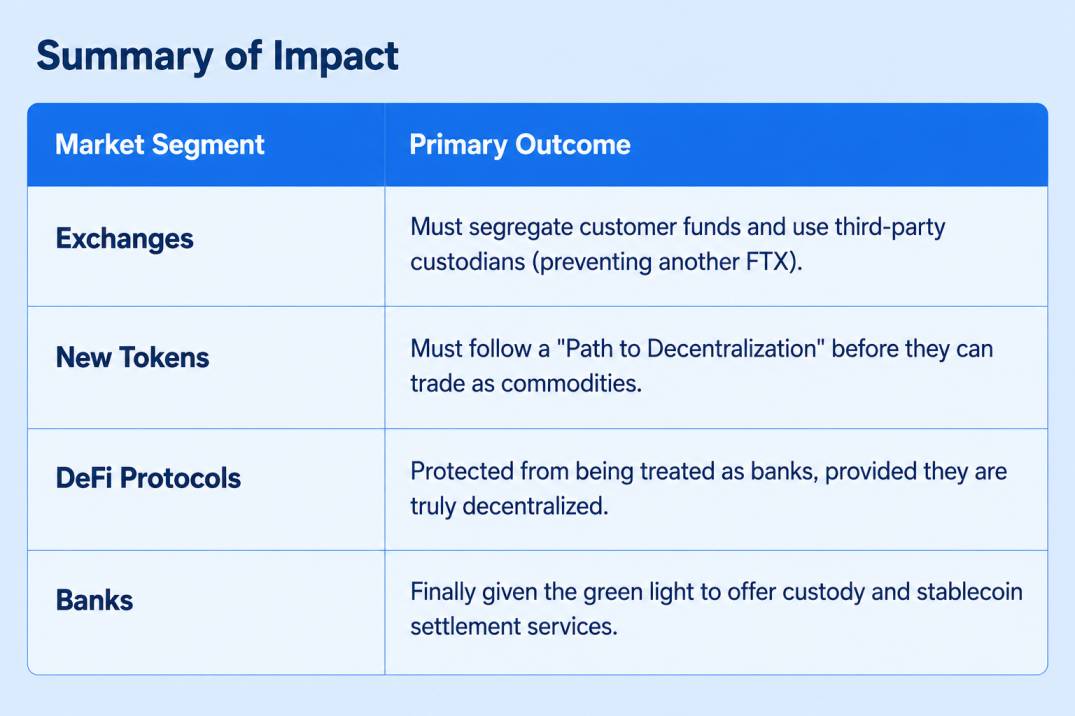
How different market segments will be impacted if the Clarity Act passes and becomes a law.
Double your advantage on Bybit: 10% off trades + $30,000 up for grabs! Sign up now and claim these exclusive rewards. Offer expires soon!
Why Today’s Markup Matters?
The Clarity Act is the first-ever crypto market structure bill that the Senate is working and debating on. This is the point where the Clarity Act will shift from a proposal to a law that could pass.
The committee will be voting on crucial compromises, especially the “Tillis-Alsobrooks” deal. This agreement aims to find a balance between the banking industry’s fear of deposit outflows and the crypto industry’s aspiration of offering stablecoin rewards.
If the markup is successful today, it will mean there is bipartisan support to bring “regulation by enforcement” to an end. It will also clearly define the roles and jurisdiction of the SEC and the CFTC before the 2026 legislative session comes to an end.
If the Clarity Act markup is delayed yet again today or is unsuccessful, it can push the next possible legislative window to at least 2030. Senator Cynthia Lummis and Bernie Moreno have both warned against it.
This is our last chance to pass the Clarity Act until at least 2030. We can’t afford to surrender America’s financial future.
— Senator Cynthia Lummis (@SenLummis) April 10, 2026
Closing Thoughts
The Clarity Act aims to provide comprehensive regulatory framework, that will resolve the legal uncertainty surrounding crypto assets. It will define the roles of government authorities and bring the crypto and banking industries to a middle ground. This may also result in massive institutional adoption while ensuring the decentralized aspect of the industry remains intact. Under the Act, the “regulation by enforcement” era will end and investors and developers both can confidently move forward towards a more transparent digital economy.
Disclaimer: All content on The Moon Show is for informational and educational purposes only. The opinions expressed do not constitute financial advice or recommendations to buy, sell, or trade cryptocurrencies. Trading involves significant risk and may result in substantial losses. Always seek independent financial advice before making investment decisions. The Moon Show is not responsible for any financial losses or decisions made based on the information provided.
Please view the full disclaimer at: https://themoonshow.com/disclaimer

How to Buy Bitcoin for Beginners – A Step-by-Step Guide
When you are new to crypto, buying Bitcoin (BTC) can feel complicated. In practice, the process...

How to Choose a Crypto Exchange in 2026: Fees, Security, Regulation
Over the years, cryptocurrency exchanges have evolved considerably. What first began as simple ...

All-time Highs: A Detailed Guide for Crypto Traders
All-time high is the highest price an asset hits since it starts trading. To learn more about A...