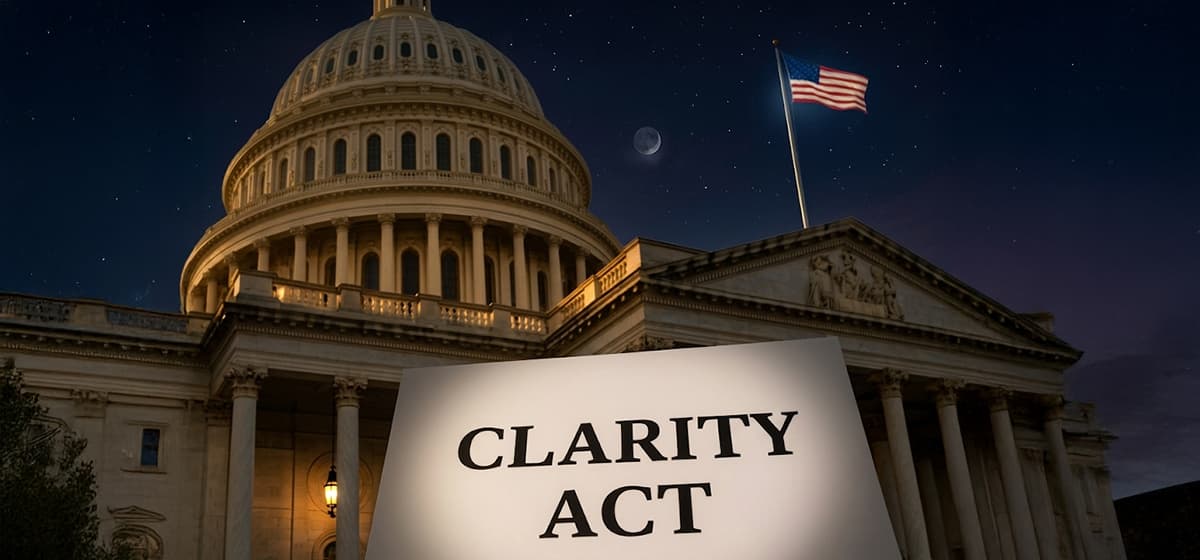
Clarity Act Passed the Senate Banking Committee: What’s Next?
Key Takeaways
- The Clarity Act passed the Senate Banking Committee on Thursday with a 15-9 vote.
- During the hearing, Democrats and Republicans continued discussions to resolve various points of disagreement.
- The bill had several key supporters such as Ripple, Coinbase, Circle and Venture capital firm Andreessen Horowitz along with several prominent political figures.
- Despite strong opposition from the banking industry, the Clarity Act scored a win but still has a long way to go.
After months of delays and speculations of further delays, the Senate Banking Committee finally passed the Clarity Act on Thursday with a 15-9 vote. Democrats Sen. Angela Alsobrooks and Sen. Ruben Gallego joined all 13 Republicans to vote in favour of the Clarity Act bill.
The hearing was over 2 hours long with high stakes, where both parties (Republicans and Democrats) continued to work through their disagreements. This included ways to ensure the crypto space becomes safer by catching criminals who use crypto and setting rules so that elected officials cannot personally benefit from these assets.
Eleanor Terrett reported that intense “last-minute negotiations” between both parties did come to a fruitful end. However, it came with a huge compromise on Sen. Cynthia Lummis’ amendment that caused the elimination of language from the Blockchain Regulatory Certainty Act (BRCA).
Removing these parts from Section 301 has made the DeFi supporters concerned regarding the necessary protections for software developers. However, during the hearing Sen. Bernie Moreno stated that Section 301 continues to be a work in progress, hinting at further discussions between Banking and Agriculture Committees as they try to combine their texts before presenting the legislation to the full Senate floor.
🚨SCOOP: Last minute negotiations between Banking Committee Republicans and Democrats over multiple amendments were brokered this morning in an effort to secure bipartisan support for today’s vote on the Clarity Act, multiple sources tell me.
— Eleanor Terrett (@EleanorTerrett) May 14, 2026
However, the compromise came at the…
According to the bill approved on Thursday, crypto exchanges will not be able to pay interest to customers if they simply hold stablecoins. Instead, it allows them to issue rewards if the customers use stablecoins for activities such as using the platform or making payments.
The Clarity Act has been endorsed by several prominent names including Coinbase, Ripple, Circle, political figures such as Sen. Lummis, Sen. Tim Scott and even got support from the White House.
Watch Senator Lummis explaining the significance of the Clarity Act.
WATCH: @SenLummis explains why passing the CLARITY Act matters:
— Conservative War Machine (@WarMachineRR) May 14, 2026
“This is a pro-law enforcement bill, and it's also a pro-consumer bill. Consumers can now transmit money between them faster and cheaper... It provides a level playing field, regardless of whether you live in Rwanda… pic.twitter.com/8gfiKbSnL8
Source: Conservative War Machine
The bill has also faced strong opposition from the banking industry, labour unions and law enforcement sectors. Each with its own set of concerns, most of which were addressed during the hearing on Thursday but were either not drafted properly or were voted down.
What’s Next for the Clarity Act?
Even though passing the Senate Banking Committee is a major win for the crypto industry, the journey has just begun as the most difficult phase is yet to come.
Passing the full Senate vote is a bigger challenge, as it will require at least 60 out of 100 senators to be on board. Once the bill is approved by the full Senate floor, it will then be presented to President Trump to be signed into law.
However, there are several factors that can complicate the negotiations. First of all, the Senate Banking and Agriculture Committees need to merge their versions of the bill to come to one version with little, preferably no discrepancies. Issues such as stablecoin provisions and Section 301 may prolong the discussions and an effective solution that addresses all concerns.
Support from at least 7 Democrats will be needed to pass the bill. However, the Democrats have said they will not support it unless the provisions include “conflict-of-interest” that would restrict elected officials including President Trump from personally profiting from crypto. White House representatives have, however, clearly stated that any draft of the bill that directly targets the president will not be accepted.
The ultimate target to present the bill for the presidential signature is by July 4th. Failure to do so may result in immediate market volatility or a complete reset of the legislative process.
However, if the bill passes, the “regulation by enforcement” era will end and approximately 50 million Americans will get clear regulatory protections, encouraging businesses and institutions to operate with ease in the USA.
Disclaimer: All content on The Moon Show is for informational and educational purposes only. The opinions expressed do not constitute financial advice or recommendations to buy, sell, or trade cryptocurrencies. Trading involves significant risk and may result in substantial losses. Always seek independent financial advice before making investment decisions. The Moon Show is not responsible for any financial losses or decisions made based on the information provided.
Please view the full disclaimer at: https://themoonshow.com/disclaimer

Researchers Propose Shielded Bitcoin for Zcash-Style Privacy Without a Soft Fork
Researchers at Bitcoin cryptography developer Alloc Init have published a proposal called Shiel...

Bitget Says Spoofed Transaction Data Enabled $351.6 Million Hack
Crypto exchange Bitget lost approximately $351.6 million on September 24 in a hack involving fo...

IBM Adds Swift Ledger Beta for Tokenized Deposits to Digital Asset Haven
IBM announced on September 24 a beta messaging adapter connecting Digital Asset Haven to Swift’...