Understanding the Symmetrical Triangle Pattern in Crypto Trading
Key Takeaways:
- The symmetrical triangle is a neutral pattern formed by converging trendlines (lower highs and higher lows).
- It reflects market indecision and decreasing volatility, meaning it does not predict whether the market will go up or down.
- Volume usually declines during the formation of the triangle and then expands sharply during the breakout.
- A symmetrical triangle is only reliable when the trendlines are cleanly converging. Forced formation leads to weak signals and unreliable trades.
The symmetrical triangle pattern plays a vital role in crypto trading strategies and technical analysis. Due to the cryptocurrency industry’s unpredictable nature, digital assets can experience sudden drops and sharp surges. Chart patterns, such as the symmetrical triangle pattern, can help traders and investors make calculated decisions when the market is unstable or gearing towards a new trend.
In this blog, we will discuss what a symmetrical triangle pattern is, how it forms, and how it can be implemented into a trading strategy.
Let’s take a look!
Get started on WEEX with a simple 40 USDT reward. Deposit 100 USDT, make your trade, and claim the bonus.
What is the Symmetrical Triangle Pattern?
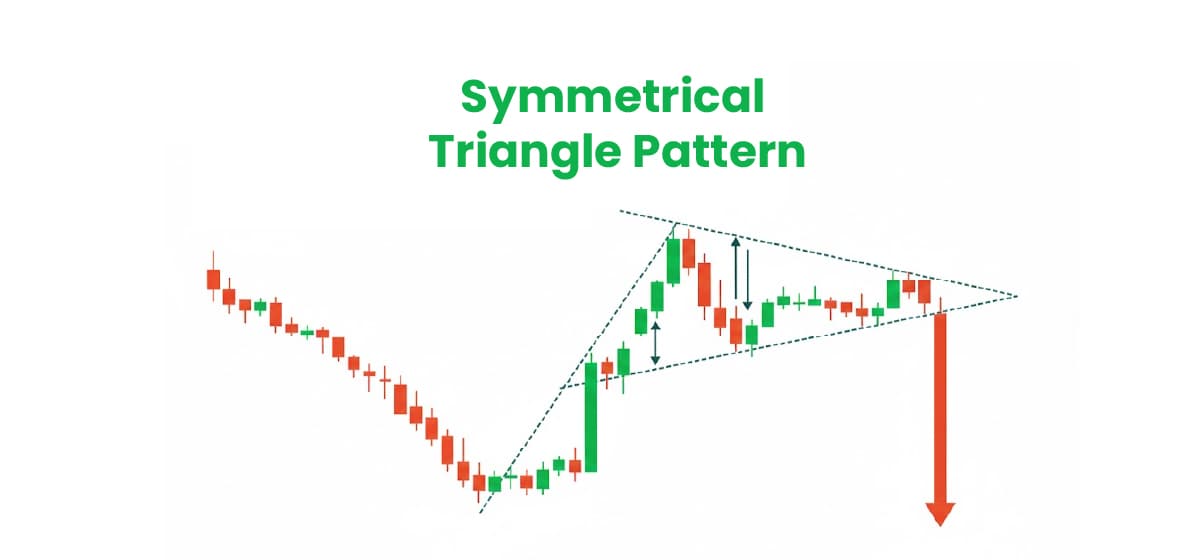
The symmetrical triangle pattern usually appears before large price movements. Unlike the ascending and descending triangle patterns, the symmetrical triangle pattern is a neutral formation that can appear during both bullish and bearish market conditions. It forms when the price moves between two converging trend lines. One line forms a downward line from above, while the other creates an upward trend from below. This pattern signifies a period of consolidation where neither the buyers nor the sellers are in control of the market.
Volatility decreases as the triangle narrows, and traders expect a breakout when this pattern appears on the charts. The direction of the breakout determines whether the pattern will become bearish or bullish. When the breakout occurs above the trendline, it signals the continuation of an uptrend. Subsequently, when the breakout occurs below the lower line, it indicates continuation of a downtrend.
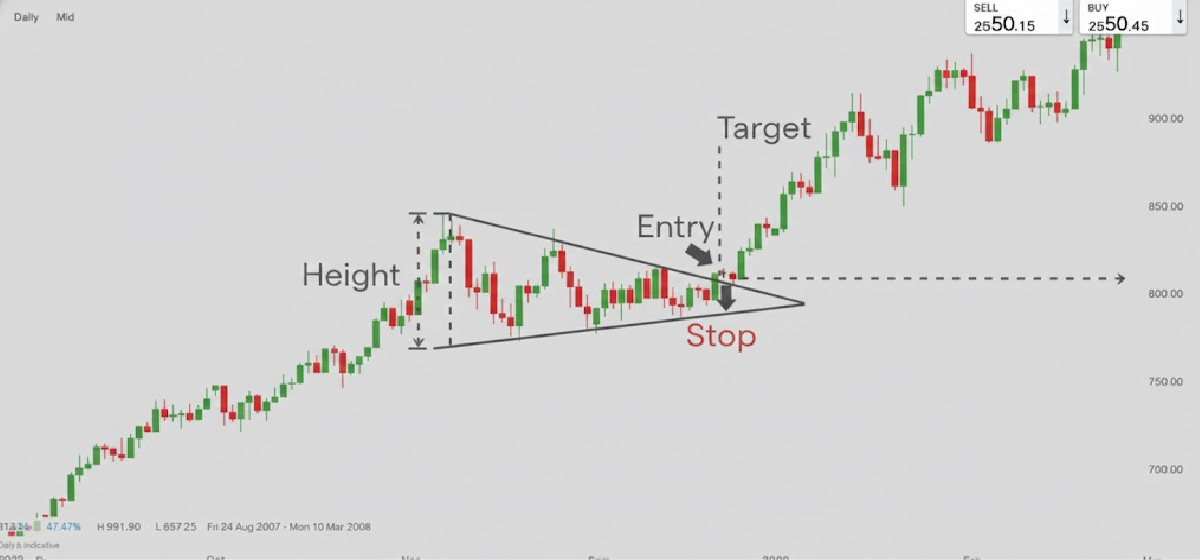
Symmetrical triangles are generally considered a continuation pattern, and they can occasionally signal a reversal of the trend. Understanding the context of the pattern, how it is made, and why it is forming is of paramount importance.
How to Identify a Valid Symmetrical Triangle Pattern
A valid symmetrical triangle requires a clear and structured formation. It is not simply a consolidation but a specific pattern with defined characteristics. A valid symmetrical triangle pattern follows the criteria mentioned below:
- A sequence of lower highs and higher lows
- Clearly converging trendlines
- A noticeable decline in volatility during formation
- A breakout that occurs before the pattern fully closes
While these elements provide a strong foundation, context also matters. The pattern becomes more reliable when it aligns with broader market trends.
Market Psychology Behind the Pattern
The symmetrical triangle reflects a temporary balance between buyers and sellers. During this phase, both buyers and sellers attempt to control price movement but fail to create a decisive moment. Initially, buyers may push prices higher, but each attempt loses momentum, resulting in progressively lower highs. Similarly, sellers push prices downward but are unable to sustain the pressure, forming higher lows.
Together, this movement creates compression in price action. As the range tightens, market participants begin to look out for a breakout.
Usual Signals and Bias (No Guarantees)
The symmetrical triangle is generally considered a neutral pattern, but its behavior often depends on the preceding trend. In an uptrend, it frequently acts as a continuation pattern, while in a downtrend, it may continue bearish momentum. However, this is not a rule, and reversals can occur if market sentiment shifts.
For this reason, traders should rely on confirmation signals before entering a trade. False breakouts do happen, especially when the market is volatile. Traders must always do their research to manage risk carefully.
Where Does the Pattern Appear?
The pattern usually appears during phases where the market pauses before continuing its movement. It is often observed in the middle of trends or near key support or resistance levels. On lower timeframes, such as 5-minute or 15-minute charts, symmetrical triangles tend to produce more false signals due to market volatility. In comparison, higher timeframes such as 4-hour or daily charts provide a clearer formation and more reliable breakouts.
How to Trade Symmetrical Triangle Pattern?
Trading the symmetrical triangle pattern effectively requires a structured approach. Instead of entering or exiting a trade prematurely, traders should focus on confirming the pattern and then devising a risk management strategy.
Entry
There are two commonly used entry methods for the symmetrical triangle pattern. The first one involves entering the trade immediately after a breakout candle closes outside the trendline. While this allows early positioning, it carries a higher risk due to possible false breakout.
The second approach is more moderate in risk. The traders wait for a breakout and then enter on a retest of the broken trendline. This method usually provides a better risk-to-reward ratio and stronger confirmation.
Breakout Confirmation
Before entering a trade, it is important to evaluate the strength of the breakout to confirm it is not false. A valid breakout usually includes:
- A strong candle closing clearly outside the trendline.
- Noticeable increase in trading volume.
- Clean price structure without unpredictable movement.
Without these confirmations, the breakout may lack reliability and could result in loss.
Stop-Loss Placement
Risk management plays a critical role in trading symmetrical triangles. Stop-loss placement should allow space for price fluctuations while protecting your capital. Traders often place stop-loss orders just beyond the breakout candle or near the most recent swing point within the triangle. A more cautious approach may involve placing the stop-loss order slightly deeper to avoid being triggered by minor volatility.
Price Targets
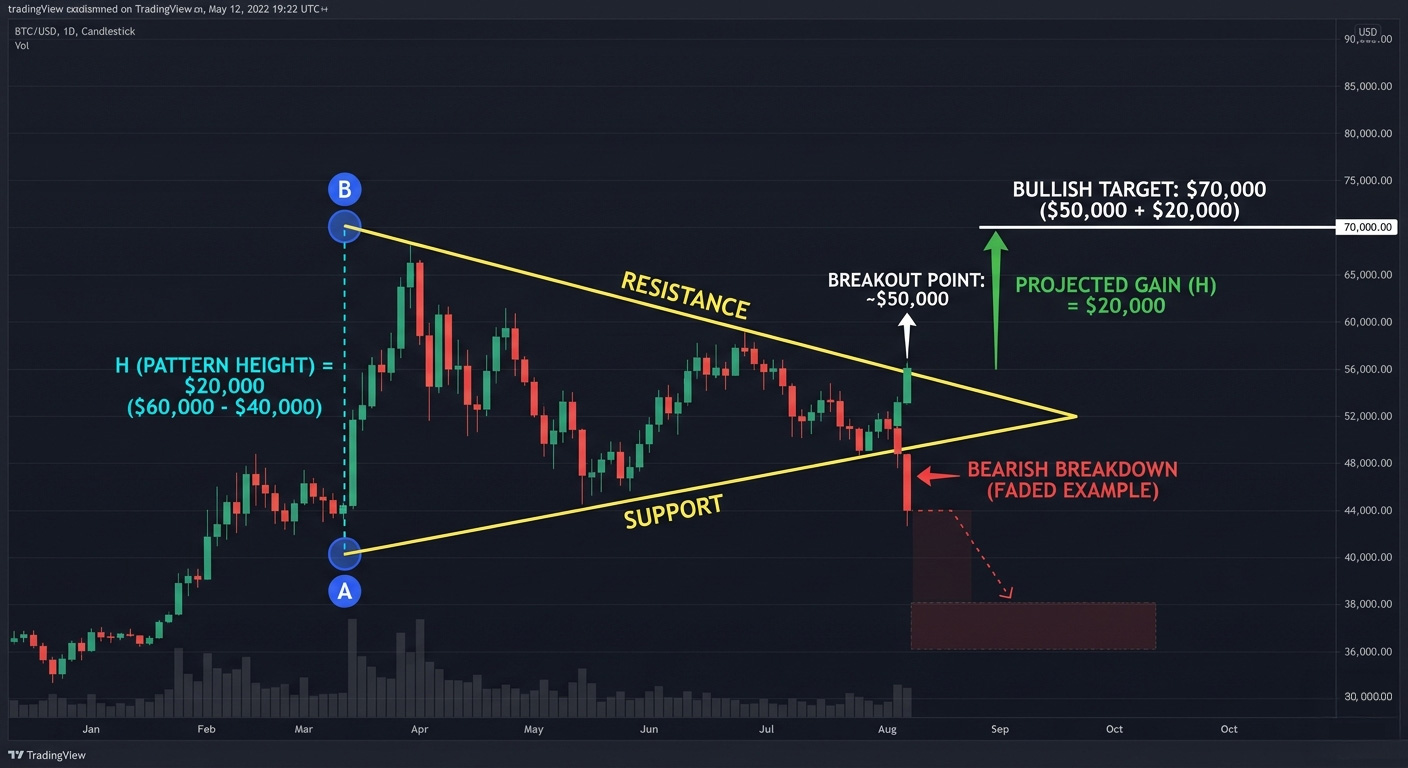
Price targets are commonly determined using the measured move technique. This technique involves calculating the height of the triangle at its widest point and projecting that distance from the breakout level.
Here is how traders use this method:
- To identify the widest point of the triangle, traders look at the beginning of the pattern where the distance between the upper and lower trendlines is the largest.
- Measure that vertical distance as this is your “range.”
- Apply it from the breakout point. If the price breaks upwards, add the distance above the breakout level. Subsequently, if the price breaks downward, subtract the distance below the breakout level.
Here is an example of Bitcoin/USD to further simplify it.
- Highest point of triangle: $60k
- Lowest point of Triangle: $40k
- Triangle height: $20K
Now:
- If the breakout happens at $50k (upwards), your target is $70k.
- If the breakout happens at $47k (downwards), your target is $27k.
What if the Pattern Fails?
No chart pattern is guaranteed to succeed, and the symmetrical triangle is no exception. Failure occurs when the price breaks out but quickly reverses and moves back within the triangle. This usually indicates weak momentum, and in such situations:
- Traders should exit positions promptly
- Avoid holding onto losing trades
- Wait for a clearer structure
Common Mistakes to Avoid
There are common mistakes that traders make when it comes to symmetrical triangle patterns. In order to make sure you enter and exit positions at the right moment, you should do your absolute best to avoid them. Let’s take a look at some of them.
Entering a Position Before Breakout Confirmation
One major mistake that traders often make is entering new trade positions before a breakout is confirmed. Acting too early can expose the traders to false breakouts, where the price briefly moves outside the trendline but returns within the triangle. It is better to wait for confirmation and look for increased volume or a strong candle close beyond the trendline.
Making Assumptions
Another mistake that new traders make is assuming that symmetrical triangles always result in the continuation of the prior trend. While this is often the case, reversals can happen. Reversals occur especially when the market sentiment has shifted unexpectedly. Relying solely on triangle formation without considering other factors, indicators, or market context can lead to misinterpretation.
Misidentifying Pattern
At times, traders misidentify the pattern by forcing trendlines on the chart. For a symmetrical triangle to be valid, the highs and lows should clearly form a narrowing structure. If the trendlines are not converging or if the price movements appear to be irregular, the pattern may not provide the guidance required to make a good investment decision.
Final Takeaways!
The symmetrical triangle pattern is a valuable tool for traders who want to understand the market and prepare for any breakouts. While the pattern cannot predict the direction of the market sentiment, it can highlight when the market is gaining momentum or going towards a breakout. By analyzing volume, trendlines, and the market sentiment, traders can use a symmetrical triangle to support their strategic decision-making.
Start trading on WEEX with a 100 USDT deposit and unlock 40 USDT back after completing your first trading step.
FAQs
What is a symmetrical triangle pattern in crypto trading?
The symmetrical triangle pattern occurs when converging trendlines form. One line forms a downward line from above, while the other creates an upward trend from below.
Is a symmetrical triangle bullish or bearish?
It is a neutral pattern, and the direction of the breakout determines whether the pattern indicates bearish or bullish market conditions.
How long does a symmetrical triangle usually last?
Depending upon the market volatility, it can form over days, weeks, or even months.
What signals a breakout from the triangle?
A strong move beyond either trendline with increased volume often confirms a breakout.
Is volume important when tracking this pattern?
Yes, rising or decreasing volume is important. Tracking the volume can help improve the reliability of the pattern.
Should I enter a trade before the breakout?
No, it is safer to wait for confirmation to avoid any false breakouts.
Disclaimer: All content on The Moon Show is for informational and educational purposes only. The opinions expressed do not constitute financial advice or recommendations to buy, sell, or trade cryptocurrencies. Trading involves significant risk and may result in substantial losses. Always seek independent financial advice before making investment decisions. The Moon Show is not responsible for any financial losses or decisions made based on the information provided.
Please view the full disclaimer at: https://themoonshow.com/disclaimer

What is a Bull Flag in Crypto Trading?
Traders use a bull flag pattern to assess whether a sharp rally might continue after a brief co...

Cup and Handle Pattern: Crypto Trading Rules, Targets, and Risks
The cup and handle is a bullish continuation chart pattern that signals a potential upward pric...

How Does Bitcoin Work? Blockchain, Mining, and Wallets Explained
Bitcoin is the world’s first decentralized digital currency that lets people send money directl...