Hyperliquid Exchange Review: The Highest-Volume Decentralized Perps Platform
Hyperliquid, launched in 2023, has quickly become one of the most talked-about decentralized exchanges (DEXs) in the crypto trading community. Within its first year, it attracted significant trading volume, built a rapidly expanding user base, and consistently ranked among the top venues for derivatives trading. The exchange delivers the speed and interface quality typically associated with centralized platforms while operating as a fully on-chain, decentralized protocol on its own Layer 1 blockchain. Although spot trading and liquidity-provider yields are available, the primary focus and main attraction remains its leveraged perpetual futures product.
This Hyperliquid exchange review takes a detailed look at the platform’s features, performance, and day-to-day trading experience. Let’s take a look.
Pros and Cons
Pros
- High performance with low-latency execution
- Zero gas fees and competitive trading costs
- Avoids centralized exchange risks and KYC requirements
- Combines a traditional order book with on-chain settlement
- Liquidity providers receive a share of platform revenue
- Community-owned liquidity pools through Vaults
- User-friendly decentralized exchange interface
Cons
- Limited chain support
- Leverage capped at 40x
- Fewer altcoins are available compared to major exchanges
- Regulatory uncertainty persists
What is Hyperliquid Exchange?
Hyperliquid is a decentralized perpetual futures exchange that launched in 2023 and operates on its own dedicated Layer 1 blockchain. Unlike most DEXs that run on Ethereum, Arbitrum, or other shared networks, Hyperliquid built a purpose-designed chain from the ground up. The result is a platform that offers the execution speed, tight spreads, and intuitive interface usually found only on centralized exchanges, yet remains fully on-chain, transparent, and non-custodial.
The core product of Hyperliquid is perpetual futures trading. Hyperliquid currently lists close to 200 perpetual markets with leverage up to 40x on major assets such as Bitcoin, Ethereum, Solana, and a wide range of altcoins. Spot trading is available, but volumes there remain modest compared to the dominant derivatives activity.
The project was co-founded by Jeff Yan and Iliensinc, both Harvard graduates with experience in traditional finance and blockchain development. The platform also includes HyperEVM, an Ethereum-compatible environment that allows developers to deploy smart contracts and build additional DeFi applications directly within the Hyperliquid ecosystem.
The native token, HYPE, powers governance, staking, and transaction fees inside HyperEVM. It officially entered circulation on November 29, 2024, through one of the largest airdrops in crypto history. More than 310 million tokens, representing 31 percent of the total supply, were distributed to almost 100,000 early users and contributors. Today, Hyperliquid ranks as the highest-volume decentralized venue for crypto derivatives.
How Does Hyperliquid Exchange Work?
Hyperliquid runs on a custom Layer 1 blockchain built purely for trading performance. It uses a consensus mechanism called HyperBFT, which produces blocks in about 0.2 seconds and can theoretically handle up to 200,000 transactions per second. The network currently relies on just 21 validators, a choice that clearly favors speed and low latency over the broader decentralization seen on chains like Ethereum.
The key feature is a fully on-chain central limit order book. While nearly every other DEX depends on automated market makers and liquidity pools, Hyperliquid records every order, cancellation, and fill directly on the blockchain. To keep execution fast, the actual matching engine runs off-chain, but the moment a trade occurs, the result is committed on-chain and can be verified by anyone.
This combination gives traders the tight spreads and order precision normally found only on centralized platforms, along with full support for limit, post-only, and reduce-only orders. Positions and margin are managed entirely by smart contracts, so the platform never holds user funds. Deposits, withdrawals, and collateral moves happen straight between wallets.
On the trading side, users can open perpetual contracts with up to 40x leverage, switch between cross and isolated margin modes, and earn maker rebates by providing liquidity. Spot markets follow the same order-book model, although activity there stays modest compared to the heavy derivatives volume.
Hyperliquid Exchange Key Features
No KYC Required
Hyperliquid skips any form of identity verification. Traders only need to connect a compatible wallet and can start placing orders immediately. No email, no documents, no personal details are ever necessary, which keeps privacy intact while the platform still operates securely.
Fully On-Chain Order Book
The entire order book runs directly on the blockchain. Every bid, ask, cancellation, and execution is recorded on-chain in real time. The custom HyperBFT consensus delivers the necessary throughput, so the platform never has to fall back on automated market makers or off-chain matching engines.
Zero Gas Fees
As Hyperliquid controls its own Layer 1 chain, users never pay network gas fees. The protocol covers the underlying blockspace costs internally and only applies small fixed trading fees that appear clearly before any order is placed.
Up to 40x Leverage
Perpetual contracts support leverage as high as 40x across major pairs. Traders can switch freely between cross and isolated margin modes and use the full range of advanced order types familiar from centralized venues.
Liquidity Vaults and HLP
Community members can create vaults where others deposit funds and automatically copy their trades, sharing profits and losses. The protocol also runs the Hyperliquidity Provider (HLP) vault, which acts as the main counterparty, provides market-making liquidity, handles liquidations, and earns a share of trading fees.
Professional-Grade Trading Tools
Real-time charts, depth ladder, detailed order book view, limit, market, stop, post-only, reduce-only, take-profit, and stop-loss orders are all available. The interface and feature set match what most active traders already use on platforms like Binance or Bybit.
HYPE Staking
Token holders can stake HYPE with any approved validator to earn passive yield. Current real APYs range between roughly 0.8% and 2.3%, with most rewards funded from actual platform revenue rather than inflationary emissions.
Hyperliquid Exchange Spot Trading
Hyperliquid does offer a spot trading section alongside its dominant perpetuals product. Users can swap stablecoins (mainly USDC or the native USDH) for actual tokens and take direct ownership. Once a trade fills, the coins move straight to the connected wallet through smart contracts with no custodial step in between.
The spot market currently lists more than 50 pairs. Major assets sit next to smaller caps, including some less common tokens such as Axelar (AXL). Order types include standard market and limit orders, plus larger-scale options like Scale and TWAP for anyone needing to move larger sizes quietly.
In practice, activity remains very light compared to the derivatives side. Daily spot volume typically runs in the low hundreds of millions, sometimes less. That translates to thinner books and noticeably wider slippage than most traders are used to on bigger centralized spot venues.
The interface itself feels clean and familiar. Anyone who has used Binance or Bybit spot will recognize the layout instantly, just without logins or withdrawal queues. Still, for most users, Hyperliquid spot is more of a convenience feature than the main reason to be on the platform. The real volume and liquidity stay firmly in perpetual futures, which we will talk about in the next section.
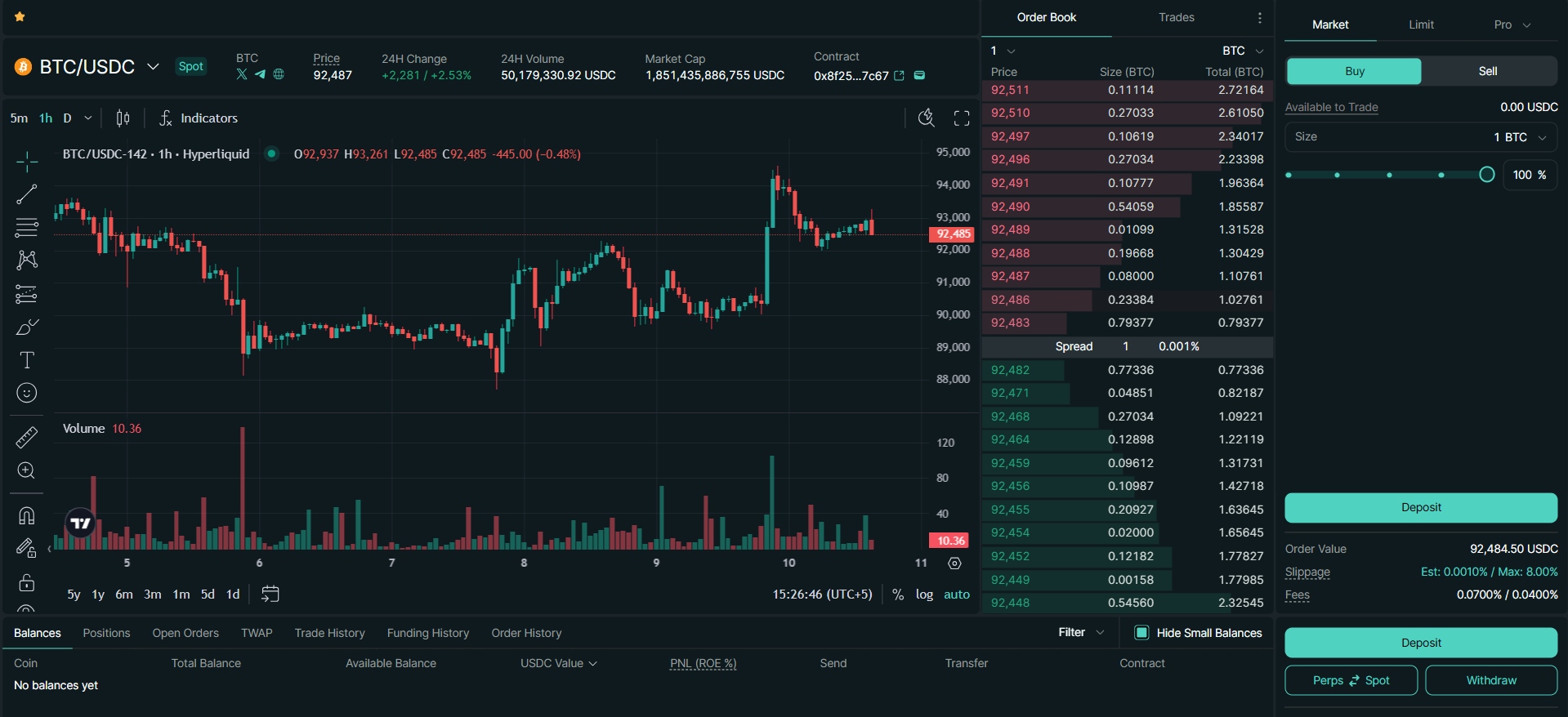
Fees follow a simple maker-taker schedule. Makers pay between 0.040% and 0% while takers pay 0.070% down to 0.030%, with rates dropping as 30-day volume rises. Liquidity providers, therefore, get decent rebates, and the overall cost stays competitive with larger centralized spot desks.
Hyperliquid Exchange Futures Trading
Futures are where Hyperliquid truly dominates. The platform regularly posts $5–10 billion in daily perpetual volume and carries open interest above $6 billion, making it comfortably the highest-volume DEX for crypto derivatives. Traders get up to 40x leverage on BTC/USDC (just 2.5% initial margin), 25x on ETH, 20x on XRP, and typically 3–5x on smaller altcoins and meme coins. Those numbers sit on the conservative side compared to some offshore CEXs that push 100x or more, but the trade-off is full wallet-based anonymity and on-chain settlement.
More than 250 perpetual contracts are live at the time of writing this review. The same clean interface used for spot carries over, complete with TradingView charts, depth ladder, and the full range of order types: market, limit, post-only, reduce-only, scale, TWAP, plus attached take-profit and stop-loss triggers.
Execution feels instant, spreads stay tight thanks to the HLP vault and community market makers, and both cross and isolated margin modes are available. Whether trading long or short, the experience matches what most people expect from top centralized perpetual desks, just without KYC or withdrawal limits.
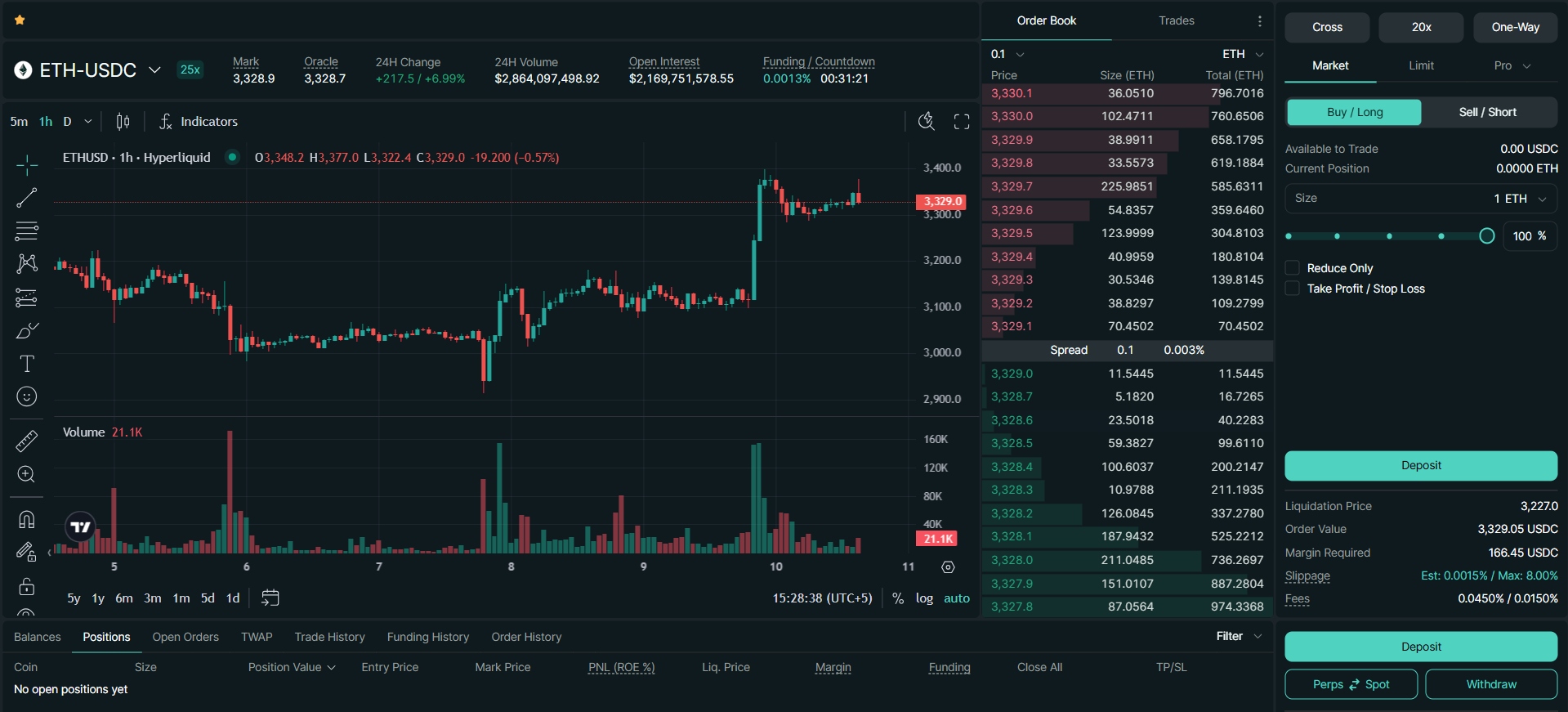
Fees stay competitive. Perpetuals use the same maker-taker structure as spot. Base taker fee is 0.045% (drops to 0.019% at higher volume tiers), while makers pay 0.015% at low tiers and eventually reach 0.000% once 14-day volume climbs high enough. High-frequency traders and liquidity providers, therefore, operate at almost zero cost.
In short, futures are the clear flagship product and the main reason the vast majority of users and volume are on Hyperliquid in the first place.
Staking on Hyperliquid Exchange
Hyperliquid runs on proof-of-stake, so holding HYPE gives the option to stake directly with any of the approved validators. The process is fully on-chain and permissionless. Users pick a validator based on current APY, commission rate, and uptime, then delegate their tokens straight from the platform interface.
Current real yield sits between roughly 2.0% and 2.6%. Those numbers already account for validator commissions and any downtime, so the displayed rate is what actually lands in the wallet. Most of the rewards come from protocol revenue (trading fees, vault profits, and other ecosystem income) rather than new token emissions, which keeps inflation low and makes the yield relatively sustainable.
There is no minimum stake and no long lock-up. Tokens become liquid again after a one-week unbonding period (validators themselves only require a one-day notice, but the extra days are a protocol-level cooling-off). Rewards accrue in real time and can be claimed or re-staked whenever the user wants.

Stakers also gain governance rights proportional to their stake. They can vote on new markets, protocol upgrades, fee adjustments, and treasury matters. Overall, staking HYPE stays simple. Delegate once, earn a modest but genuine share of platform earnings, keep reasonable liquidity, and retain a voice in the project’s direction.
Hyperliquid Vaults
Hyperliquid handles liquidity through vaults instead of traditional AMM pools. Users deposit USDC, and the vault automatically puts that capital to work by placing bids and offers in the order book. Every vault helps keep spreads tight and depth solid across perpetual markets.
There are two main types. The protocol runs its own Hyperliquidity Provider (HLP) vault that acts as the primary market maker, counterparty for opening positions, and liquidator when needed. The HLP earns trading fees, funding payments, liquidation penalties, and spread capture. Its APY usually stays in the low to mid-teens in normal markets, though it can spike higher during volatility.
Community vaults work more like copy-trading. Any user can create a vault and trade manually (or with bots) using the pooled funds. Depositors follow that strategy and share profits or losses proportionally. Vault leaders keep 10% of net profits as a performance fee. Some of these vaults have posted eye-watering returns (occasionally above 1000% annualized during hot periods), but the risk is equally extreme, and many also lose money.
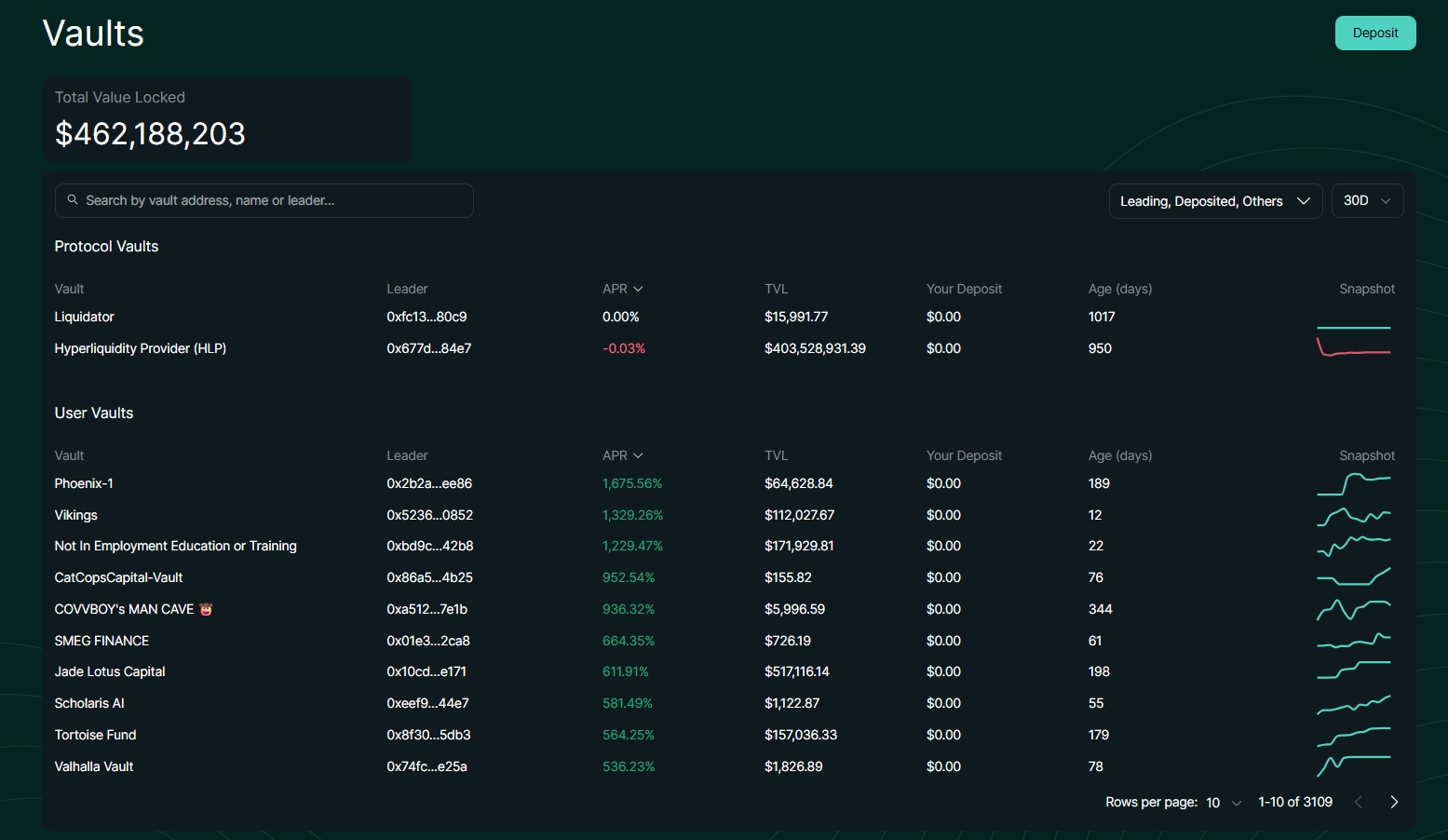
Deposits into any vault have a four-day lock-up counted from the most recent deposit. Withdrawals can be requested anytime, but funds only become available after that window. The system is fully on-chain, so performance, holdings, and historical returns for every vault are public and verifiable.
In practice, most traders stick to the safer protocol HLP vault for steady yield, while a smaller group chases higher returns (or losses) in the community-run ones. Either way, the vault model replaces passive AMM farming with active order-book liquidity provision and gives users a direct way to earn from the platform’s trading volume.
HYPE Token
HYPE serves as the native token for the entire Hyperliquid ecosystem. It handles gas fees for transactions on the Layer 1 chain and HyperEVM, powers staking to secure the network, and gives holders voting rights on governance matters like fee adjustments, new markets, and protocol upgrades. Beyond that, staking HYPE unlocks trading fee discounts up to 40%, depending on the amount locked.
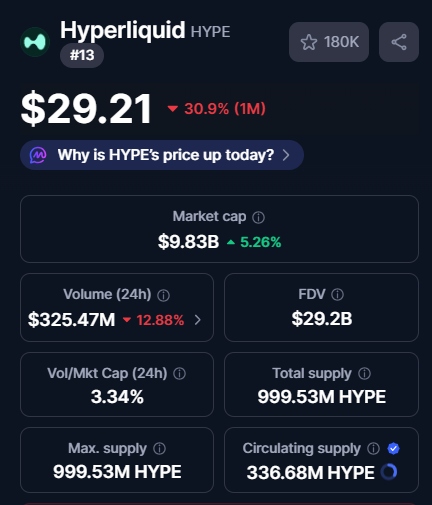
The token launched on public markets in late November 2024 at around $3.20. Despite the massive airdrop, it avoided the usual post-distribution dump and climbed steadily to $35 within weeks, before pushing to an all-time high of $59.39 in September 2025. As of now, HYPE trades at about $29.00, with a market cap of roughly $9.8 billion. Circulating supply stands at 337 million tokens, or 33.7% of the 1 billion total cap, leaving the fully diluted value around $29 billion. Future unlocks from emissions and vesting will gradually increase that float, potentially adding some downward pressure over time.
Total supply caps at 1 billion to keep things stable and avoid runaway inflation. The distribution puts heavy emphasis on the community, with no private sales or venture allocations. The genesis airdrop claimed 31%, or 310 million tokens, spread across nearly 100,000 early users on November 29, 2024, in what became one of the biggest and most generous drops in crypto history, averaging $45,000 to $50,000 per recipient at launch prices. Another 38.9% goes toward future staking rewards, trading incentives, and community programs. Core contributors hold 23.8%, vested over multiple years starting a year after launch. The Hyper Foundation gets 6% for ecosystem development, and 0.3% funds community grants.
Users can buy HYPE directly on the Hyperliquid spot market or through centralized exchanges like Binance and Bybit. In practice, the token ties everything together without dominating the spotlight, focusing instead on real utility to support the platform's growth rather than pure speculation.
Hyperliquid Fees
Hyperliquid keeps costs low across the board, with no gas fees on its Layer 1 chain and trading commissions that beat most centralized competitors. Rates use a maker-taker model based on 14-day volume, which updates dynamically to reward consistent activity. Spot and perpetuals have separate schedules, though spot volume counts double toward tier progression. Staking HYPE adds extra discounts up to 40% on top of volume tiers.
Spot Trading Fees
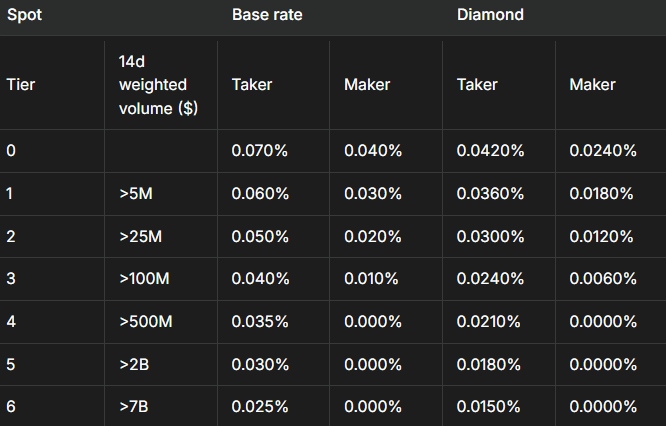
Entry-level traders pay 0.040% for makers and 0.070% for takers on limit and market orders. Those rates already undercut platforms like Binance or OKX, which start at 0.100% across the board. Volume kicks in at $5 million over 14 days for the first VIP tier, dropping makers to 0.030% and takers to 0.060%. Higher brackets continue the slide, with top makers reaching 0.000% at $7 billion in volume and takers hitting a floor of 0.025%. Volume here measures total position size, not just margin posted, so leverage amplifies the progress.
Perpetual Futures Fees
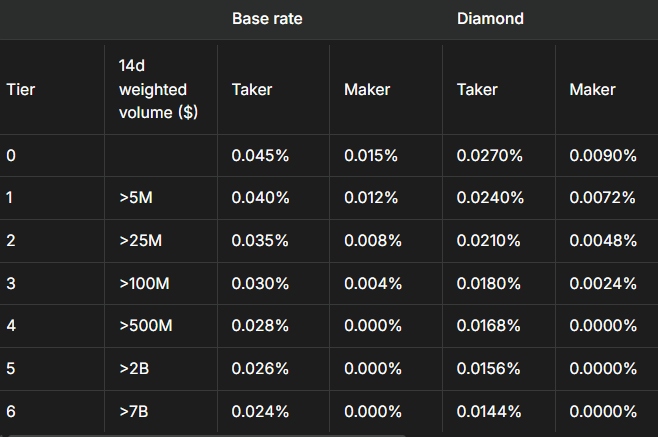
Perps start at 0.015% for makers and 0.045% for takers, again more aggressive than Bybit's 0.020%/0.055% baseline. The same 14-day tiers apply, with takers falling to 0.019% and makers to 0.000% at the upper end. High-frequency or institutional users, therefore, trade near cost-free once they scale up.
You can also visit the Hyperliquid exchange fee page to get a detailed breakdown of all fees applicable on the platform.
Other Costs
Deposits and withdrawals only incur standard network fees for USDC transfers, with no platform markup. Funding rates follow the industry norm at 0.01% every eight hours for major pairs like BTC/USDC, paid between longs and shorts based on market skew. Smaller markets see higher rates during swings, such as 2.47% on WCT/USDC. All fees flow directly to the community through HLP, assistance funds, and spot deployers, rather than insiders or teams. In practice, the structure makes Hyperliquid one of the cheapest venues for serious volume, especially when paired with HYPE staking perks.
Hyperliquid Supported Coins and Markets
Hyperliquid currently lists more than 220 perpetual markets and around 50 spot pairs. Almost every pair uses USDC as the quote currency, with a small number also offering USDH settlements. Traders can open positions on all major assets such as BTC, ETH, SOL, XRP, AVAX, BNB, and of course, the native HYPE token.
The selection stretches far beyond blue-chips. Popular meme coins stay permanently available, including DOGE, PEPE, BONK, WIF, BRETT, POPCAT, TRUMP, and dozens of others that rotate in and out based on demand. Mid-cap and thematic tokens also appear regularly, covering categories like Layer 2 projects, AI coins, DeFi primitives, and gaming tokens.
New markets come through community governance. Anyone can submit a Hyperliquid Improvement Proposal (HIP) to add a token. Staked HYPE holders then vote, and once a proposal passes the required threshold, the pair goes live within days. This process keeps the lineup fresh and focused on coins that actually move volume rather than filling the list with dead assets.
Deposits and withdrawals happen through native Arbitrum USDC or a handful of other bridged stablecoins. The platform deliberately avoids supporting hundreds of random tokens to keep liquidity concentrated and reduce fragmentation. In practice, traders almost always find the assets they want, especially on the perpetual side, where depth and tight spreads matter most.
Is Hyperliquid Secure?
Hyperliquid puts security at the forefront through its decentralized Layer 1 design. Users stay in full control of their assets at all times. Unlike centralized exchanges that hold funds, Hyperliquid never touches private keys or balances. Risks like platform hacks, withdrawal freezes, or mismanagement simply do not exist. Every trade, position, and liquidation records directly on the public blockchain. Anyone can verify activity in real time, which removes any chance of hidden market manipulation.
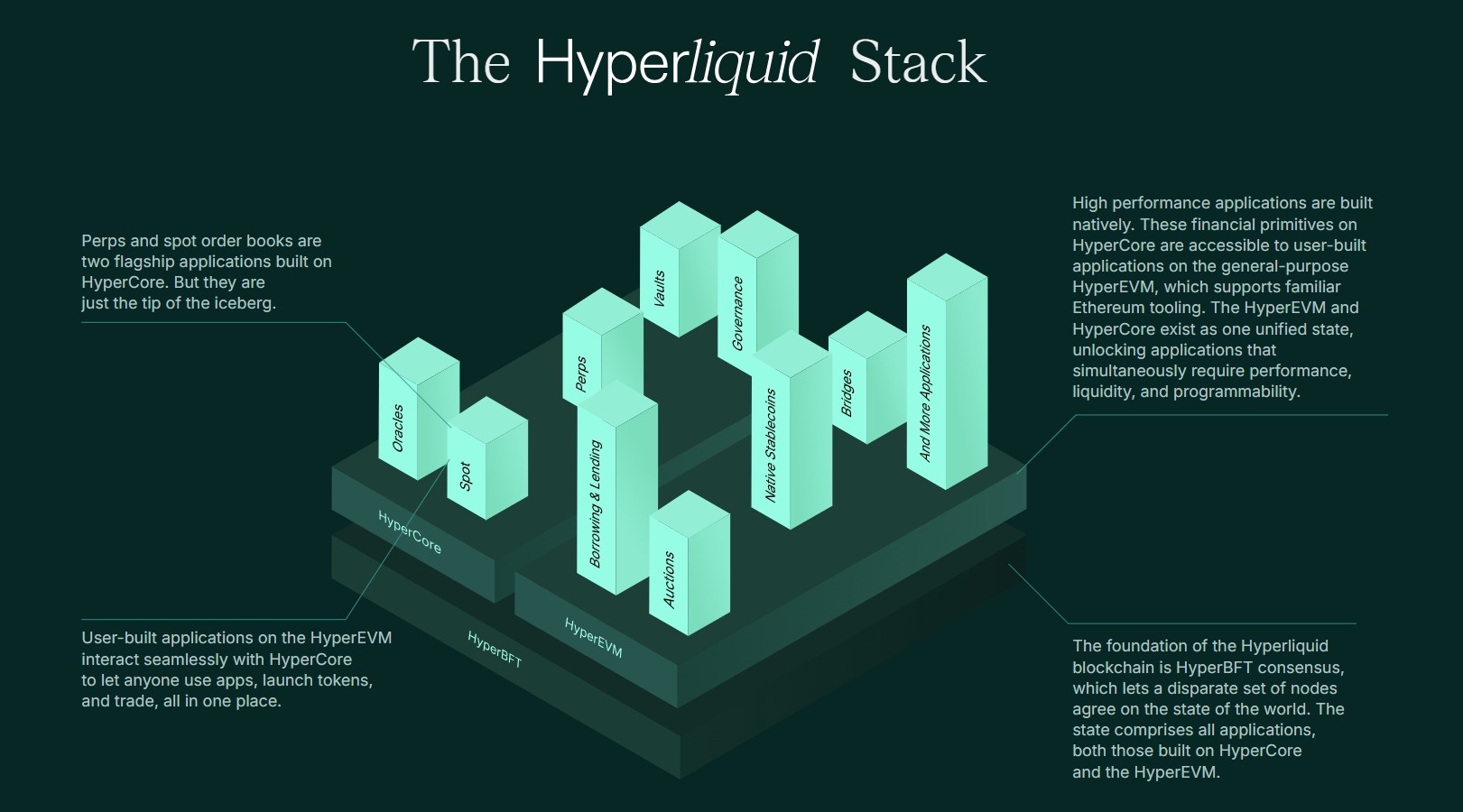
The network runs on HyperBFT consensus. This Byzantine Fault Tolerant system keeps operating even if up to one-third of nodes fail or turn malicious. Validators stake HYPE to participate and face strong economic penalties for bad behavior. The bridge to Arbitrum requires two-thirds validator approval before any transfer completes, adding another solid check. Core consensus code stays closed-source to reduce obvious attack paths, yet all on-chain results remain fully transparent and auditable.
Audits from firms like Zellic found no critical issues in the bridge contracts. An active bug bounty program pays researchers for responsible disclosures. Native multi-signature support lets users add extra keys to their accounts for additional protection.
Nothing is perfect, however. With only around twenty validators at present, the setup leans more centralized than older chains and could theoretically face coordination risks. The bridge and price oracles introduce smart contract vulnerabilities that no audit can completely rule out. Open interest caps and order distance limits help contain damage from oracle attacks, but they exist. Wallet security falls entirely on the user, with no recovery options if seeds get stolen.
Overall, Hyperliquid offers stronger structural security than most centralized venues and solid transparency for a DEX. Traders just need to treat it like any self-custodial platform. Protect your keys, use hardware wallets, and stay mindful of bridge and oracle risks.
Hyperliquid User Experience: Is it User-friendly?
Hyperliquid feels much closer to Bybit or Binance than to a typical DEX. Connect a wallet, send USDC from Arbitrum, and the screen instantly shows a full TradingView chart, depth ladder, and order panel that look exactly like the big centralized platforms. Every tool sits in the expected place. Limit orders, post-only, reduce-only, scale entries, TWAP, take-profit and stop-loss triggers, cross and isolated margin switches all work exactly the way active traders are used to. Pages load fast and orders fill without delay.
Opening a perpetual trade takes seconds. Choose the contract and leverage, pick the order type, and the platform immediately displays the liquidation price, required margin, and current funding rate. Profits and losses update live in USDC, so no extra math is needed. Spot trading follows the same layout without leverage.
Compared to AMM-based DEXs like Uniswap or older dYdX versions, the learning curve is far lower. There are no pools to join, no impermanent loss worries, and no confusing swap router. Anyone who has traded futures on a centralized exchange can start trading here almost instantly.
The only real DEX friction points are the usual ones. Users must manage their own wallet and seed phrase, bridge funds themselves, and understand that no support team can recover a lost key. Vaults add the most complexity. Depositing into the safe protocol HLP vault is easy, but many community vaults run active strategies built on funding arbitrage, delta hedging, or moving averages that can confuse beginners. Most people simply skip those and trade manually.
For anyone already comfortable with a non-custodial wallet, Hyperliquid offers one of the cleanest and fastest trading experiences in all of decentralized finance, centralized or decentralized. The gap in polish between Hyperliquid and the top centralized perpetual platforms has essentially disappeared.
How to Bridge to Hyperliquid?
Bringing funds into Hyperliquid takes just a few minutes and works almost entirely from Arbitrum. The platform uses its own fast native bridge instead of slow third-party routers, so transfers usually complete in under a minute with tiny fees.
Here is the exact step-by-step process most traders follow.
- Install and set up a wallet such as MetaMask, Rabby, or OKX Wallet if you do not already have one.
- Switch the wallet network to Arbitrum One.
- Send or buy USDC on Arbitrum. The bridge accepts native Arbitrum USDC (not Ethereum mainnet USDC).
- Go to hyperliquid.xyz and connect your wallet.
- Click the “Deposit” button in the top-right corner.
- Choose USDC (Arbitrum) as the asset, enter the amount, and hit “Deposit”.
- Confirm the transaction in your wallet. The fee is normally a few cents and paid in ARB or ETH on Arbitrum.
- Wait roughly 10–40 seconds. Once the bridge finalizes, the USDC appears directly in your Hyperliquid trading balance.
Withdrawing works in reverse. Click “Withdraw”, pick the amount, and the funds land back in your Arbitrum wallet almost instantly.
There is nothing too complicated here. As long as you start with USDC on Arbitrum, the entire process feels smoother and is as smooth as centralized exchange deposits. Readers can check our Hyperliquid exchange tutorial for a clear walkthrough on setting up an account and placing trades.
Final Takeaway
Hyperliquid has earned its place as the highest-volume decentralized perpetuals DEX for good reason. It combines centralized-grade speed, tight spreads, and a familiar TradingView interface with the transparency and self-custody of a true on-chain platform. No KYC, zero gas fees, and a proper order book make it genuinely different from both traditional AMM DEXs and most centralized venues.
That said, it is still a relatively young Layer 1 with a small validator set, bridge dependencies, and no account recovery options. Spot liquidity remains thin, and community vaults can be extremely risky. Fees are low but not always the absolute cheapest once you factor in funding rates on smaller pairs.
In the end, Hyperliquid works exceptionally well for experienced traders who want deep perpetual markets without handing over custody. It is not perfect, and it is not for complete beginners, but right now it is the strongest on-chain alternative available for serious crypto derivatives trading. Whether it deserves a spot in your lineup comes down to how much you value speed and transparency versus the usual centralized conveniences.
Frequently Asked Questions – FAQs
Is Hyperliquid a centralized or decentralized exchange?
Fully decentralized. It runs on its own Layer 1 blockchain with an on-chain order book and self-custody.
Do I need KYC to trade on Hyperliquid?
No KYC or signup required. Just connect a wallet and trade.
Which wallet works best?
MetaMask, Rabby, OKX Wallet, or any WalletConnect-compatible wallet.
How do I get funds onto Hyperliquid?
Deposit native Arbitrum USDC via the official bridge at app.hyperliquid.xyz. Takes under a minute.
What is the maximum leverage on Hyperliquid?
Up to 40x on BTC, 25x on ETH, 20x on most large-caps, 3–5x on meme coins.
Are there gas fees when trading on Hyperliquid?
No. Hyperliquid covers all gas fees. You only pay small trading commissions.
How much are trading fees on Hyperliquid?
For perpetuals, makers pay between 0.015% and 0% while takers pay between 0.045% and 0.019%. For spot, makers pay between 0.040% and 0% and takers pay between 0.070% and 0.030%. Fees decrease based on your 14-day volume and any HYPE you have staked.
Can I earn passive income on Hyperliquid?
Yes. Deposit into the protocol HLP vault (10–20% APY typical) or stake HYPE (≈2–2.6% real yield).
Is there a Hyperliquid mobile app?
No official mobile app yet. The web interface works well on mobile browsers.
How many markets are listed on Hyperliquid?
Around 220 perpetual contracts and 50+ spot pairs, all quoted in USDC.
Is Hyperliquid safe?
No custodial risk, audited contracts, active bug bounty, and on-chain transparency. Risks include a small validator set and bridge/oracle dependencies.
Can I withdraw anytime on Hyperliquid?
Yes. Withdrawals to Arbitrum are near-instant with only normal network fees.
Disclaimer: All content on The Moon Show is for informational and educational purposes only. The opinions expressed do not constitute financial advice or recommendations to buy, sell, or trade cryptocurrencies. Trading involves significant risk and may result in substantial losses. Always seek independent financial advice before making investment decisions. The Moon Show is not responsible for any financial losses or decisions made based on the information provided.
Please view the full disclaimer at: https://themoonshow.com/disclaimer

BloFin Exchange Review – Key Features, Fees and Security
Choosing a cryptocurrency exchange is not easy. Traders look for the right mix of features, low...
Bybit Review 2026 – Best Derivatives Trading Platform?
Bybit remains one of the world’s leading crypto exchanges in 2026 with over 84 million users an...

WEEX Exchange Review 2026: High Leverage, No KYC, But Is It Worth the Trade-Offs?
Choosing a cryptocurrency exchange is never a simple decision. You need a platform packed with ...