Aster Dex Review: The Multi-Chain Decentralized Perps Platform with 1001x Leverage
The decentralized finance landscape has undergone a significant transformation, moving from basic automated market makers to sophisticated platforms capable of rivaling centralized entities. Aster DEX, launched in mid-2025, represents a pivotal development in this evolution. As a decentralized perpetual exchange (perp DEX) built on a proprietary Layer-1 blockchain, Aster Chain seeks to address the historical limitations of decentralized trading, specifically regarding liquidity fragmentation, capital inefficiency, and high-latency execution.
The following review provides a professional and objective analysis of Aster DEX, examining its technical infrastructure, product offerings, fee structures, and security protocols. Let’s take a look:
What is Aster DEX?
Aster DEX operates as an integrated ecosystem that combines perpetual futures, spot trading, and yield-bearing assets into a singular, interoperable framework. The platform was established following a strategic merger in late 2024 between two pre-existing projects: APX Finance, an established perpetual trading platform, and Astherus, a multi-asset liquidity and yield aggregator. This merger was designed to create a comprehensive solution for both derivatives trading and yield-optimized asset management.
Pros and Cons
Pros
- Users control assets
- Up to 100x leverage
- Bridgeless multi-chain trading
- Yield-bearing collateral
- Hidden order protection
Cons
- No fiat deposits
- Lower altcoin leverage
- Higher 100x commissions
- Low spot volume
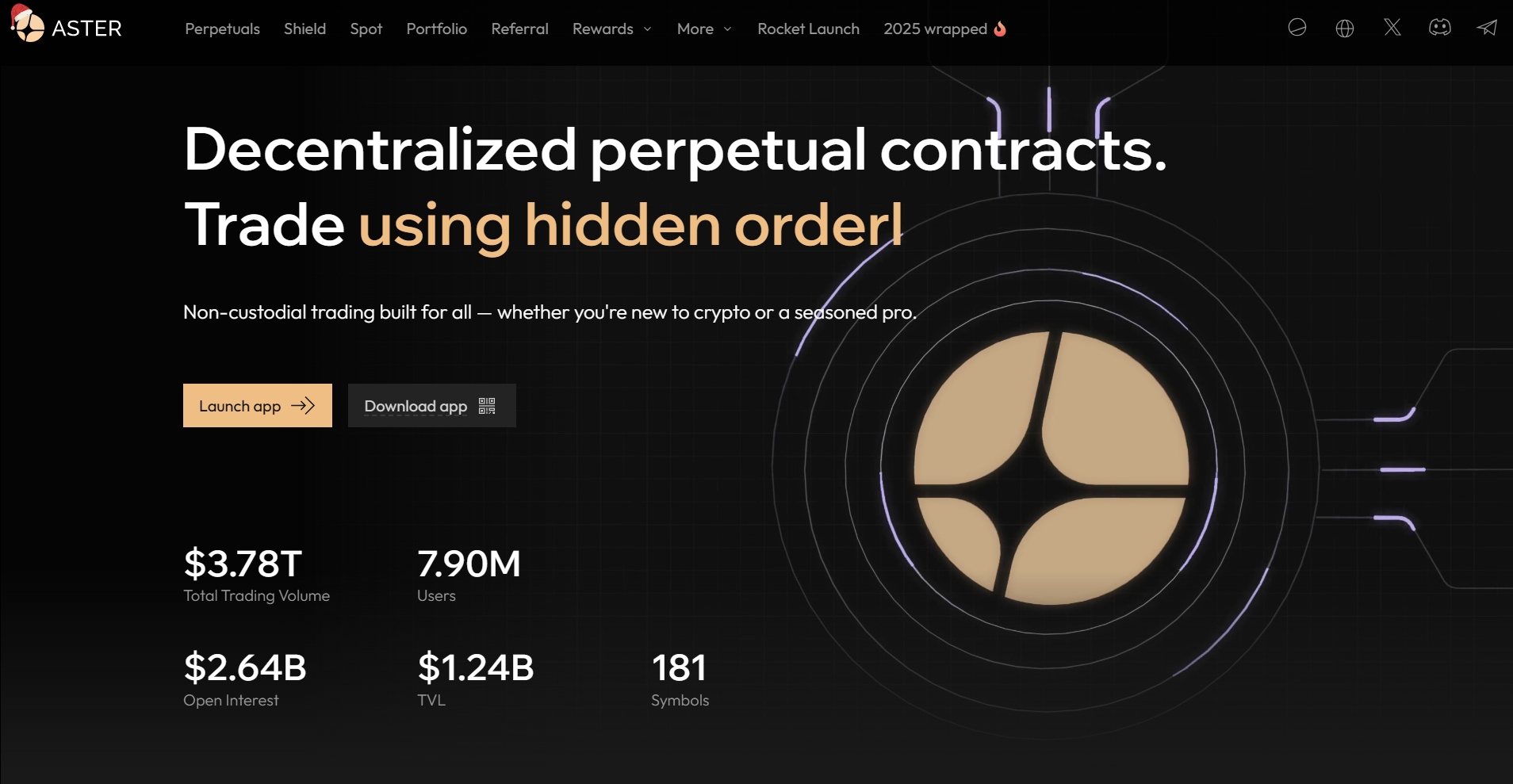
A distinctive factor in the rapid adoption of Aster DEX is its association with prominent industry figures. Market data suggests that the platform gained substantial traction following technical and product-focused advisory support from Changpeng Zhao, the founder of Binance. This involvement has positioned Aster as a primary competitor to other high-performance on-chain platforms such as Hyperliquid. Since its launch, the exchange has reported a user base exceeding 2 million participants and a cumulative trading volume surpassing $500 billion, figures that show its significant market presence within the DeFi sector.
Aster Chain and Layer-1 Capabilities
At the core of the platform is Aster Chain, a high-performance Layer-1 blockchain specifically engineered for on-chain trading. Unlike many DEXs that operate as application layers on general-purpose blockchains, Aster Chain is optimized for the rigors of high-frequency trading and complex financial settlements.
High-Performance Settlement
The blockchain utilizes zero-knowledge (ZK) settlement protocols to ensure that transactions are finalized with high speed and low latency. This architectural choice is critical for perpetual futures trading, where price volatility necessitates immediate order execution and liquidations. The network demonstrates block times of approximately 50 milliseconds and execution finality of 10 milliseconds, metrics that place it at the top tier of current blockchain technology standards.
Privacy and MEV Resistance
One of the most persistent challenges in on-chain trading is Maximal Extractable Value (MEV), where bots exploit the transparency of the mempool to front-run or "sandwich" user trades. Aster Chain integrates zero-knowledge proofs to enable private transactions. By encrypting trade intent and validating it off-chain before settlement, the protocol effectively mitigates front-running risks and predatory order sniping. This ensures a fairer trading environment for all participants alike.
Aster DEX Core Trading Products
Aster DEX distinguishes itself through a multi-tiered trading environment designed to serve different demographics of the trading community. The platform offers four primary trading verticals: Aster Pro, 1001x (Simple Mode), Aster Spot, and Tokenized Stocks.
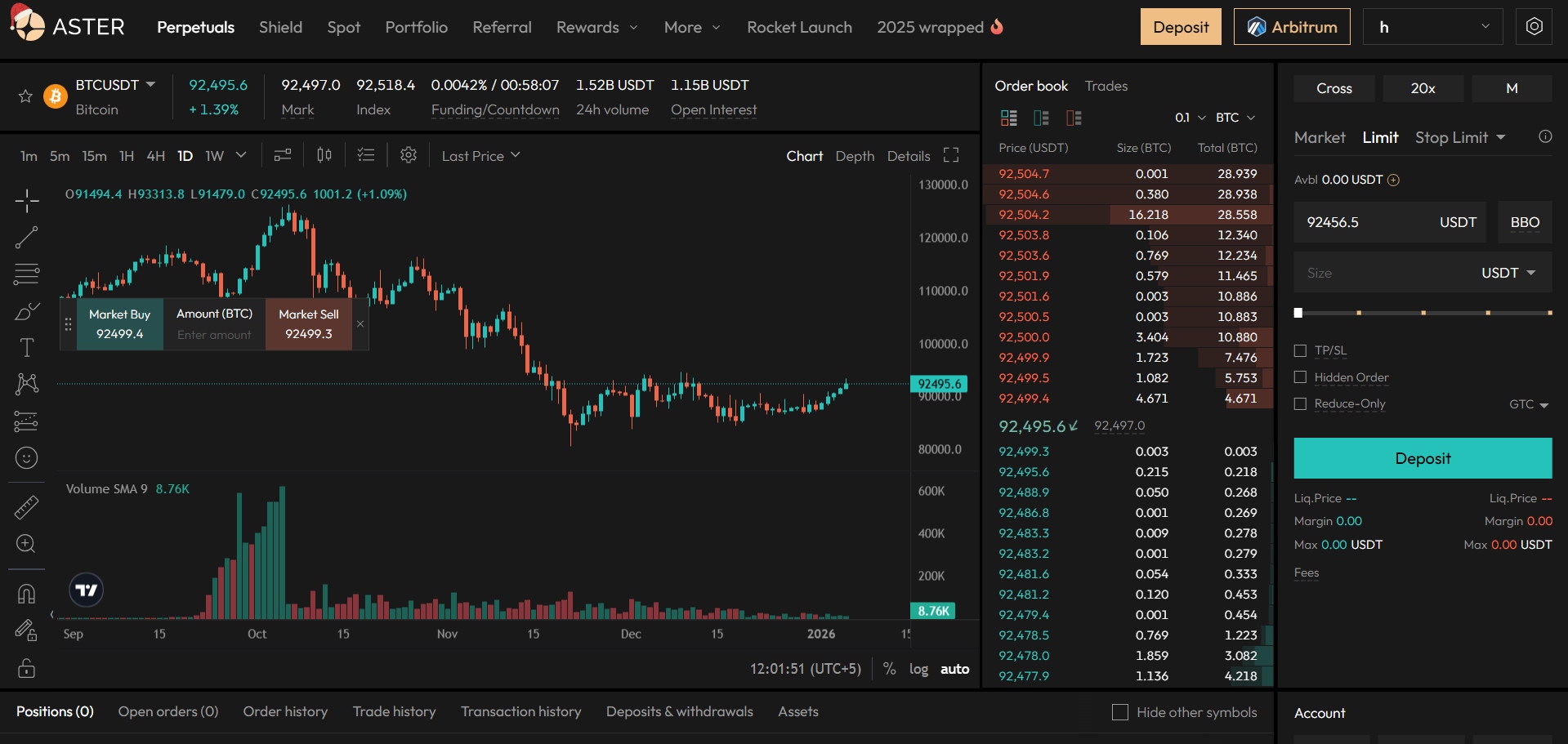
1. Aster Pro:
Aster Pro is the exchange's flagship product, offering a decentralized limit order book (DLOB) experience that mirrors the functionality of a centralized exchange.
- Multi-Chain Integration: The platform supports unified liquidity across major networks, including BNB Chain, Ethereum, Solana, and Arbitrum.
- Margin Modes: Traders can utilize Single-Asset Mode, primarily using USDT as collateral for isolated margin, or Multi-Asset Mode. The latter allows for cross-portfolio margining, where multiple digital assets contribute to a unified margin balance, significantly improving capital efficiency. Assets such as BNB, USDF, and ASTER are supported as collateral.
- Order Sophistication: Pro Mode supports a comprehensive suite of order types, including limit, market, stop-limit, trailing stop, and post-only orders. It also includes advanced risk tools like automated grid trading and hedge mode.
2. 1001x (Simple Mode): High-Leverage Access
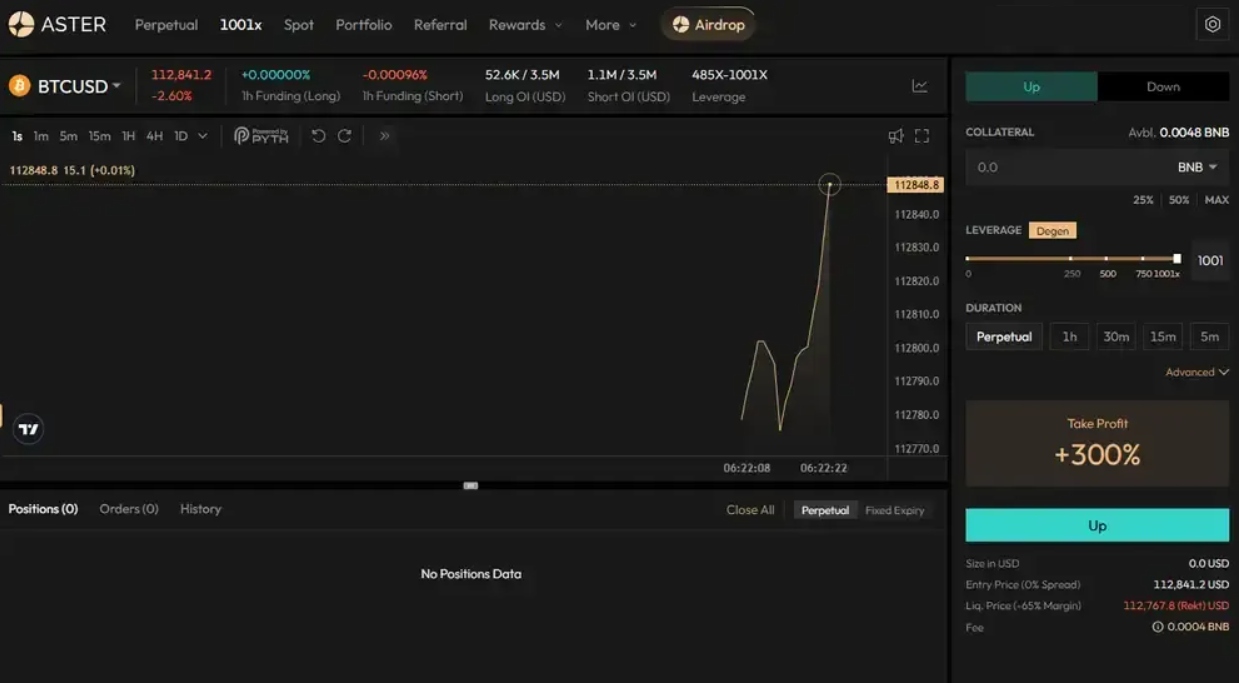
Designed for traders seeking high-exposure opportunities with simplified execution, the 1001x platform utilizes the ALP liquidity pool to facilitate trades. This cross-asset liquidity pool acts as the counterparty for all trades in this mode.
- Leverage Thresholds: The platform offers up to 1001x leverage on major pairs such as BTC/USD and ETH/USD, while altcoins and forex pairs carry lower maximum thresholds (75x to 250x).
- Degen Mode: This specific configuration allows for 500x to 1001x leverage with zero opening fees and minimal slippage.
- Dumb Mode: A unique short-term price prediction tool that allows users to speculate on immediate price movements with a simplified ROI structure, reaching up to 82% return on investment.
3. Tokenized Stock Perpetuals
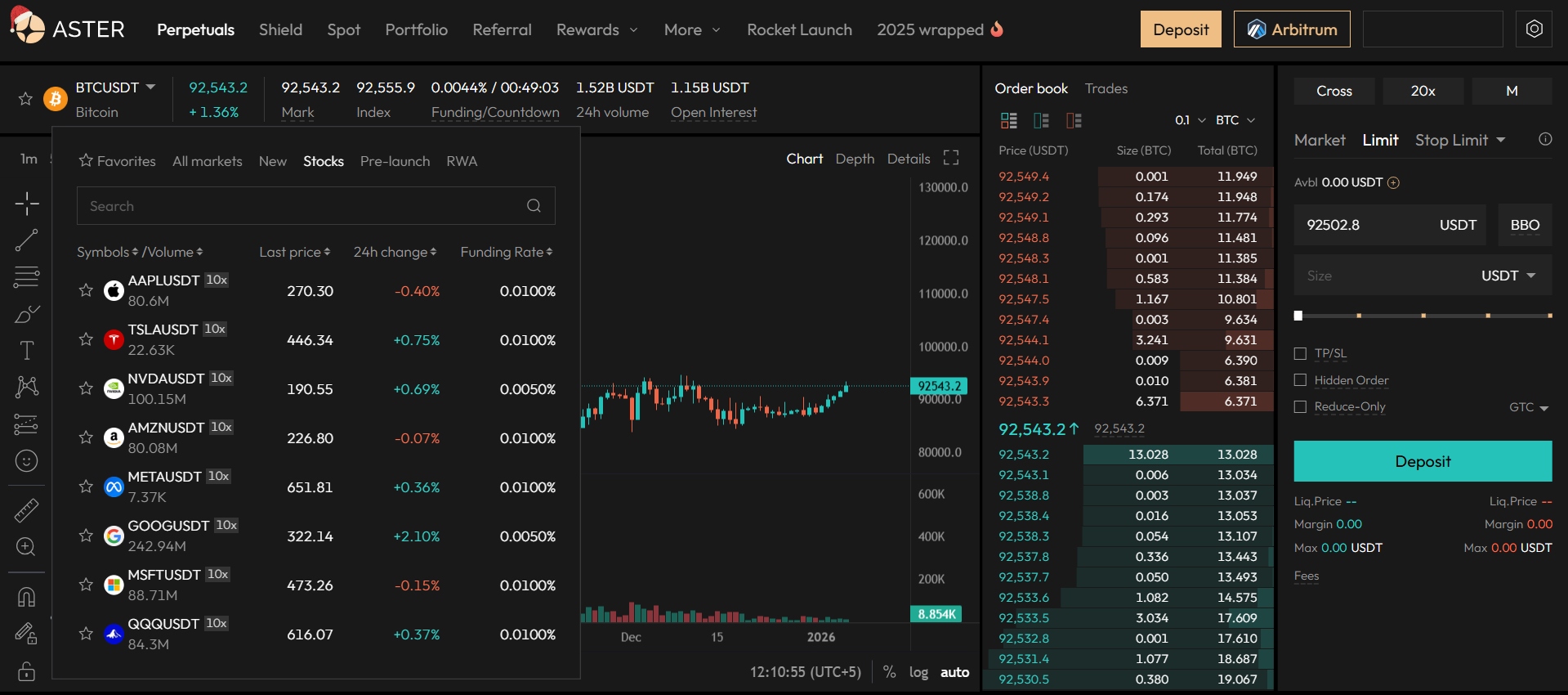
In a move toward the convergence of traditional finance (TradFi) and DeFi, Aster Pro enables the trading of perpetual contracts for major U.S. equities, such as Apple (AAPL), Tesla (TSLA), Amazon (AMZN), and Nvidia (NVDA).
- 24/7 Trading: Unlike traditional stock markets, these tokenized assets are available for trading around the clock.
- Settlement: All positions are settled in USDT, removing the need for traditional brokerage accounts.
- Oracle Integration: Price feeds are sourced from decentralized oracles like Pyth and Chainlink to ensure alignment with global market prices. As of late 2025, the platform has rolled out a zero-fee structure across its entire lineup of stock perpetual contracts.
4. Aster Spot
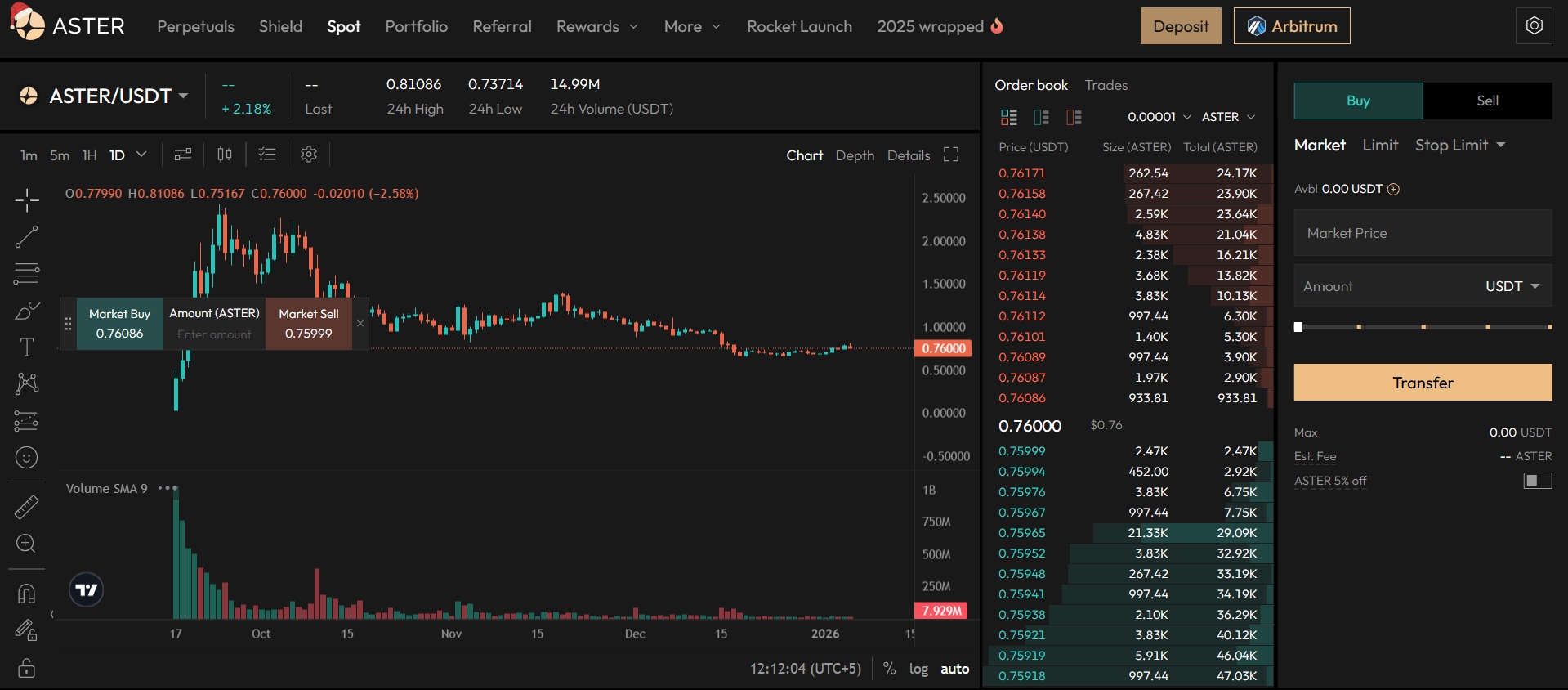
The spot exchange facilitates the direct purchase and ownership of digital assets. It operates primarily on the BEP-20 standard for fast settlement and supports a variety of assets, including the native ASTER token, BTC, ETH, and APX. Spot trading allows you to buy the asset directly without the use of leverage.
Capital Efficiency and the "Earn" Ecosystem
A recurring criticism of decentralized exchanges is that collateral often remains idle, providing no utility beyond maintaining a position. Aster DEX addresses this through its Aster Earn suite and the use of yield-bearing collateral.
Yield-Bearing Collateral
Traders can use liquid staking tokens and stablecoin derivatives as margin for their perpetual positions. This allows the underlying capital to continue generating passive income even while it is being used to back active trades.
- asBNB: A liquid staking derivative of BNB that generates staking rewards from the Binance ecosystem while serving as collateral in Aster Pro.
- USDF Stablecoin: A fully collateralized, yield-bearing stablecoin pegged 1:1 to USDT. USDF is backed by delta-neutral trading strategies and diversified DeFi lending protocols. Profits are distributed weekly to holders who stake their USDF for asUSDF, which features a 10x Au multiplier for $ASTER rewards.
USDF Resilience
Unlike some algorithmic or synthetic stablecoins that struggle during bearish market conditions, USDF utilizes a diversified strategy. The underlying USDT reserves are deployed in delta-neutral strategies (e.g., funding fee arbitrage) to minimize price volatility risks. If funding rates turn negative, the protocol pivots toward lending strategies to maintain its yield-bearing properties. Reserves are held by custodial partner Ceffu, ensuring institutional-level security.
Aster DEX Hidden Orders
In June 2025, Aster DEX became the first perpetual DEX to natively integrate Hidden Orders within its matching engine. This feature is particularly relevant for institutional participants and high-volume traders.
When a trader selects the hidden order option, their intent (size, price, and direction) is not displayed on the public order book. These orders are placed directly into the main matching engine and only become visible to the public once they are executed.
Strategic Advantages
- Front-Running Prevention: By masking the size of a large buy or sell order, traders prevent bots from adjusting their own orders to take advantage of the incoming liquidity demand.
- Slippage Reduction: Hidden orders allow for large-scale accumulation or distribution without alerting the market and causing premature price movements.
- Liquidity Integration: Unlike traditional dark pools, which often fragment liquidity into separate venues, Aster's hidden orders share the same liquidity pool as the public order book, ensuring efficient price discovery without dispersing liquidity.
Aster DEX Fee Structure
Aster DEX maintains a competitive fee schedule that varies depending on the product and the volume tier of the trader.
Aster Pro Fees
The professional perpetual platform utilizes a maker-taker model. Standard maker fees are set at 0.005%, while taker fees are 0.04%. These rates are notably lower than those of major centralized exchanges, which typically charge higher. Traders can receive a 5% discount if they choose to pay fees using the native ASTER token.
1001x and Spot Fees
Traders pay a flat fee of 0.08% for both opening and closing positions. As this mode does not support limit orders, all participants are treated as market takers.
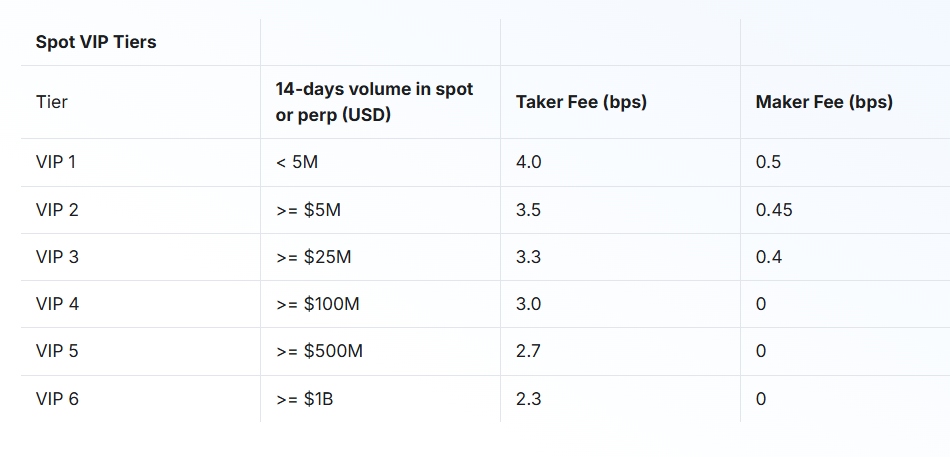
For spot, standard maker fees are 0.005% and taker fees are 0.04%. The platform utilizes a VIP program based on a rolling 14-day volume metric to further reduce these costs.
ASTER Token
The ASTER token is the native utility and governance asset of the ecosystem. It was launched in September 2025 with a total supply of 8 billion tokens.
- Distribution: Over 53% of the supply is allocated to community rewards and airdrops, while 30% is reserved for ecosystem development.
- Utility: Holding ASTER provides fee discounts, governance voting rights, and access to premium features like gated liquidity pools and enhanced margin options.
- Deflationary Pressure: The protocol utilizes a portion of platform revenue to buy back ASTER from the market.
Aster DEX Security
The primary advantage of Aster DEX over centralized counterparts is its non-custodial nature. Users retain control over their private keys at all times, interacting with the platform through wallets such as MetaMask, Phantom, or Binance Wallet.
Trade execution, collateral management, and liquidations are handled entirely by audited smart contracts. This removes the risk of fund misappropriation by the exchange and ensures that users can withdraw their assets at any time without requiring centralized authorization. The integration of zero-knowledge technology further enhances on-chain privacy for sensitive data like liquidation points.
It is important to note that because Aster is a decentralized service, it does not offer traditional security features like withdrawal whitelisting or two-factor authentication. Security is entirely dependent on the user's self-custody wallet. If a user's wallet is compromised, the platform cannot recover the funds.
Aster DEX User Experience and Accessibility
Aster DEX has been developed with a focus on streamlining the transition from centralized to decentralized environments. The platform provides a sophisticated dashboard with customizable TradingView charts, technical indicators, and drawing tools. Diverse pricing timeframes range from one minute to one month. The transition between Simple and Pro modes is seamless, allowing users to choose the level of complexity that fits their needs. While a native Android application is available, the iOS version currently operates through a testing environment.
The onboarding experience is notably efficient. Users can connect via a traditional Web3 wallet or utilize an email-based login system that generates a blockchain trading address. Through a partnership with Alchemy Pay, users can also purchase ASTER tokens using fiat methods like debit cards and bank transfers. However, as a no-KYC (Know Your Customer) platform, the exchange itself does not collect personal information or identification documents for direct trading.
Final Takeaway
Aster DEX effectively bridges the gap between the high-performance execution of centralized exchanges and the transparent, non-custodial nature of decentralized protocols. By solving the dual challenges of MEV vulnerability and capital inefficiency through its ZK-infrastructure and yield-bearing collateral, the platform has established a defensible niche in a highly competitive sector. While the project will continue to face the challenges of decentralized governance and the volatility inherent in high-leverage markets, its current framework provides a solid foundation for institutional and retail adoption.
Frequently Asked Questions (FAQs)
What is the primary difference between Aster Pro and 1001x mode?
Aster Pro utilizes a professional order book for precise trading, while 1001x (Simple Mode) offers one-click execution against a liquidity pool with extreme leverage.
How does Aster DEX protect traders from front-running and MEV attacks?
The platform employs zero-knowledge proofs and a "Hidden Order" feature that masks trade details from the public order book until the moment of execution.
Can I trade traditional assets like stocks on Aster DEX?
Yes, Aster Pro supports 24/7 trading of tokenized stock perpetuals for major U.S. companies like Apple, Tesla, and Nvidia, all settled in USDT.
What are the native utility and governance functions of the ASTER token?
The ASTER token is used to vote on protocol upgrades, reduce trading fees, and unlock exclusive rewards within the platform's ecosystem.
How does the USDF stablecoin generate yield for its holders?
USDF generates passive income through delta-neutral trading strategies and funding fee arbitrage, distributing weekly profits to stakers.
Does Aster DEX require any identity verification or KYC to start trading?
As a decentralized and non-custodial platform, Aster DEX does not collect personal information or require KYC documents from its users.
Which blockchains are currently supported for trading on Aster?
Aster provides unified multi-chain liquidity across the BNB Chain, Ethereum, Solana, and Arbitrum networks without the need for manual bridging.
What is yield-bearing collateral, and how does it benefit traders?
Traders can use assets like BNB to back their positions, allowing them to earn staking rewards while simultaneously using that capital for active trading.
Are my funds safe on Aster DEX compared to a centralized exchange?
Aster is non-custodial, meaning you retain full control of your private keys; however, you are solely responsible for your own wallet security.
What are the trading fees for perpetual contracts on Aster Pro?
Standard fees on Aster Pro are highly competitive, charging makers 0.01% and takers 0.035%, with further discounts available for high-volume VIP tiers.
Disclaimer: All content on The Moon Show is for informational and educational purposes only. The opinions expressed do not constitute financial advice or recommendations to buy, sell, or trade cryptocurrencies. Trading involves significant risk and may result in substantial losses. Always seek independent financial advice before making investment decisions. The Moon Show is not responsible for any financial losses or decisions made based on the information provided.
Please view the full disclaimer at: https://themoonshow.com/disclaimer

BloFin Exchange Review – Key Features, Fees and Security
Choosing a cryptocurrency exchange is not easy. Traders look for the right mix of features, low...
Bybit Review 2026 – Best Derivatives Trading Platform?
Bybit remains one of the world’s leading crypto exchanges in 2026 with over 84 million users an...
WEEX Exchange Review 2026: High Leverage, No KYC, But Is It Worth the Trade-Offs?
Choosing a cryptocurrency exchange is never a simple decision. You need a platform packed with ...