
Bitcoin Falls to $75K as Fed Splits 8-4 and Oil Peaks at $126 on Iran War Fears
BTC is caught between the Fed's most divided rate decision in 30 years and a fresh escalation in the Iran conflict. The FOMC voted 8-4 to hold rates at 3.5%-3.75% on April 29, the largest number of dissents since October 1992, and BTC dropped from $76,200 to a low of $74,937. Then on Thursday, Brent crude hit a wartime high of $126 after reports that CENTCOM is briefing Trump on military options including hypersonic missiles. The $75,000 support level is the line between a temporary dip and a deeper move toward $70,000.
Key Takeaways
- The FOMC voted 8-4 to hold rates at 3.5%-3.75%, the most divided decision since October 1992.
- BTC dropped from $76,200 to $74,937 after Fed’s decision, then recovered slightly.
- Spot BTC ETFs posted $137.77 million in net outflows on April 29, snapping a 9-day inflow streak.
- Brent crude hit a wartime high of $126 a barrel on Thursday after Axios reported CENTCOM is briefing Trump on military options against Iran.
- This was Powell's final press conference as Fed chair. His term ends May 15. Kevin Warsh, the incoming chair, cleared the Senate Banking Committee vote and heads to a full Senate confirmation.
The Fed's Most Divided Decision in 30 Years
The FOMC voted 8-4 on April 29 to keep rates at 3.5%-3.75%, and the four dissenters were not even on the same page. Stephen Miran voted for an immediate quarter-point cut. Beth Hammack, Neel Kashkari, and Lorie Logan voted to hold but wanted the committee to strip out any language that could be read as signaling future easing. That kind of split has not happened since October 1992.
The committee flagged elevated inflation tied to global energy prices and warned that Middle East developments are adding 'a high level of uncertainty' to the outlook. Markets responded by pricing out rate cut expectations for 2026 entirely. And with Powell stepping down on May 15 and Kevin Warsh, known for hawkish inflation views, clearing the Senate Banking Committee this week, the path to easier policy just got longer.
Then Oil Hit $126
As if the Fed was not enough, Brent crude surged over 7% on Thursday to a wartime high of $126 a barrel, the highest intraday level since 2022. Axios reported that US Central Command is set to brief Trump on new military options against Iran, including the potential deployment of hypersonic missiles, which would be a first for the US military.
Trump had already rejected Iran's proposal to reopen the Strait of Hormuz, insisting any deal must address the nuclear program. The Strait has been shut since the war began in late February, pushing oil up roughly 60% since the conflict started.
For Bitcoin, surging oil feeds directly into inflation expectations, lifts Treasury yields, and reinforces the macro backdrop that keeps the Fed locked in place. Oil goes up, inflation expectations rise, the Fed cannot cut, and risk assets stay under pressure.
BTC had already pulled back from Monday's $79,500 high before the Fed decision, and the Thursday oil spike has made holding above $75,000 meaningfully harder.
The Chart: $75,000 Support Under Pressure
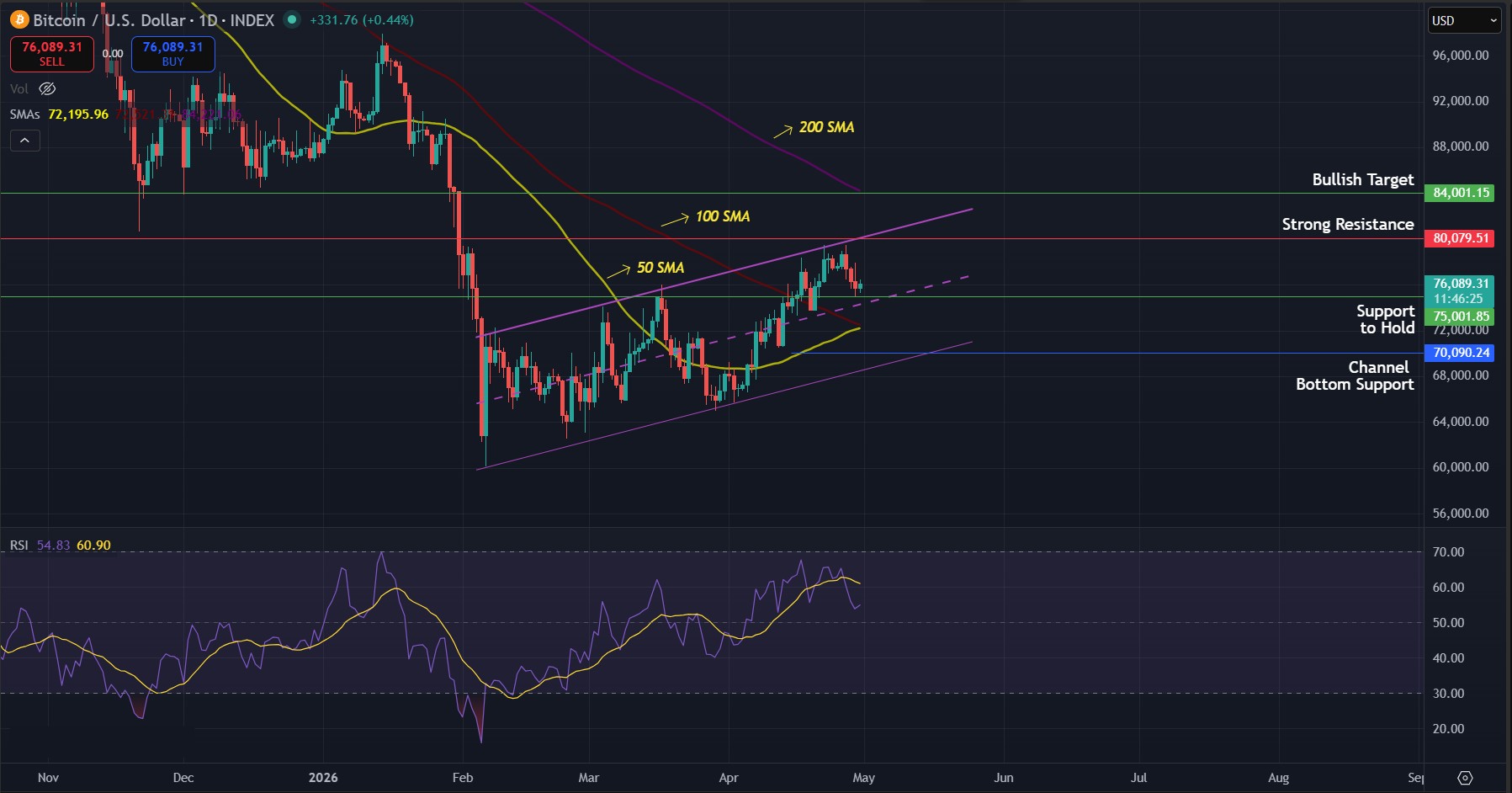
BTC/USD daily chart showing the pullback from $79,500 and the test of $75,000 support. Chart via TradingView.
BTC is trading within an ascending channel dating back to early February, and this pullback is testing the lower half. The $75,000 level lines up with the 50-day SMA and has been the support buyers have defended on each dip since mid-April. Below that, $70,000 is where the lower channel band meets the multi-month falling trendline from the October $126,000 high, a strong confluence zone. If $70,000 breaks, $65,000, the March low, comes into play.
On the upside, $80,000 is still the wall after multiple failed attempts this month. The 50-day SMA is on the verge of crossing above the 100-day SMA, which would normally be a bullish crossover, but that signal means very little if the macro keeps pushing price lower. RSI sits slightly above 50, neutral but with momentum clearly fading.
What to Expect Next
- Bullish: BTC holds $75,000 and the 48-hour post-FOMC selling window (April 30 to May 1) produces stable ETF flows. A de-escalation signal from Iran or an oil pullback below $110 would be the strongest catalyst for a bounce back toward $77,000.
- Bearish: BTC loses $75,000 and oil stays above $120. Next support is $70,000 at the channel floor. Below that, $65,000, the March low.
- Key catalyst: Watch the next 48 hours. Bitcoin has dropped after 9 of the last 10 FOMC meetings, and the low typically forms about 48 hours after the decision, not at the announcement itself.
- Invalidation: A daily close below $70,000 breaks the ascending channel and the entire April recovery structure.
BTC is caught between two forces and is in a critical spot. The Fed is more divided than it has been in three decades, with the incoming chair likely to be even more hawkish. And the Iran situation just escalated from stalled talks to the US military preparing hypersonic missile options. Institutional demand is still there, Strategy is still buying and April ETF inflows have been strong, but the macro headwinds are now strong enough to cap every rally before it can break $80,000. The 48-hour post-FOMC window through May 1 is the real test at the moment. If BTC holds $75,000 and ETF flows stabilize, the floor is intact. If not, $70,000 is where the next real fight happens.
Join WEEX and unlock 40 USDT back with your first deposit-and-trade step. Deposit 100 USDT and start trading.
Why did BTC drop after the Fed decision?
The FOMC held rates at 3.5%-3.75% with a 8-4 vote, the most divided since 1992. The dissent pattern, with three members opposing any easing bias, priced out rate cut expectations for 2026 and pushed risk assets lower. BTC has now dropped after 9 of the last 10 FOMC meetings regardless of the actual decision.
Why is oil affecting BTC right now?
Brent crude at $126 feeds directly into inflation expectations, which keeps the Fed locked into holding or tightening. That removes the monetary easing that BTC typically rallies on. The feedback loop between oil, inflation, and Fed policy is the dominant force on risk assets right now.
Who is Kevin Warsh and why does he matter?
Kevin Warsh is the incoming Fed chair, nominated by Trump and known for hawkish views on inflation. He cleared the Senate Banking Committee this week and will likely preside over the June FOMC meeting. His reputation suggests the path to rate cuts could get even longer under his leadership.
What BTC levels should I watch?
$75,000 is immediate support (50-day SMA). $70,000 is the channel floor with trendline confluence. $65,000 is the March low. On the upside, $80,000 is the resistance that has rejected BTC multiple times this month.
Disclaimer: All content on The Moon Show is for informational and educational purposes only. The opinions expressed do not constitute financial advice or recommendations to buy, sell, or trade cryptocurrencies. Trading involves significant risk and may result in substantial losses. Always seek independent financial advice before making investment decisions. The Moon Show is not responsible for any financial losses or decisions made based on the information provided.
Please view the full disclaimer at: https://themoonshow.com/disclaimer

Bitcoin and Ethereum Quarterly Returns 2026: Q1-Q3 Trends and Q4 Outlook
Quarterly returns for Bitcoin (BTC) and Ethereum (ETH) offer a simple way to measure how the tw...

LINK Breaks August High as Chainlink Expands Into Global Payments
LINK is holding above $13 on September 7 after gaining 9.9% in the previous session. The move c...

XRP ETF Inflow Streak Ends After $170M Run. Can Price Hold $1.31?
XRP is trading near $1.36 on September 3 after U.S. spot XRP ETFs recorded their first net outf...