
Bitcoin Fades to $76,200 as ETF Streak Ends, Consumer Sentiment Hits All-Time Low
US spot Bitcoin ETFs posted $263 million in net outflows on April 27, ending a nine-day inflow streak that had drawn $2.1 billion into the market since April 13. BTC, which peaked at $79,500 before failing to clear $80,000 twice in one week, is now trading at $76,200. University of Michigan consumer sentiment printed an all-time low of 49.8 in April, with one-year inflation expectations jumping to 4.7% from 3.8% the prior month. The Fed is expected to hold rates at 3.5% to 3.75% at Wednesday's FOMC decision, and that event is now the only remaining catalyst that could push BTC back toward $80,000 this week.
Key Takeaways
- US spot Bitcoin ETFs posted $263 million in outflows on April 27. Fidelity's FBTC led with $150 million, BlackRock's IBIT went flat after a multi-day inflow run.
- BTC failed to hold above $77,000 on Monday and has pulled back to $76,200. This is the second rejection at $79,000 to $80,000 in eight sessions.
- University of Michigan consumer sentiment hit a final reading of 49.8 in April, an all-time low. One-year inflation expectations rose to 4.7% from 3.8% the prior month. Long-term expectations hit 3.5%, the highest reading since October 2025.
- The FOMC decision on April 29 is the key event this week
Start trading on WEEX with a 100 USDT deposit and unlock 40 USDT back after completing your first trading step.
The ETF Streak Ends at Nine Days
Spot Bitcoin ETFs recorded $263 million in net outflows on April 27, according to SoSoValue and Farside data. It was the first negative session since mid-April and ended a streak that had brought $2.1 billion into the market as BTC rallied roughly 10% off its late-March lows.
Fidelity's FBTC accounted for the bulk of the move, posting $150 million in outflows. GBTC followed at $46.6 million and ARKB at $43.3 million. BlackRock's IBIT and Morgan Stanley's MSBT both went flat after their own multi-day inflow runs. Ether ETFs also posted $50.5 million in outflows on the same day.
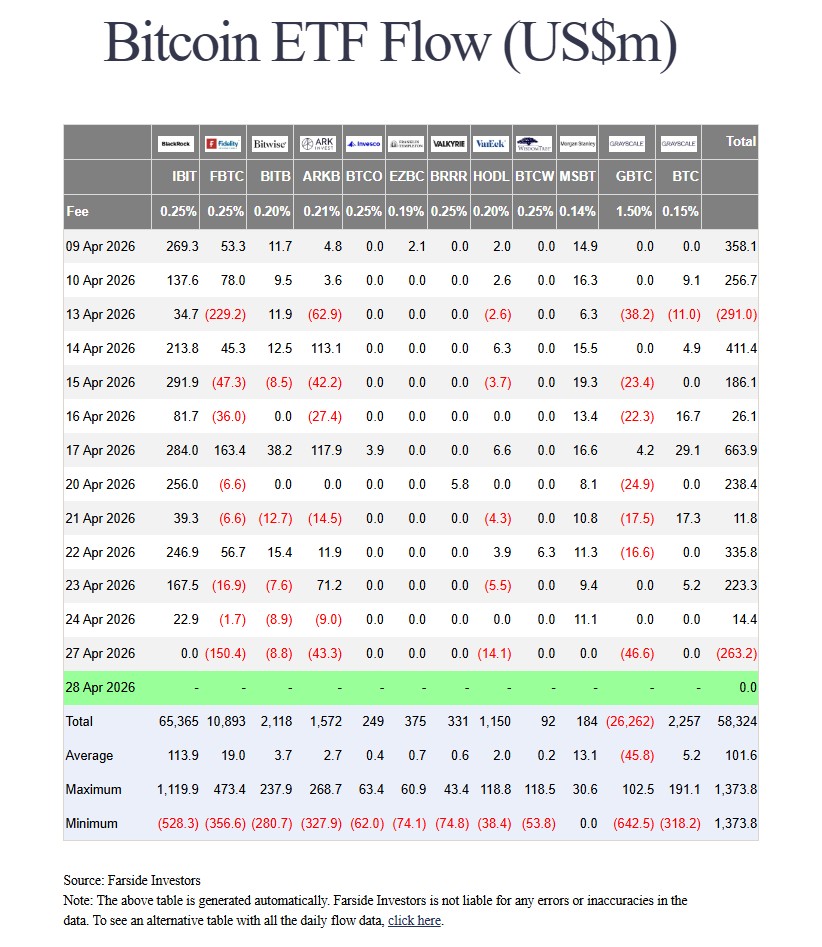
Daily spot Bitcoin ETF inflows by issuer. Source: Farside
The macro backdrop is what makes this harder to read as routine profit-taking. The University of Michigan's final April consumer sentiment reading came in at 49.8, an all-time low. One-year inflation expectations rose to 4.7% from 3.8% in a single month. Long-term expectations hit 3.5%, the highest since October 2025. Analysts at Bitfinex noted that a one-month shift of that size raises the bar for any near-term rate cut, since the Fed monitors long-term expectations closely when assessing whether inflation psychology is shifting. The Crypto Fear and Greed Index, which briefly touched Neutral (47) during Monday's high, flipped back to Fear on Tuesday.
BTC Stalls Below $80,000 Prior to FOMC Decision
In our April 27 analysis, we flagged $79,000 to $80,000 as the breakeven zone for buyers who entered during the February correction, and that level is still generating consistent selling pressure. BTC has now been rejected there twice in eight sessions, most recently during Asian hours on Monday before sliding back to $76,200. MACD also shows price struggling to flip short-term momentum.
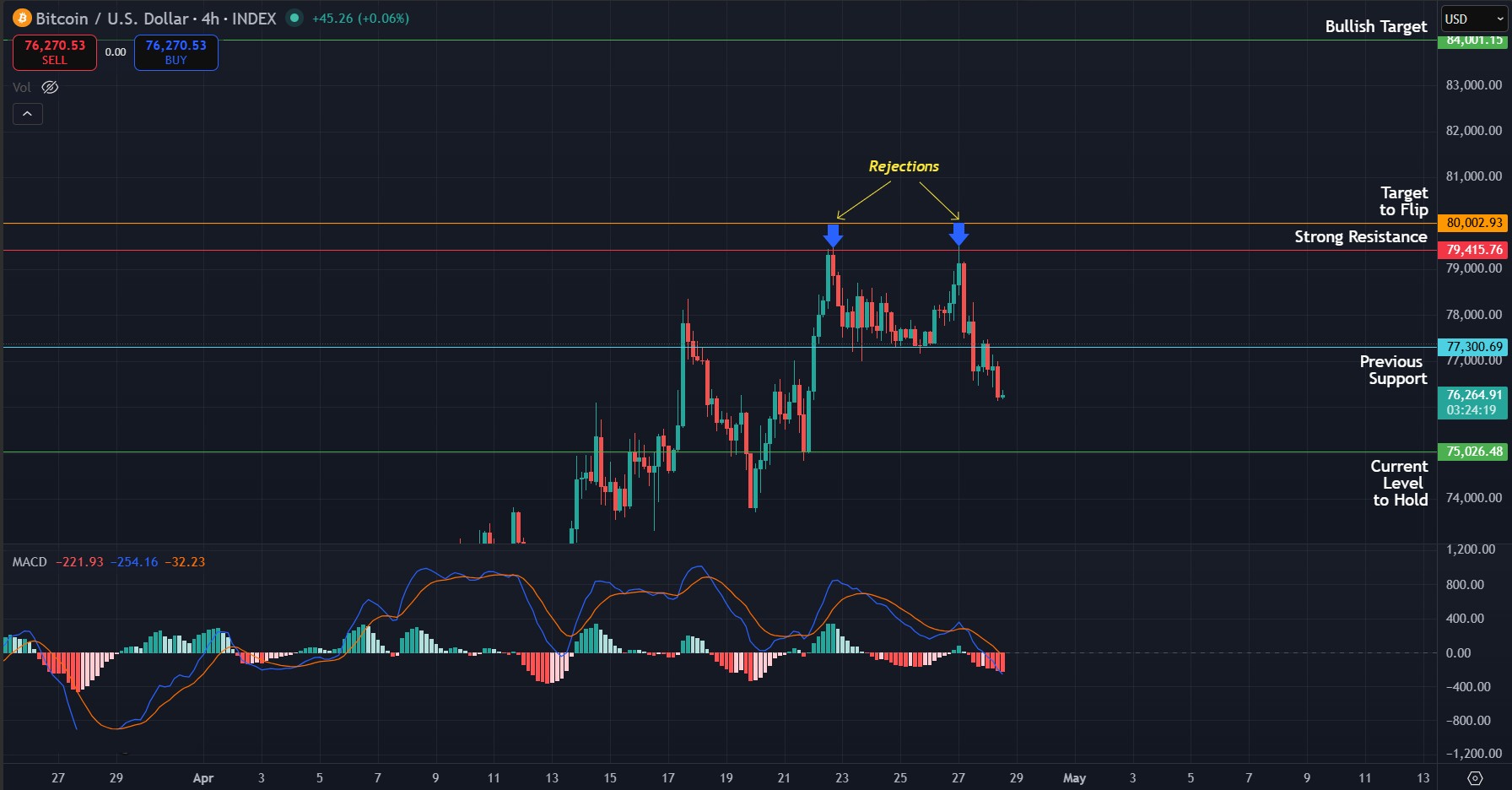
BTC/USD 4H chart showing the second rejection at $79,000 in eight sessions. Chart via TradingView.
On the derivatives side, Open Interest peaked near $32 billion as BTC pushed toward $78,000, then flushed to $21 billion as price slipped below $77,000, triggering over $100 million in long liquidations in the process. OI has since recovered to roughly $25 billion, showing that leveraged traders are re-entering ahead of the Fed. That pattern leaves BTC exposed to another flush if Wednesday's statement disappoints.
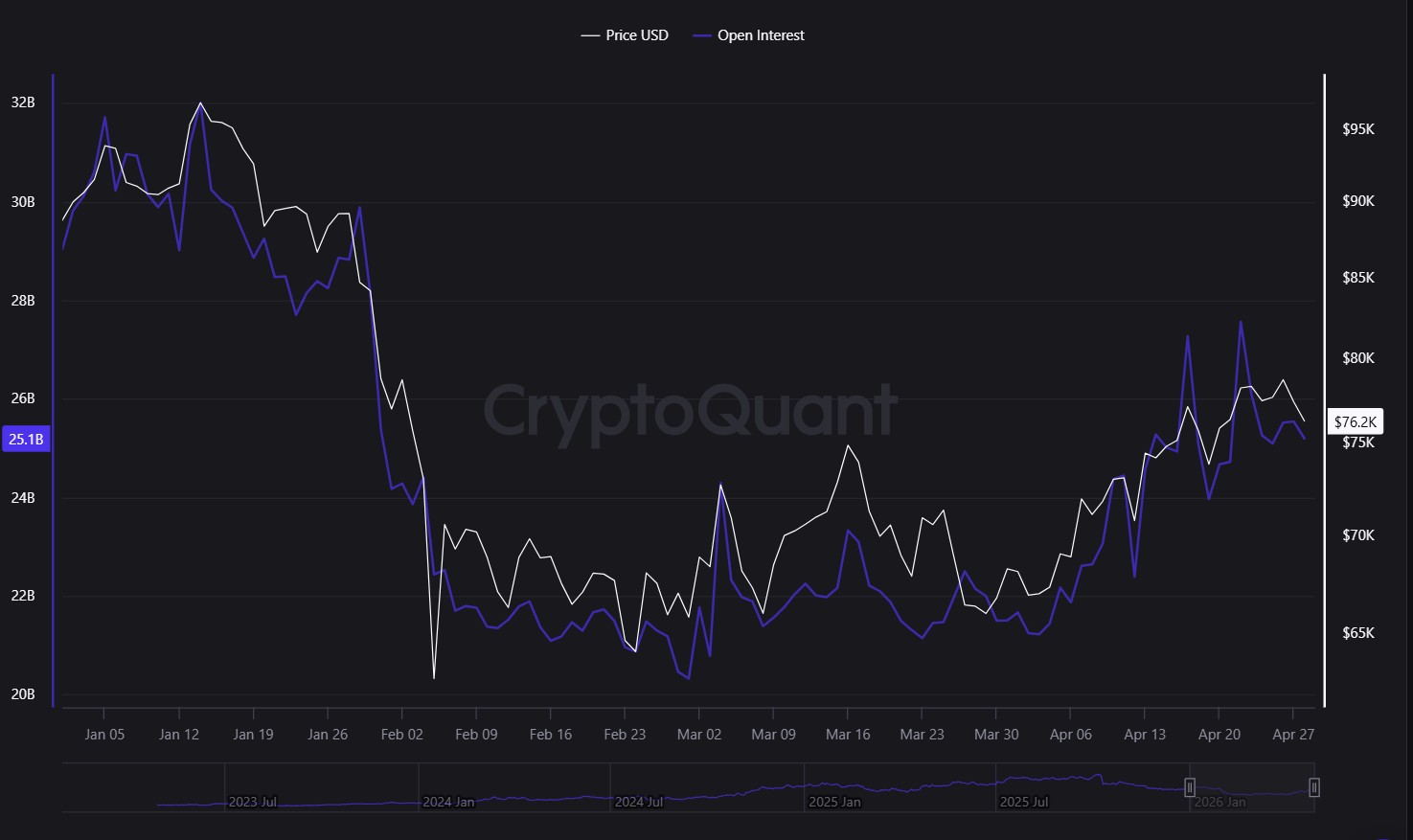
Bitcoin Open Interest across exchanges in 2026. Source: CryptoQuant
The Coinbase Premium index has flipped negative, signaling weakening demand from US buyers. Nasdaq 100 futures are 0.5% lower as of Tuesday morning and the DXY is up 0.25%. The macro setup is not helping at these levels.
What to Expect Next
- Bullish: FOMC delivers a dovish hold with language hinting at cuts ahead. Combined with renewed institutional buying, BTC clears $80,000 on the daily close and opens the path to $84,000.
- Bearish: Fed holds with hawkish language citing elevated inflation expectations. Coinbase Premium stays negative, ETF outflows continue, and BTC loses $75,000. Next support at $72,000 to $73,000.
- Key catalyst: FOMC statement and Powell press conference on April 29.
- Invalidation: A daily close below $73,000 signals the April recovery has reversed.
The nine-day streak and the $79,500 high gave bulls a real window. But $80,000 has now held as a ceiling twice, the macro data has turned outright negative, and the FOMC is going into the decision with the least room to be dovish it has had all year. Whether that changes on Wednesday is the only question that matters this week.
Join WEEX and unlock 40 USDT back with your first deposit-and-trade step. Deposit 100 USDT and start trading.
Why did Bitcoin ETFs post outflows on April 27?
Spot ETFs posted $263 million in net outflows after BTC failed to break above $80,000 for the second time in a week. Fidelity's FBTC led with $150 million, followed by GBTC and ARKB. The outflows snapped a nine-day inflow streak totalling $2.1 billion.
Why can't BTC break $80,000?
The $80,000 zone is the breakeven cost basis for a large cluster of buyers who entered during the February to March correction. Each time price approaches, those holders sell to exit flat or at a small profit, creating consistent resistance. A catalyst large enough to absorb that selling, like a dovish FOMC surprise or a major new institutional buy, is what it takes to clear it.
What is the consumer sentiment data telling us?
The University of Michigan final reading of 49.8 is an all-time low, and the jump in one-year inflation expectations from 3.8% to 4.7% in a single month is exactly the kind of data the Fed watches when deciding whether to cut. A move that large makes a near-term pivot much harder to justify publicly, which keeps the ceiling on risk assets including BTC.
What levels should I watch?
$79,000 to $80,000 is the key resistance band. $75,000 is the immediate support that has held throughout April. $72,000 to $73,000 is the next support area below. A daily close above $80,000 opens the rally. A close below $73,000 signals the recovery has failed.
Disclaimer: All content on The Moon Show is for informational and educational purposes only. The opinions expressed do not constitute financial advice or recommendations to buy, sell, or trade cryptocurrencies. Trading involves significant risk and may result in substantial losses. Always seek independent financial advice before making investment decisions. The Moon Show is not responsible for any financial losses or decisions made based on the information provided.
Please view the full disclaimer at: https://themoonshow.com/disclaimer

Bitcoin and Ethereum Quarterly Returns 2026: Q1-Q3 Trends and Q4 Outlook
Quarterly returns for Bitcoin (BTC) and Ethereum (ETH) offer a simple way to measure how the tw...

LINK Breaks August High as Chainlink Expands Into Global Payments
LINK is holding above $13 on September 7 after gaining 9.9% in the previous session. The move c...

XRP ETF Inflow Streak Ends After $170M Run. Can Price Hold $1.31?
XRP is trading near $1.36 on September 3 after U.S. spot XRP ETFs recorded their first net outf...