Proof of Work vs Proof of Stake: The Comprehensive Guide to Blockchain Consensus
Key Takeaways:
- Proof of Work and Proof of Stake serve the same purpose but operate differently. Both consensus mechanisms validate transactions and secure blockchain networks, but PoW relies on computational power while PoS relies on staked cryptocurrency.
- Proof of Work offers a proven security model. Used by Bitcoin for over a decade, PoW secures networks through mining and significant computational effort, making attacks extremely costly and difficult.
- Proof of Stake is significantly more energy-efficient. Unlike PoW, which requires energy-intensive mining operations, PoS validates transactions through staking, reducing electricity consumption and environmental impact.
- Both mechanisms use economic incentives to maintain network security. PoW miners invest in hardware and electricity, while PoS validators lock up cryptocurrency and risk losing their stake if they act maliciously.
- Each mechanism faces centralization challenges. PoW can become concentrated among large mining pools, while PoS may favor validators with substantial token holdings.
- The crypto industry is increasingly adopting Proof of Stake. Many modern blockchain projects choose PoS for its sustainability, scalability, and lower operational costs, while Bitcoin continues to rely on PoW.
- There is no universally superior consensus mechanism. The choice between PoW and PoS depends on a blockchain's priorities, such as security, decentralization, scalability, and energy efficiency.
Cryptocurrencies rely on blockchain technology to maintain secure, decentralized networks without requiring a central authority. However, for a blockchain to function properly, it needs a way for participants to agree on which transactions are valid. This process is known as consensus. Among many consensus mechanisms developed over the years, Proof of Work (PoW) and Proof of Stake (PoS) have emerged as the two most influential systems in the crypto industry.
While both serve the same purpose of validating transactions and securing blockchain networks, they operate in fundamentally different ways. In this blog, we will discuss proof of work vs proof of stake, how they work, and their advantages and disadvantages.
Let’s begin!
What is Consensus Mechanism?
A consensus mechanism is a protocol that enables participants in a decentralized network to agree on the state of the blockchain. It ensures that transactions are verified accurately, prevents double-spending, and maintains network security. Without consensus mechanisms, blockchain networks would be vulnerable to fraud, manipulation, and conflicting transaction records.
The two most widely adopted consensus mechanisms are:
Each approach offers unique benefits and trade-offs.
What Is Proof of Work (PoW)?
Proof of Work is the original blockchain consensus mechanism introduced by Bitcoin in 2009. Under PoW, miners compete to solve complex mathematical puzzles using computational power. The first miner to solve the puzzle earns the right to add a new block of transactions to the blockchain and receives a reward in the form of newly minted cryptocurrency and transaction fees.
How Proof of Work Works?
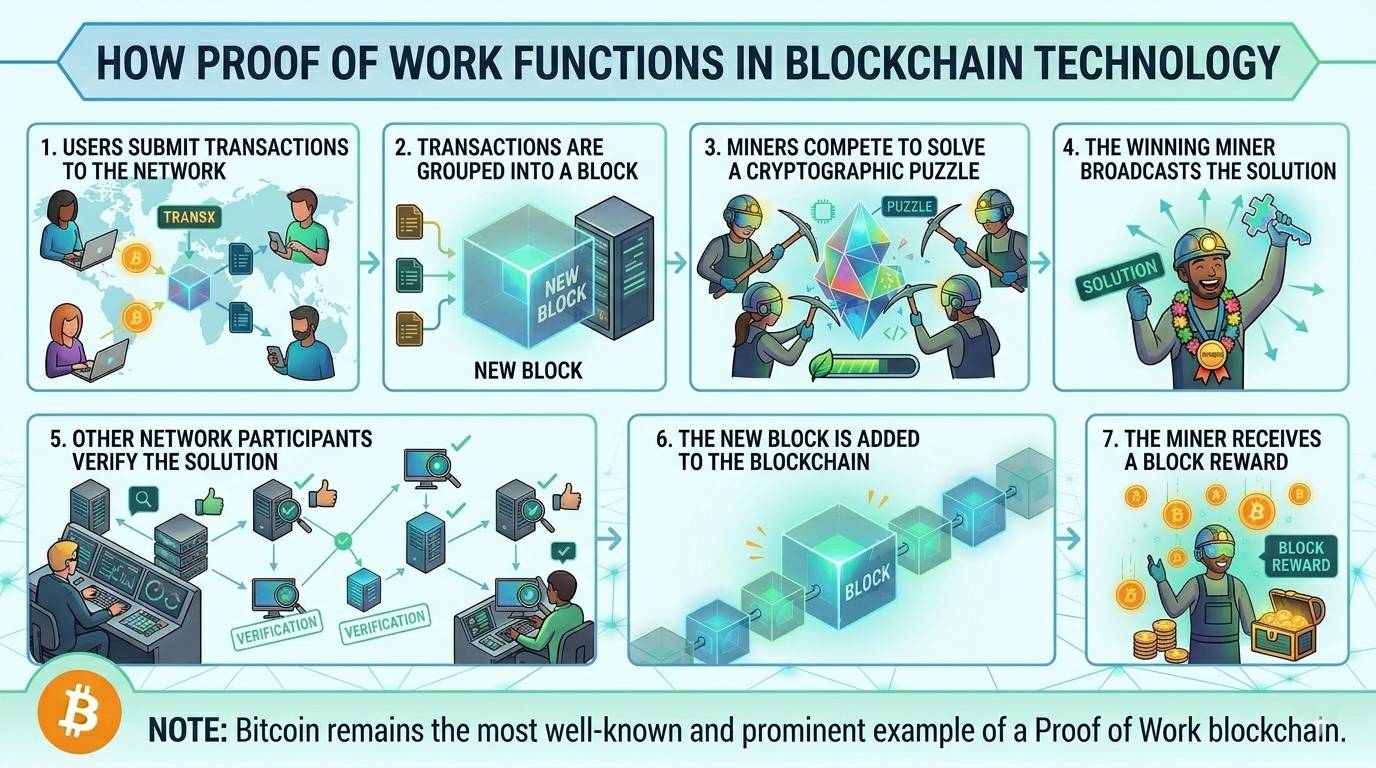
The process generally follows these steps:
- Users submit transactions to the network.
- Transactions are grouped into a block.
- Miners compete to solve a cryptographic puzzle.
- The winning miner broadcasts the solution.
- Other network participants verify the solution.
- The new block is added to the blockchain.
- The miner receives a block reward.
Bitcoin remains the most prominent example of a Proof of Work blockchain.
Advantages of Proof of Work
Proof of Work has several strengths:
- Proven security through years of real-world operation.
- High resistance to attacks due to substantial computational requirements.
- Strong decentralization when mining participation is widespread.
- Transparent and straightforward validation process.
Disadvantages of Proof of Work
Despite its security, PoW has notable drawbacks:
- High energy consumption.
- Expensive mining equipment requirements.
- Slower transaction processing compared to some alternatives.
- Potential mining centralization through large mining pools.
Environmental concerns surrounding energy-intensive mining operations have also led to increased scrutiny from regulators and sustainability advocates.
What Is Proof of Stake (PoS)?
Proof of Stake was developed as an alternative to Proof of Work, aiming to improve scalability and reduce energy consumption. Instead of relying on computational power, PoS selects validators based on the amount of cryptocurrency they lock, or "stake," within the network. Validators are chosen to verify transactions and create new blocks. In return, they earn rewards similar to mining rewards in PoW systems.
How Proof of Stake Works
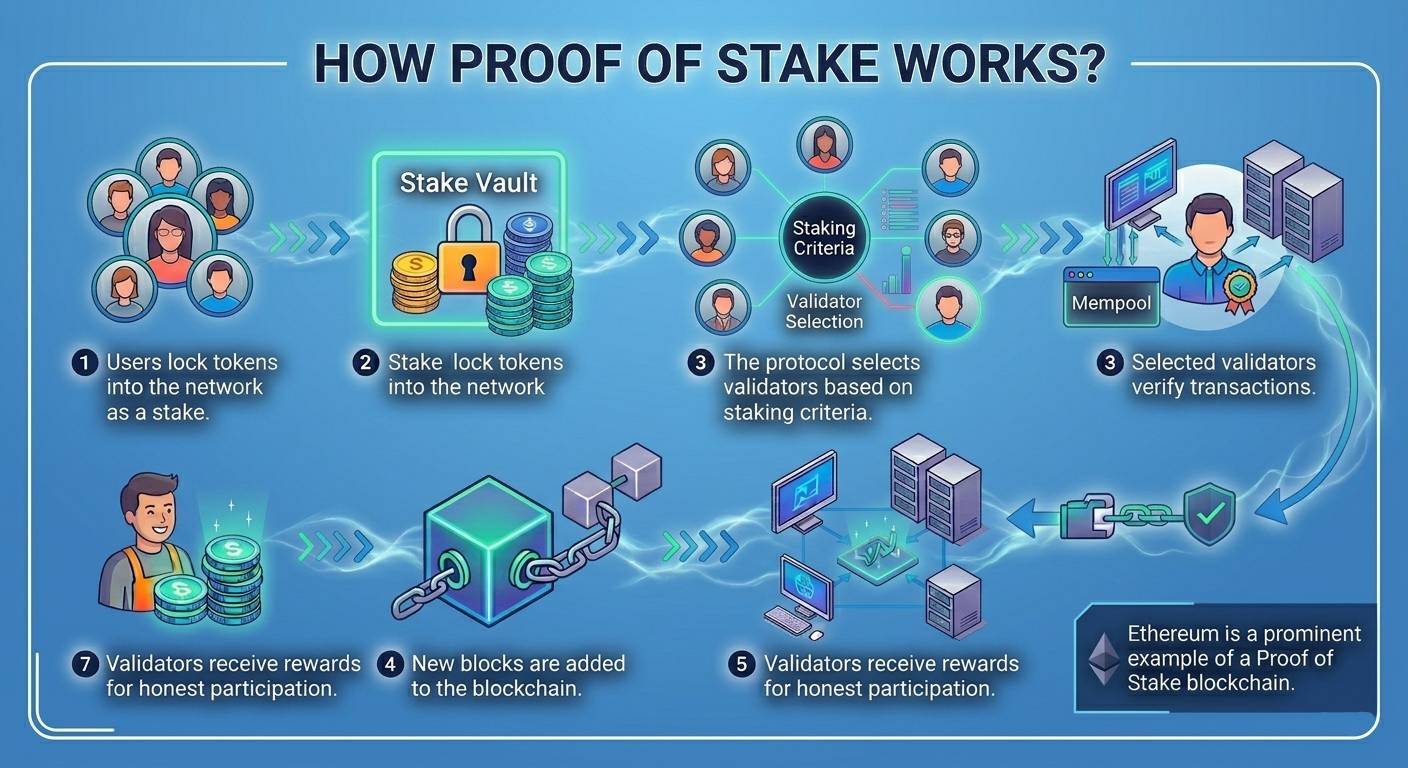
A typical Proof of Stake process includes:
- Users lock tokens into the network as a stake.
- The protocol selects validators based on staking criteria.
- Selected validators verify transactions.
- New blocks are added to the blockchain.
- Validators receive rewards for honest participation.
If validators attempt to cheat the system, a portion of their staked assets may be confiscated through a process known as slashing. Ethereum transitioned from Proof of Work to Proof of Stake in 2022 through an upgrade known as The Merge, becoming one of the largest PoS networks in the world.
Advantages of Proof of Stake
Proof of Stake offers several benefits:
- Significantly lower energy consumption.
- Faster transaction validation.
- Reduced hardware requirements.
- Improved scalability potential.
- Lower barriers to network participation.
These advantages have made PoS increasingly popular among newer blockchain projects.
Disadvantages of Proof of Stake
However, PoS is not without criticism:
- Wealthier participants may gain greater influence.
- Some networks risk validator centralization.
- Less historical security testing compared to Bitcoin's PoW model.
- Staking mechanisms can be complex for new users.
Critics argue that PoS may favor large token holders, potentially creating a concentration of power within the network.
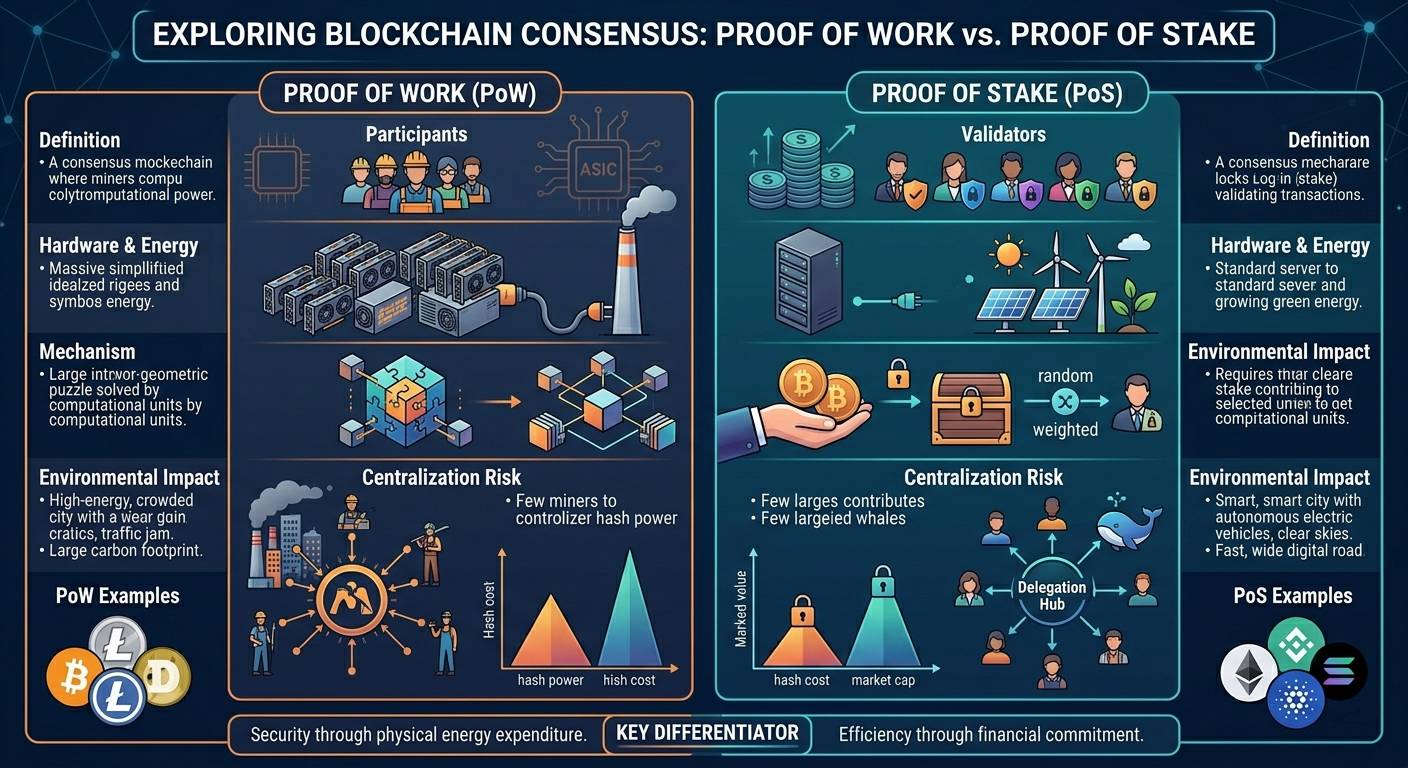
Key Differences Between Proof of Work vs Proof of Stake
Although both systems aim to secure blockchain networks, they differ significantly in their operation and resource requirements.
|
Feature |
Proof of Work (PoW) |
Proof of Stake (PoS) |
|
Definition |
A consensus mechanism where miners use computational power to solve cryptographic puzzles and validate transactions. |
A consensus mechanism where validators lock up (stake) cryptocurrency to gain the right to validate transactions and create blocks. |
|
Validation Method |
Mining through solving complex mathematical problems. |
Staking tokens and being selected as a validator based on stake size and other factors. |
|
Participants |
Miners |
Validators |
|
Resource Requirement |
High computational power and specialized hardware. |
Cryptocurrency holdings used as collateral. |
|
Energy Consumption |
Very high due to continuous mining operations. |
Extremely low compared to PoW because no intensive computations are required. |
|
Hardware Requirements |
ASIC miners, GPUs, cooling systems, and mining infrastructure. |
Standard computers or servers with internet connectivity. |
|
Barrier to Entry |
High initial investment in mining equipment and electricity costs. |
Lower entry barrier; users can participate by staking tokens. |
|
Block Creation Process |
Miners compete to solve a puzzle; the first to solve it adds the next block. |
Validators are selected by the network to propose and validate blocks. |
|
Security Mechanism |
Security is achieved through computational difficulty and energy expenditure. |
Security is achieved through financial incentives and penalties (slashing). |
|
Attack Cost |
Requires controlling over 50% of the network's computing power, which is extremely expensive. |
Requires controlling a majority of the staked tokens, making attacks financially risky. |
|
Environmental Impact |
Significant due to high electricity consumption. |
Minimal due to lower energy requirements. |
|
Transaction Speed |
Generally slower because block validation requires puzzle-solving. |
Typically faster because validation does not depend on computational competition. |
|
Scalability |
More difficult to scale due to energy and processing constraints. |
Better scalability and higher transaction throughput potential. |
|
Transaction Fees |
Often higher during periods of network congestion. |
Generally lower due to more efficient validation processes. |
|
Reward System |
Miners receive block rewards and transaction fees. |
Validators earn staking rewards and transaction fees. |
|
Punishment for Misbehavior |
Miners lose electricity and hardware investments if attacks fail. |
Validators can lose a portion or all of their staked assets through slashing. |
|
Decentralization |
Can become centralized through large mining pools controlling significant hash power. |
Can become centralized if large token holders accumulate substantial staking power. |
|
Economic Incentive |
Invest in hardware and energy to earn rewards. |
Lock tokens in the network to earn rewards. |
|
Network Participation |
Requires technical expertise and mining infrastructure. |
More accessible through staking services and staking pools. |
|
Examples of Cryptocurrencies |
Bitcoin, Litecoin, Dogecoin |
Ethereum, Cardano, Solana |
|
Network Maturity |
Battle-tested with over a decade of proven security. |
Relatively newer but increasingly adopted by modern blockchain networks. |
|
Economic Risk |
Risk tied to hardware depreciation and electricity costs. |
Risk tied to token price volatility and slashing penalties. |
|
Governance Influence |
Miners influence network security through hash power. |
Validators influence network security through staked assets. |
|
Sustainability |
Often criticized for environmental concerns. |
Widely viewed as a more sustainable blockchain model. |
|
Best Suited For |
Networks prioritizing maximum security and censorship resistance. |
Networks prioritizing scalability, efficiency, and sustainability. |
Resource Requirements
Proof of Work relies on computing power and electricity. Miners invest in specialized hardware and consume substantial energy to compete for rewards. Proof of Stake relies on financial commitment rather than computational effort. Validators lock tokens instead of purchasing expensive mining equipment.
Energy Efficiency
One of the most significant differences between the two systems is energy usage. Proof of Work networks consume large amounts of electricity due to continuous mining activity. Proof of Stake networks require far less energy because validators do not perform intensive computational tasks. As a result, PoS is often viewed as the more environmentally sustainable option.
Security Models
Proof of Work secures networks through economic costs associated with mining hardware and electricity consumption. Attacking the network would require enormous computational resources. Proof of Stake secures networks through financial incentives. Validators risk losing their staked assets if they act dishonestly. Both approaches create strong economic deterrents against malicious behavior, but they achieve security through different mechanisms.
Scalability
Proof of Stake generally offers greater scalability potential. Since PoS does not require miners to solve complex puzzles, transactions can often be processed more efficiently. This allows many PoS networks to support higher throughput and lower transaction fees. Proof of Work networks may experience congestion during periods of heavy demand, leading to slower processing times and higher fees.
Which Consensus Mechanism Is Better?
There is no universal answer to this question. The ideal consensus mechanism depends on a blockchain's goals and priorities.
Proof of Work may be preferable when:
- Maximum security is the primary objective.
- A network values long-term stability and proven reliability.
- Decentralization through mining participation is prioritized.
Proof of Stake may be preferable when:
- Energy efficiency is important.
- Faster transaction processing is needed.
- Scalability is a major consideration.
- Lower operational costs are desired.
Many blockchain developers continue to explore hybrid approaches that combine elements of both systems to achieve the best balance between security, decentralization, and efficiency.
The Future of Blockchain Consensus
As blockchain adoption expands, consensus mechanisms will continue to evolve. While Bitcoin remains firmly committed to Proof of Work, many newer networks are embracing Proof of Stake due to its sustainability and scalability advantages.
The debate between PoW and PoS reflects broader discussions within the crypto industry about security, decentralization, environmental impact, and long-term network growth. Both mechanisms have demonstrated their ability to support successful blockchain ecosystems, and each is likely to remain an important part of the cryptocurrency landscape for years to come.
Final Takeaways
Proof of Work and Proof of Stake represent two distinct approaches to achieving consensus in decentralized networks. Proof of Work prioritizes security through computational effort, while Proof of Stake emphasizes efficiency through economic incentives.
Understanding the differences between these mechanisms is essential for anyone interested in blockchain technology, cryptocurrency investing, or the future of decentralized finance. As the industry matures, both PoW and PoS will continue shaping how blockchain networks operate, innovate, and scale across the global digital economy.
Your $30,000 bonus + 10% discount are waiting on Bybit! Sign up and claim these rewards before they're gone. Time's ticking!
Disclaimer: All content on The Moon Show is for informational and educational purposes only. The opinions expressed do not constitute financial advice or recommendations to buy, sell, or trade cryptocurrencies. Trading involves significant risk and may result in substantial losses. Always seek independent financial advice before making investment decisions. The Moon Show is not responsible for any financial losses or decisions made based on the information provided.
Please view the full disclaimer at: https://themoonshow.com/disclaimer

What is a Bull Flag in Crypto Trading?
Traders use a bull flag pattern to assess whether a sharp rally might continue after a brief co...

Cup and Handle Pattern: Crypto Trading Rules, Targets, and Risks
The cup and handle is a bullish continuation chart pattern that signals a potential upward pric...

How Does Bitcoin Work? Blockchain, Mining, and Wallets Explained
Bitcoin is the world’s first decentralized digital currency that lets people send money directl...