
What Is a Pegged Currency? How Stablecoins Maintain a Stable Price
A pegged currency is one whose value is fixed to another asset, such as the US dollar, gold, or a basket of reserves. In crypto, pegging is the mechanism that keeps stablecoins like USDT and USDC locked at $1. The peg is maintained through reserve backing, arbitrage incentives, or algorithmic supply adjustments depending on the stablecoin's design. As of April 2026, the total stablecoin market cap exceeds $318 billion, with USDT alone accounting for over $184 billion of that figure. When pegs hold, stablecoins function as the backbone of crypto trading and DeFi. When they break, the consequences can be devastating, as the $40 billion Terra UST collapse in 2022 demonstrated.
Who is this for: Crypto traders and DeFi users who hold or transact in stablecoins and want to understand the mechanisms that keep them stable, and the risks when those mechanisms fail.
Key Takeaways
- USDT and USDC maintain their $1 peg through fiat reserves and an arbitrage loop that corrects any price drift.
- Crypto-collateralized stablecoins like DAI use over-collateralization (at least 150%) and on-chain liquidation to hold the peg.
- Algorithmic stablecoins attempt to hold the peg through supply adjustments alone, but this method failed catastrophically with Terra UST in May 2022.
- The stablecoin market has grown past $318 billion as of April 2026, more than doubling since early 2024.
- Depegging events, whether temporary like USDC in March 2023 or permanent like UST, are the single biggest risk of holding pegged assets.
What Does Currency Pegging Mean?
A pegged currency is a currency that tracks the value of another asset, usually the US dollar, gold, or a basket of reserves. In crypto, this concept sits at the core of stablecoins. Assets like USDT and USDC aim to stay at $1, and the peg is what keeps them there.
Now, it might sound straightforward but that is rarely the case in practice.
Different stablecoins rely on different systems to maintain that price. Some hold reserves while others depend on arbitrage. A few attempt to control supply through code alone. Each approach works under normal conditions, but the differences start to matter when markets come under stress.
As of April 2026, the stablecoin market has crossed $318 billion, with USDT accounting for more than $184 billion. These assets now act as the default liquidity layer across trading and DeFi. When the peg holds, everything functions smoothly. When it breaks, the damage spreads quickly. The Terra UST collapse in 2022 made that clear within days..
How Does Pegging Work in Crypto?
In crypto, pegging works similarly but with a few key differences. Rather than a central bank managing the peg, the job falls on stablecoin issuers, smart contracts, or algorithmic protocols depending on the type of stablecoin. The goal is always the same. Keep the token's price locked to a target value, usually $1 USD, so that users can hold and transact without worrying about volatility.
The stablecoin market has more than doubled since early 2024 on the back of this concept. Tether (USDT) dominates with over $184 billion in market cap, followed by USDC from Circle at roughly $77 billion. The speed of that growth shows how central pegged assets have become to the crypto ecosystem, serving as the default medium of exchange for trading, lending, and cross-exchange transfers.
Types of Pegging Mechanisms in Crypto
There are four main methods used to maintain a crypto peg. Each comes with its own set of trade-offs in terms of trust, transparency, and risk.
Fiat-Backed Stablecoins
This is the most straightforward approach and the one used by the two biggest stablecoins. Fiat-backed stablecoins maintain their peg by holding reserves of the underlying currency. For every USDT or USDC token in circulation, the issuing company is expected to hold an equivalent amount in reserve assets, typically a mix of cash, cash equivalents, and short-term US Treasury securities.
The peg holds because of an arbitrage mechanism. If USDT drifts below $1 on the open market, arbitrageurs can buy it at a discount and redeem it with Tether for exactly $1 worth of reserves. That buying pressure pushes the price back up. If it trades above $1, the reverse happens. New tokens are minted and sold until the price settles back down. This constant arbitrage loop is what keeps fiat-backed stablecoins tight to their peg under normal conditions.
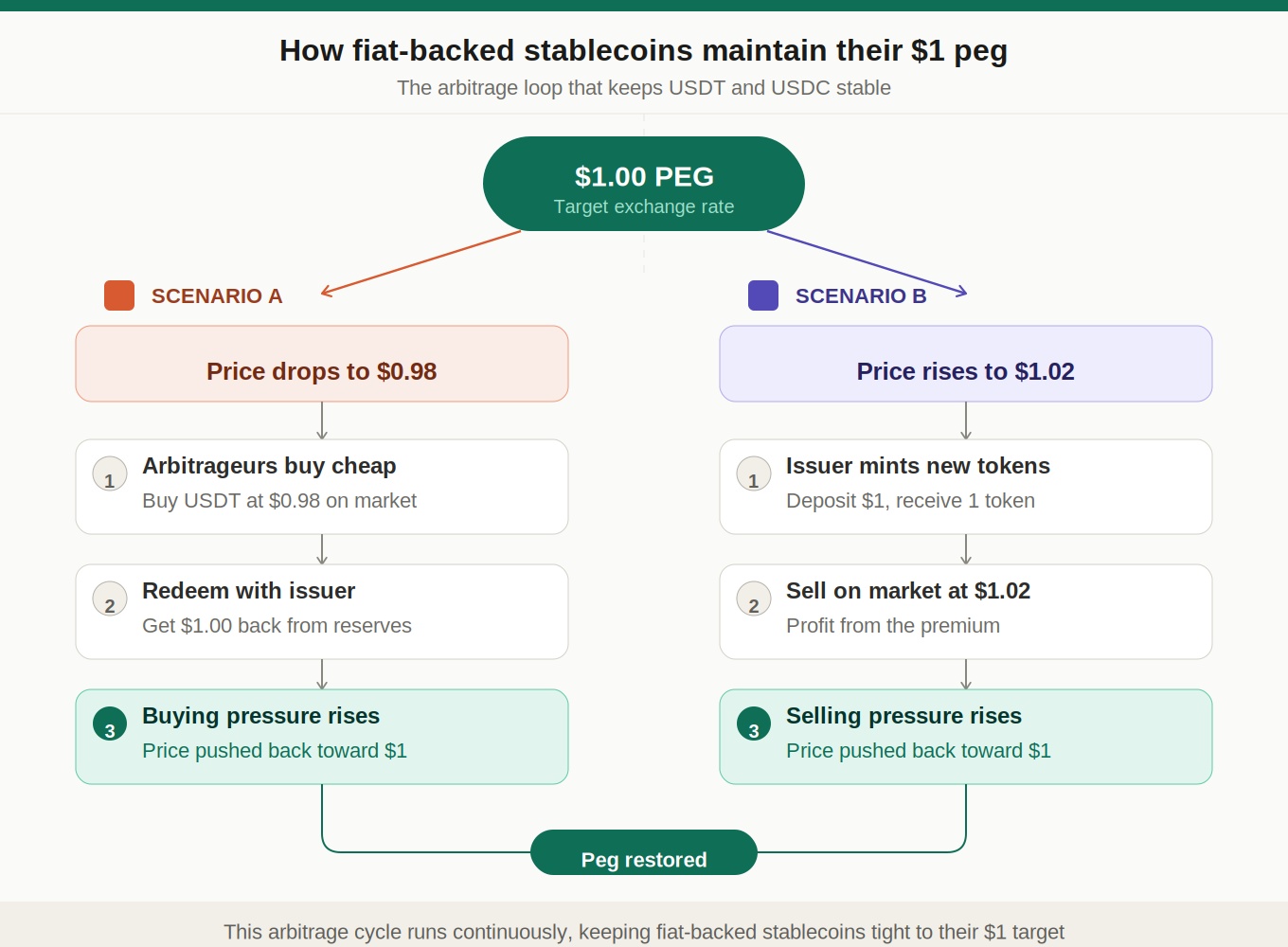
The risk with this model comes down to trust. Users have to trust that the issuer actually holds the reserves it claims to. Tether in particular has faced years of scrutiny over whether its reserves fully back every token in circulation, and while it has published attestation reports, the level of transparency has remained a point of debate in the industry.
Crypto-Collateralized Stablecoins
Instead of holding fiat in a bank account, some stablecoins are backed by other crypto assets. DAI is the most well-known example. It is pegged to the US dollar but backed by crypto collateral deposited into smart contracts on Ethereum.
Because crypto assets are volatile, this approach requires over-collateralization to absorb price swings. When a user mints DAI, they deposit collateral worth at least 150% of the stablecoin's value. If the collateral drops below a certain threshold, the system automatically liquidates it to protect the peg. This makes the whole process transparent and verifiable on-chain, which addresses the trust problem that fiat-backed stablecoins face. The trade-off is capital inefficiency, since you need to lock up significantly more value than you receive.
Algorithmic Stablecoins
Algorithmic stablecoins take a completely different approach. They do not hold reserves in the traditional sense. Instead, they use smart contracts and algorithms to expand or contract the token supply based on market demand, attempting to keep the price stable through code alone.
This method has proven to be the most fragile in practice. The most well-known failure is Terra's UST, which maintained its dollar peg through a mint-and-burn mechanism involving a companion token called LUNA. When UST drifted below $1, users could burn it and mint LUNA, creating arbitrage incentives to restore the peg. The problem was that when selling pressure overwhelmed the mechanism in May 2022, UST entered a death spiral. As the peg broke, mass redemptions flooded the market with LUNA, cratering its value and wiping out roughly $40 billion in combined market cap within days. It remains one of the most devastating collapses in crypto history.
Commodity-Backed Stablecoins
Not all pegged crypto assets are tied to fiat currencies. Some are pegged to physical commodities, with gold being the most common. PAX Gold (PAXG) is a good example, where each token represents one fine troy ounce of a London Good Delivery gold bar held in vaults by Paxos Trust Company. Tether Gold (XAUT) follows a similar model. These tokens let users gain exposure to the price of gold on-chain without physically storing the metal. The peg mechanism works much like fiat-backed stablecoins, with reserves of the underlying commodity backing each token in circulation.
What Is Depegging and When Has It Happened?
Depegging is when a stablecoin loses its intended peg and starts trading at a price meaningfully different from the target value. A stablecoin pegged to $1 that drops to $0.90 or spikes to $1.10 has depegged. Depending on the cause, it can be a temporary blip or the start of a complete collapse.
The most common causes include reserve mismatches where the issuer does not hold enough assets to back every token, market crashes that overwhelm algorithmic stabilization mechanisms, and liquidity crises where redemption demand exceeds what the issuer can process in time.
Two major real-world examples illustrate the range of outcomes. The Terra UST collapse in May 2022 fell into the algorithmic failure category, resulting in a permanent loss of roughly $40 billion. The USDC depeg in March 2023 was a different situation entirely. Circle had $3.3 billion of its reserves held at Silicon Valley Bank, which collapsed. USDC briefly dropped to around $0.87 as markets priced in uncertainty about whether those reserves were accessible. Once the bank was rescued and deposits were guaranteed, USDC quickly restored its peg. But for several days, the market was genuinely unsure whether the second-largest stablecoin would survive.
Common Mistakes When Using Pegged Crypto Assets
- Treating all stablecoins as equally safe
USDT, USDC, DAI, and algorithmic stablecoins carry very different risk profiles. A fiat-backed stablecoin from a regulated issuer with audited reserves is not the same as an algorithmic stablecoin running on untested code. Always check what backs the stablecoin you are holding.
- Holding large amounts on a single stablecoin
Even major stablecoins can depeg temporarily. Spreading holdings across two or three different stablecoins with different peg mechanisms reduces the impact if one of them has a problem.
- Ignoring the issuer's reserve transparency
If the issuer does not publish regular reserve attestations or audits, you have no way to verify that the peg is actually backed. Stablecoins with poor transparency should be treated as higher risk regardless of their market cap.
- Assuming a stablecoin peg cannot break
The Terra UST collapse proved that even a top-10 market cap stablecoin can lose its peg permanently. The USDC Silicon Valley Bank incident proved that even well-managed fiat-backed stablecoins are not immune to external shocks. The peg is a mechanism, not a guarantee.
Why Pegged Currencies Matter for Crypto Users
If you trade crypto, pegged currencies are part of your daily workflow whether you think about them or not. They are the quote currency on most trading pairs, the primary way to move value between exchanges, and the default safe haven when you want to exit a position without converting back to fiat. The entire DeFi ecosystem runs on stablecoins for lending, borrowing, and providing liquidity.
What makes them useful is the same thing that makes them risky if the peg fails. You are trusting that the $10,000 worth of USDT in your wallet will still be worth $10,000 tomorrow. For the most part, fiat-backed stablecoins from established issuers have delivered on that promise. But the history of crypto includes multiple pegs that broke, and the consequences were severe every time. Understanding how these pegs work, and what could cause them to fail, puts you in a stronger position to manage that risk.
Major Stablecoins Compared
|
Stablecoin |
Peg Target |
Mechanism |
Market Cap (Apr 2026) |
Key Risk |
|
USDT |
$1 USD |
Fiat reserves |
$184B+ |
Reserve transparency |
|
USDC |
$1 USD |
Fiat reserves (audited) |
$77B+ |
Banking partner risk |
|
DAI |
$1 USD |
Crypto over-collateral |
$5B+ |
Collateral volatility |
|
PAXG |
1 oz gold |
Physical gold reserves |
$1B+ |
Gold price volatility |
|
UST (defunct) |
$1 USD |
Algorithmic |
$0 (collapsed) |
No real backing |
Related Concepts
If you are building your understanding of stablecoins and pegged currencies, the following topics are directly connected and covered elsewhere on The Moon Show.
- How DeFi lending protocols use stablecoins as collateral and borrowing assets
- What liquidity pools are and how stablecoins provide the foundation for most trading pairs in decentralized exchanges
- How crypto exchanges handle stablecoin pairs and why USDT is the dominant quote currency
- The role of on-chain transparency in verifying reserve backing for fiat-collateralized stablecoins
Frequently Asked Questions
What does currency pegging mean?
It is the practice of fixing one currency's value to another asset so that the exchange rate between them remains stable. In crypto, this is how stablecoins maintain their target price, usually $1 USD.
How does pegging work in crypto?
Stablecoins maintain their peg through fiat reserves, crypto over-collateralization, or algorithmic supply adjustments depending on their design. The most common method is fiat reserve backing with an arbitrage loop that corrects any drift from the target price.
What is a pegged price?
A pegged price is a fixed target value that a currency or stablecoin is designed to maintain. For example, USDT is pegged to $1 USD, meaning its mechanisms are built to keep it trading at or very close to that value at all times.
What is the difference between a hard peg and a soft peg?
A hard peg allows no deviation from the target price and is maintained by strict reserve requirements. A soft peg permits minor fluctuations within an acceptable range, similar to how the Hong Kong dollar trades within a 7.75 to 7.85 band against the US dollar.
What happens when a stablecoin depegs?
The stablecoin trades at a price different from its intended value, which can trigger panic selling, liquidity crises, and in extreme cases a complete collapse. The Terra UST depeg in May 2022 wiped out $40 billion. The USDC depeg in March 2023 was temporary and resolved within days after bank deposits were guaranteed.
Which stablecoins are pegged to the US dollar?
The largest USD-pegged stablecoins are Tether (USDT), USD Coin (USDC), and DAI. Together they account for the vast majority of the stablecoin market's $318 billion market cap as of April 2026.
Can a stablecoin be pegged to something other than the US dollar?
Yes. Stablecoins can be pegged to other fiat currencies, commodities like gold (PAX Gold and Tether Gold), or a basket of assets. Gold-backed stablecoins have grown in popularity as a way to hold commodity exposure on-chain.
Are algorithmic stablecoins safe?
Algorithmic stablecoins have the weakest track record of any pegging method. The Terra UST collapse demonstrated that without real reserve backing, these mechanisms can fail catastrophically under selling pressure. Most investors and industry participants now treat algorithmic stablecoins with significantly more caution than reserve-backed alternatives.
Closing Thoughts
Currency pegging is not an abstract financial concept that only matters to economists. In crypto, it is the foundation that stablecoins are built on, and stablecoins are the infrastructure that keeps the entire market running. Whether a peg is backed by dollars in a bank vault, crypto locked in a smart contract, or an algorithm managing supply and demand, the end goal is always the same. Keep the price stable so that users can transact with confidence. The important part is knowing which method your stablecoin relies on, because that is what determines how much confidence you should actually have.
Disclaimer: All content on The Moon Show is for informational and educational purposes only. The opinions expressed do not constitute financial advice or recommendations to buy, sell, or trade cryptocurrencies. Trading involves significant risk and may result in substantial losses. Always seek independent financial advice before making investment decisions. The Moon Show is not responsible for any financial losses or decisions made based on the information provided.
Please view the full disclaimer at: https://themoonshow.com/disclaimer

Leverage Trading in Crypto: How It Works, Risks, and Examples
Leverage trading lets crypto traders control larger positions using borrowed funds or derivativ...
Margin Trading for Beginners: Leverage, Risks, and Examples
Margin trading for beginners starts with understanding how borrowed funds change risk. A small ...

Find Lost Crypto Wallets – A Step-by-Step Recovery Guide
Losing a crypto wallet does not always mean losing access to assets. Recovery may be possible i...