BTCC Review 2026 – Fees, Security, and Trading Experience
Quick Verdict: Founded in 2011, BTCC is a well-regulated cryptocurrency exchange with a flawless security record. The platform specializes in futures trading with up to 500x leverage across more than 400 trading pairs. BTCC has maintained a zero-hack record since its inception and holds regulatory licenses from FinCEN (USA), FINTRAC (Canada), and Lithuanian regulators (EU).
BTCC Pros and Cons
Pros
- Zero security breaches on record
- Up to 500x leverage on futures
- 400+ futures trading pairs
- Demo trading with $100,000 virtual funds
- TradFi Assets Trading
- Futures copy trading
- 1:1 Proof of Reserves available
- Available in 190+ countries, including US & Canada
Cons
- No staking or yield farming
- No P2P trading
- No margin trading
- No trading bots
- Spot taker fee (0.3%) is higher than that of competitors
Key Takeaways:
- BTCC is one of the world’s longest-running cryptocurrency exchanges that has maintained a zero-hack security record since its launch.
- BTCC is available in more than 190 countries, including the U.S. and Canada.
- Users are not required to complete the KYC (Know Your Customer) verification for basic trading and withdrawals up to a certain limit.
- Traders can trade over 400 widely recognized futures trading pairs on BTCC with up to 500x leverage.
- BTCC offers TradFi trading to users who look to capitalize on traditional asset prices.
- BTCC provides beginners with a demo account that holds $100,000 virtual funds.
- The platform maintains deep liquidity to facilitate seamless order execution for high-volume trades and minimize slippage.
- BTCC protects users' funds through features such as cold wallet storage, KYC, and two-factor authentication (2FA).
- The platform provides convenient deposit and withdrawal methods to help both beginners and experienced traders.
- BTCC works in accordance with international financial regulations to promote transparency and accountability.
What is BTCC?
BTCC is among the longest-operating cryptocurrency exchanges, serving millions of users worldwide. Founded in 2011, the platform has shifted its focus from Bitcoin spot exchange to high-leverage futures trading. In the current landscape, BTCC works as a mid-tier exchange that prioritizes accessibility and high leverage for retail traders.
The platform's primary focus remains on futures trading with up to 500x leverage. It offers copy trading to help beginners better understand the market. Additionally, BTCC offers innovative feature tokenized stocks, enabling traders to gain exposure to non-crypto assets, such as gold, silver, and U.S. stocks.
BTCC operates under several regulatory registrations, including FinCEN in the United States, FINTRAC in Canada, and various European regulators.
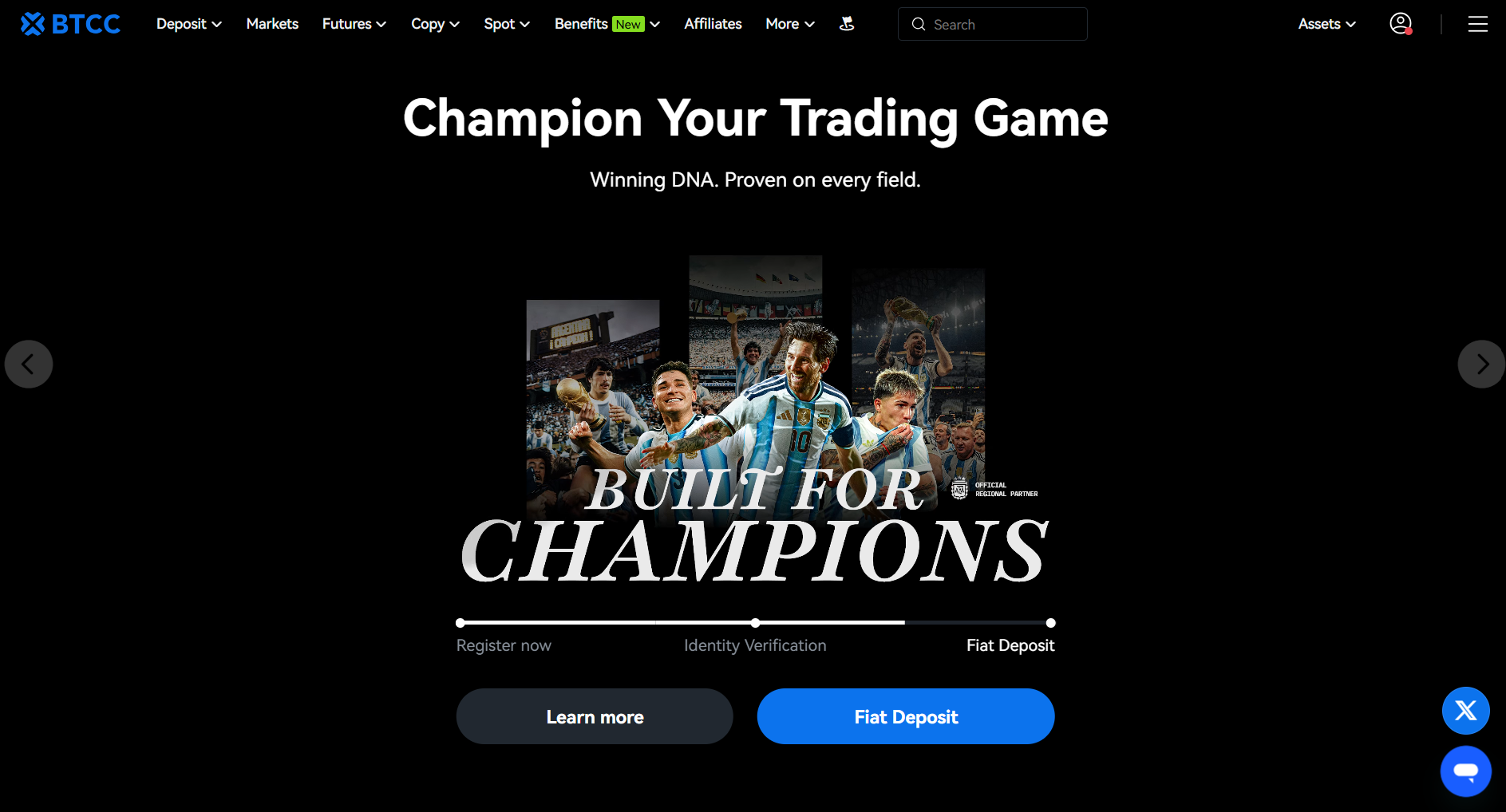
BTCC Review
|
Attributes |
Details |
|
Founded |
2011 (More than 14 years in operation) |
|
Headquarters |
London, UK |
|
Available Countries |
190+ countries, including the USA and Canada |
|
Regulatory Licenses |
FinCEN, FINTRAC, Lithuania FNTT |
|
KYC |
Optional for basic trading, but required for withdrawal limits above $10,000 per day |
|
Trading Pairs |
400+ Futures pairs / 100+ spot pairs |
|
Supported Assets |
Crypto, Stocks, Forex, Indices, Metals, Commodities |
|
Max Leverage |
Up to 500x leverage on selected pairs |
|
Futures Fees |
Maker: 0.02% / Taker: 0.06% (VIP: 0.01% / 0.015%) |
|
Spot Fees |
Maker: 0.20% / Taker: 0.30% |
|
Demo Account |
Yes, with $100,000 virtual funds |
|
Security Record |
Zero hacks since its inception in 2011 |
|
Proof of Reserves |
Yes, 1:1 ratio, quarterly audited |
|
Mobile App |
iOS and Android |
|
Customer Support |
24/7 availability |
|
Trustpilot Ratings |
2.4/5 |
Who is BTCC Best For?
BTCC is a reliable cryptocurrency exchange and is best suited for the following traders:
- Leverage Traders: Users can access up to 500x leverage and more than 400 perpetual contracts.
- Beginners: The $100k demo account is ideal for new traders who don’t want to risk real funds.
- TradFi Traders: BTCC offers gold, silver, forex, and stocks, along with cryptocurrency trading.
- Privacy-conscious Traders: Users who do not want to complete the KYC verification can enjoy up to a $10,000 daily withdrawal limit.
- US and Canadian Users: A rare cryptocurrency exchange that is fully regulated in both markets.
Who Should Not Use BTCC?
BTCC is not the right cryptocurrency exchange for you if you:
- Look for staking, DeFi, or yield farming.
- Trade spot with low fees.
- Access small-cap altcoins and new listings.
- Need trading bots to automate strategies.
- Want a Web3 or an NFT marketplace.
- Need P2P or margin trading.
Is BTCC Safe?
Since its founding in 2011, BTCC has built its reputation as one of the most secure cryptocurrency exchanges. The platform has maintained a zero-hack record, and its security measures are designed to protect users' assets and ensure safe trading.
Some of the key security measures in place include:
- Two-factor Authentication (2FA)
- Cold Storage Wallet
- Regular Internal and External Security Audits
- Proof of Reserves
- Encrypted data storage
- Bug Bounty Program
2FA lets you secure your login with Google Authenticator, phone verification, or email. Cold storage protocols isolate your funds from internet-connected devices, thereby reducing exposure to external breaches. The platform also maintains a Proof of Reserves ratio of at least 1:1 for all user assets, promising 100% reserves and never misappropriating user funds.
BTCC regularly conducts quarterly security audits performed by external cybersecurity firms. Its bug bounty program offers rewards to users for vulnerability disclosures.
Is BTCC Legit and Trustworthy?
BTCC is a fully regulated cryptocurrency exchange with multiple licenses across several jurisdictions. The platform is available for users in the USA and Canada who often have limited legal options.
|
Licenses |
Jurisdiction |
What it Means for Traders |
|
FinCEN |
USA |
Legally compliant for users in the USA |
|
FINTRAC |
Canada |
Legally operable for traders in Canada |
|
FNTT |
Lithuania (EU) |
Authorized for crypto users across the EU member states |
Security Verdict: BTCC has maintained a zero-breach track record for over 14 years. Combined with multiple layers of asset protection, 1:1 Proof of Reserves, and multi-jurisdictional regulation, BTCC stands among the safest exchanges available in 2026.
How to Create an Account on BTCC? (Step-by-Step)
The process of signing up for BTCC is straightforward. Here is a step-by-step process:
- Visit BTCC.com: Once you are on the BTCC website, tap the Register tab on the home screen.
- Select the Sign-up Method: You can create an account using your email address or mobile number. Enter your email address, create a strong password, and tap Register Now.
- Email Verification: Verify your email with the OTP (one-time passcode) sent to your email.
- 2FA: Enable Two-Factor Authentication (2FA) via Google Authenticator for account security.
- Deposit Funds: Once your account is created, you can make a deposit.
- Trade Cryptocurrency: You can either activate your free $100k demo account to practice first or start trading on both spot and futures markets with deposited funds.
Do You Need to Complete KYC on BTCC?
Know Your Customer (KYC) is a procedure used by institutions to verify customers’ identity and assess the risk they pose. BTCC allows users to trade digital assets without completing KYC for amounts up to a certain limit, though daily withdrawal limits are restricted. To unlock higher withdrawal limits of over 10K USD per 24-hours and gain access to exclusive campaigns to earn additional bonuses and rewards, you need to complete the KYC verification.
The following table shows KYC levels on BTCC:
|
KYC Level |
Documents Required |
Limits and Benefits |
|
No KYC |
None |
Trade crypto, access basic platform’s features, and enjoy up to $10k withdrawal limit |
|
Level 1 (Basic) |
Government-issued ID (national ID card, passport, driver’s license) |
Daily withdrawals over $10k, access to exclusive rewards and bonuses |
|
Level 2 (Advanced) |
Level 1 documents + facial recognition |
Unlimited deposit and withdrawal limit, and full access to the platform’s features |
What are BTCC Trading Features?
BTCC is a reliable cryptocurrency trading platform that caters to different risk tolerances and strategies. Here is the complete breakdown of each trading feature:
Spot Trading
Quick Facts:
- 100+ trading pairs (USDT + USDC)
- Maker Fee: 0.20% / Taker Fee: 0.30%
- Order Types: Limit, Market, Trigger Limit, and Trigger Market
BTCC spot trading allows users to trade cryptocurrencies at the current market price. Users can trade USDT and USDC pairs, pairing digital currencies with a stable, dollar-pegged asset. However, these pairs differ significantly in liquidity, trading ecosystems, and regulatory trust.
High-volume traders seeking maximum liquidity usually prefer USDT pairs. On the other hand, USDC pairs are favored by institutional investors who prioritize managing large funds.
Futures Trading
Quick Facts:
- 400+ perpetual contracts
- Max Leverage: 500x
- Maker Fee: 0.02% / Taker Fee: 0.06%
- Order Types: Limit, Market, SL/TP
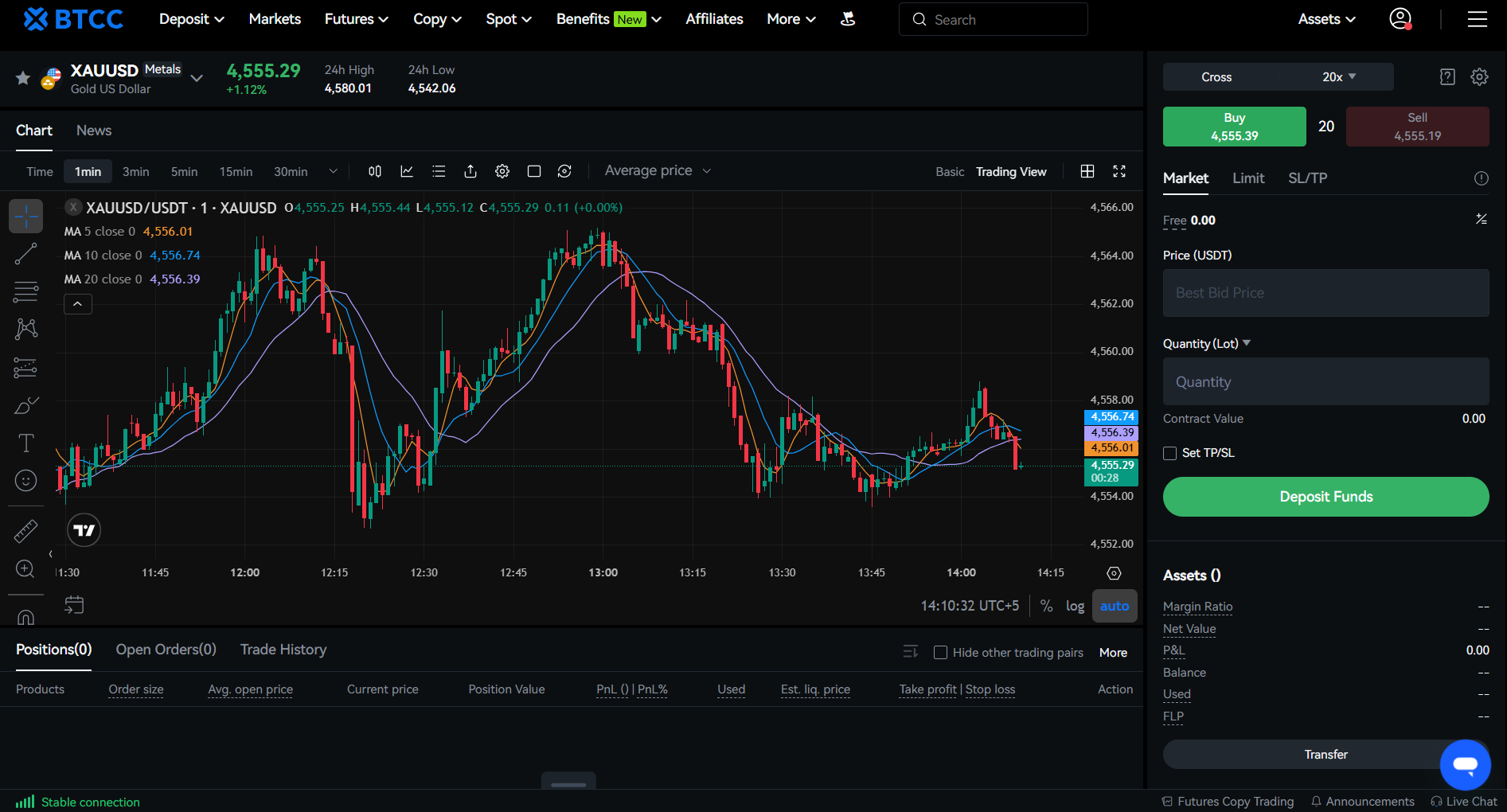
BTCC specializes mainly in futures trading, offering over 400 leading trading pairs and up to 500x leverage. The platform offers two distinct types of crypto futures:
- USDT-Margined Futures: These contracts are settled in USDT and allow users to trade with more than 300 cryptocurrencies, including BTC, ETH, XRP, SOL, and many others.
- Coin-Margined Futures: Settled in the underlying asset, coin-margined futures contracts offer users the flexibility to diversify their portfolios across a wide array of digital assets.
Leverage Warning: While high leverage contributes to large positions with minimal capital, it also increases the risk of liquidation. Therefore, traders are advised to be cautious when selecting leverage (ideally 10-20x) and to use stop-loss orders.
TradFi (Traditional Financial Assets)
Quick Facts:
- Metals, Forex, Stocks, Indices, Commodities
- Unified Margin Asset: USDT
- Leverage option
- 24/7 trading
Beyond cryptocurrency, BTCC offers a gateway to traditional financial assets. The platform tracks market trends in major traditional financial assets, enabling users to trade price movements without directly holding the underlying assets.
BTCC offers contract-based trading experience to users across traditional financial markets, including metals, FX, stocks, indices, and commodities. It is backed by a stable matching mechanism and deep liquidity, offering quick order execution, flexible leverage, and professional risk controls.
The platform uses USDT as a unified margin asset. Additionally, you can access the TradFi pairs without converting them to fiat currencies or relying on third-party tools.
Futures Copy Trading
Quick Facts:
- Copiers earn a profit share of 10%-15%.
- Up to 50 USDT first copy trade protection.
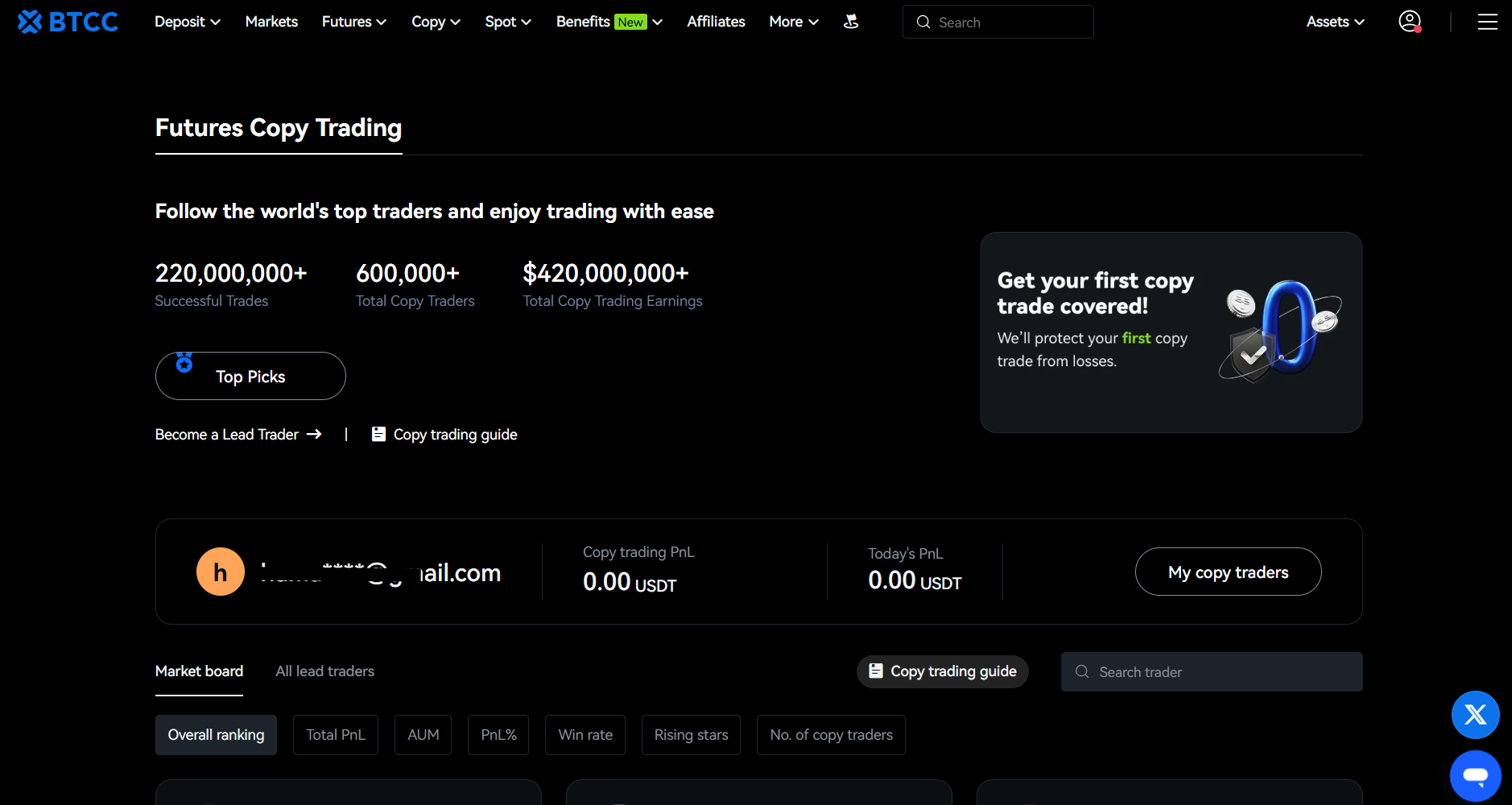
BTCC futures copy trading lets you copy the trades of professional and other high-performing traders. The platform offers two ways for you to engage in copy trading: fixed ratio and fixed amount. As an expert trader, you can also earn a profit share of 10% to 15% of the copier’s trade. On the other hand, the platform claims to cover your first copy trade from losses.
Demo Trading
Quick Facts:
- $100k virtual funds
- Accessible to all
For beginners who are concerned about risking their funds, BTCC offers a demo trading account. It enables investors to improve their trading experience without sacrificing capital. Once you create an account on the platform, you receive a $100,000 demo account that provides a detailed understanding of how the platform works without risking any real funds.
What are BTCC Fees?
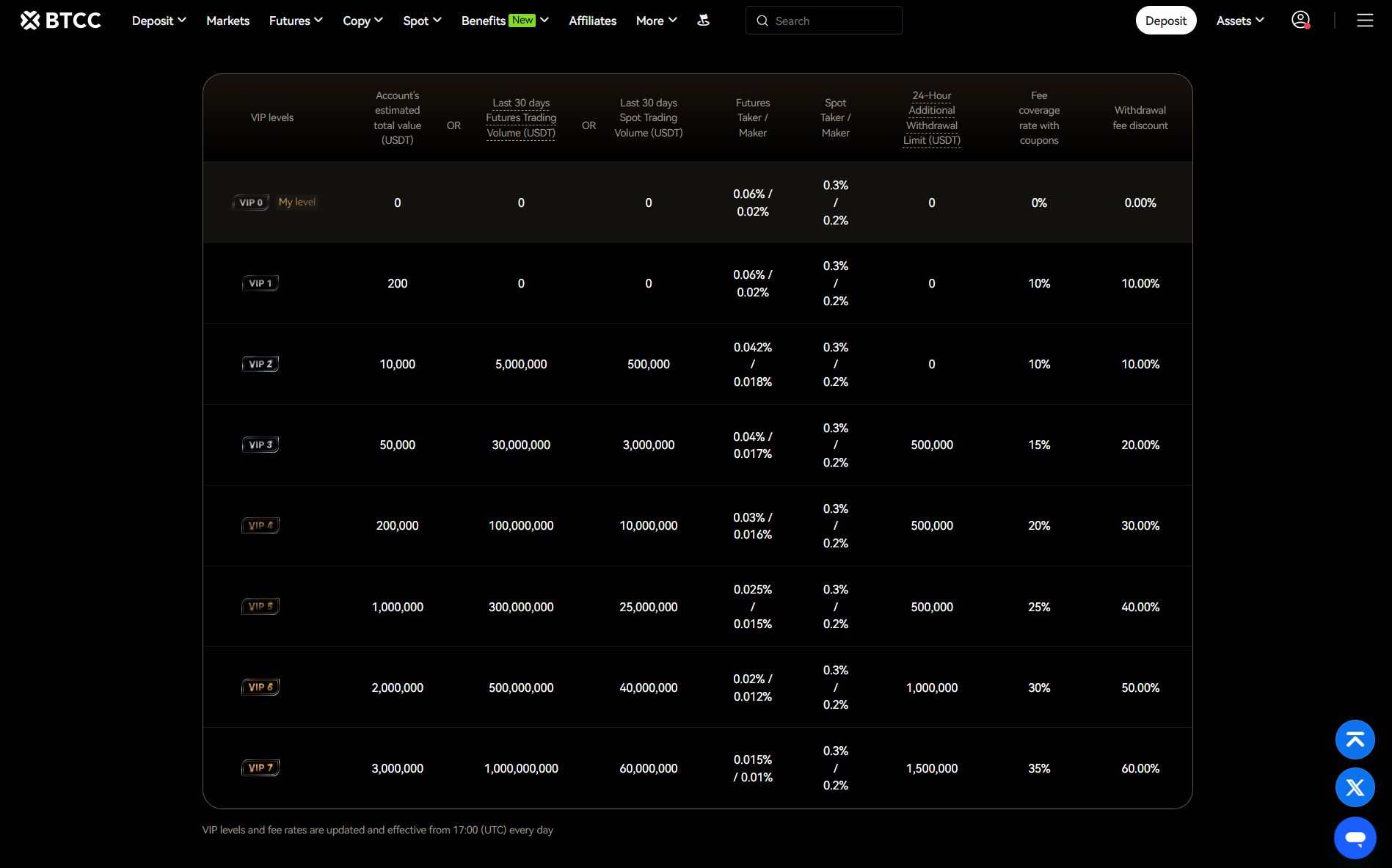
BTCC boasts a competitive fee structure and discounts for VIP customers. The platform follows a maker/taker fee structure for users.
Here is the full breakdown:
|
Account Tier |
Maker Fee |
Taker Fee |
|
Spot |
0.2% |
0.3% |
|
Futures |
0.02% |
0.06% |
|
VIP (Futures) |
0.01% |
0.015% |
|
Deposit Fees |
Network Dependent |
--- |
|
Withdrawal Fees |
Free |
Free |
Which Cryptocurrencies are Available on BTCC?
BTCC supports both large-cap and mid-cap digital assets, as well as over 400 trading pairs. The platform puts a strong emphasis on high liquidity and enhanced convenience for users. The following table shows some of the popular available assets on the platform:
|
Large Cap |
Mid Cap |
Stablecoins |
TradFi Assets |
|
Bitcoin (BTC) |
Polkadot (DOT) |
Tether (USDT) |
Gold (XAUUSDT) |
|
Ethereum (ETH) |
Avalanche (AVAX) |
USD Coin (USDC) |
TSLA Stock |
|
Solana (SOL) |
Chainlink (LINK) |
--- |
Silver (XAGUSDT) |
|
XRP |
Dogecoin (DOGE) |
--- |
EUR/USD Forex |
|
BNB |
Litecoin (LTC) |
--- |
S&P 500 Index |
How to Make a Deposit on BTCC?
BTCC offers users both fiat and crypto deposits. Here are the details:
How to Make a Fiat Deposit on BTCC?
You can deposit prominent fiat currencies into your BTCC account, including USD, EUR, and GBP.
- Tap the Deposit tab and then select Fiat Deposit.
- Select the payment method and choose the fiat currency you want to deposit.
- Enter the amount, and proceed with the transaction.
How to Make a Crypto Deposit on BTCC?
BTCC supports USDT, BTC, ETH, and other digital assets for deposits.
- Under the Deposit tab, select the Crypto Deposit option to proceed.
- Choose the cryptocurrency you want to deposit and the blockchain network.
- Copy the deposit address to paste into the wallet from which you are sending funds.
- Remember to select the same deposit network you used in the external wallet.
How to Make a Withdrawal on BTCC?
BTCC allows users to easily withdraw funds from their accounts.
- Tap the Assets tab on the homepage and then select Withdraw.
- Select the cryptocurrency you want to withdraw, the withdrawal network, and the withdrawal address.
- Once done, enter the withdrawal amount to proceed.
BTCC Campaigns
BTCC runs various campaigns where investors can participate for a chance to win exciting rewards. Listed below are the campaigns:
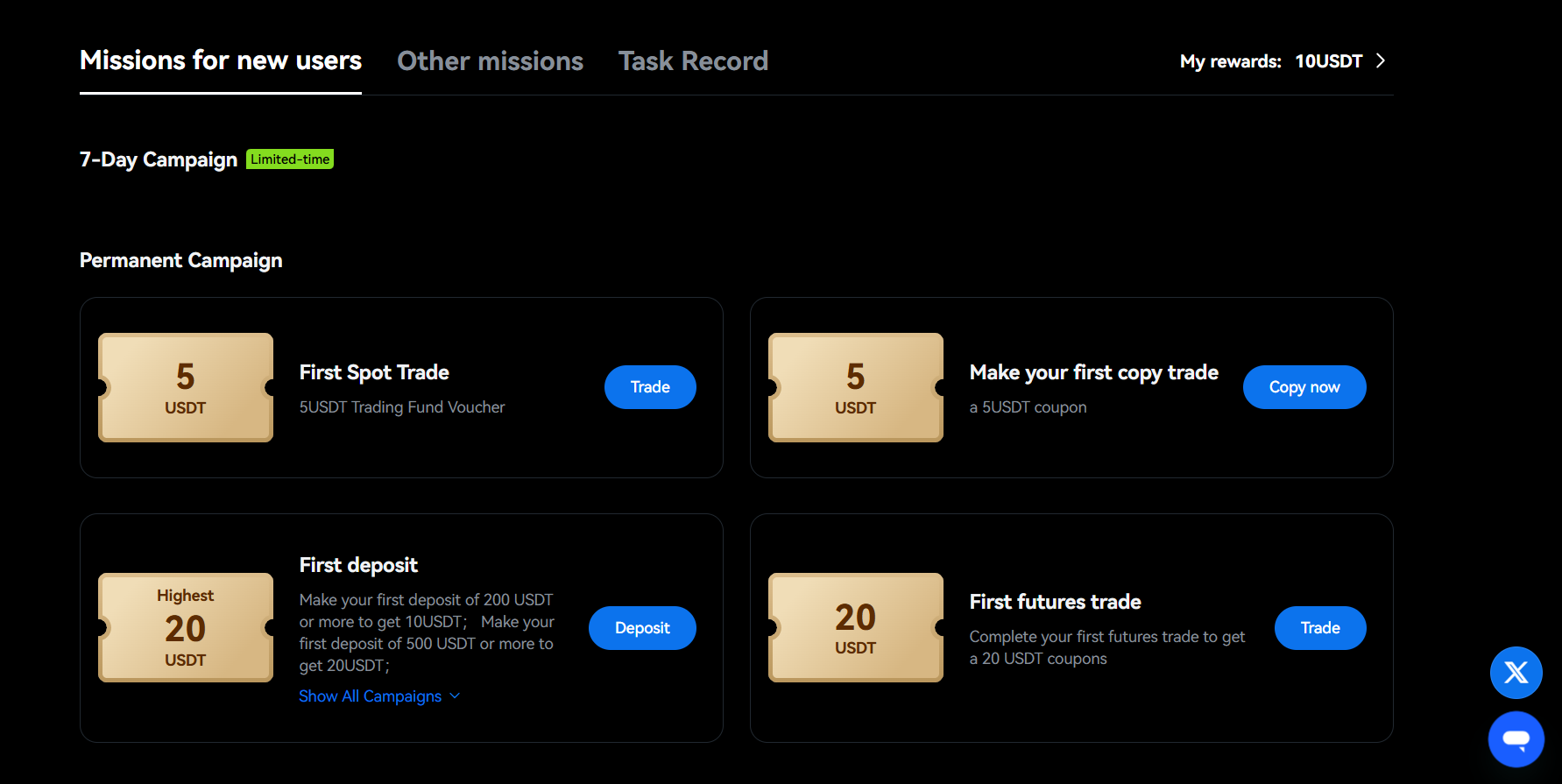
What are New User Welcome Rewards on BTCC?
As a new user on BTCC, you can get rewards up to 30,000 USDT through completing several tasks, such as registration, identity verification, deposits, and more.
What are Copy Trading Bonuses on BTCC?
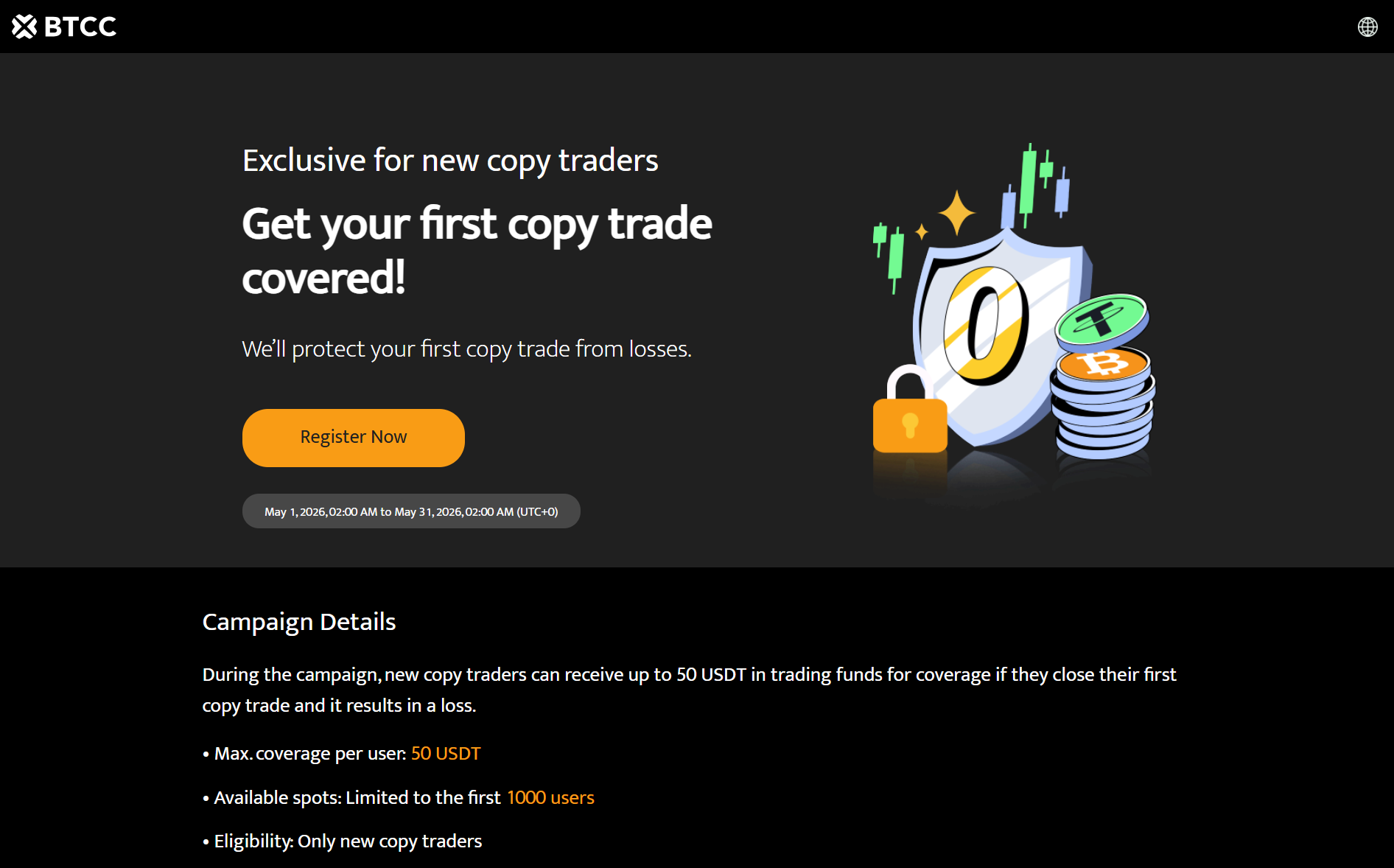
For first-time copy traders, BTCC offers up to 50 USDT loss coverage on the first copy trade. It reduces the risk for new traders and enables them to experiment with less fear of initial losses.
What is BTCC Earn?
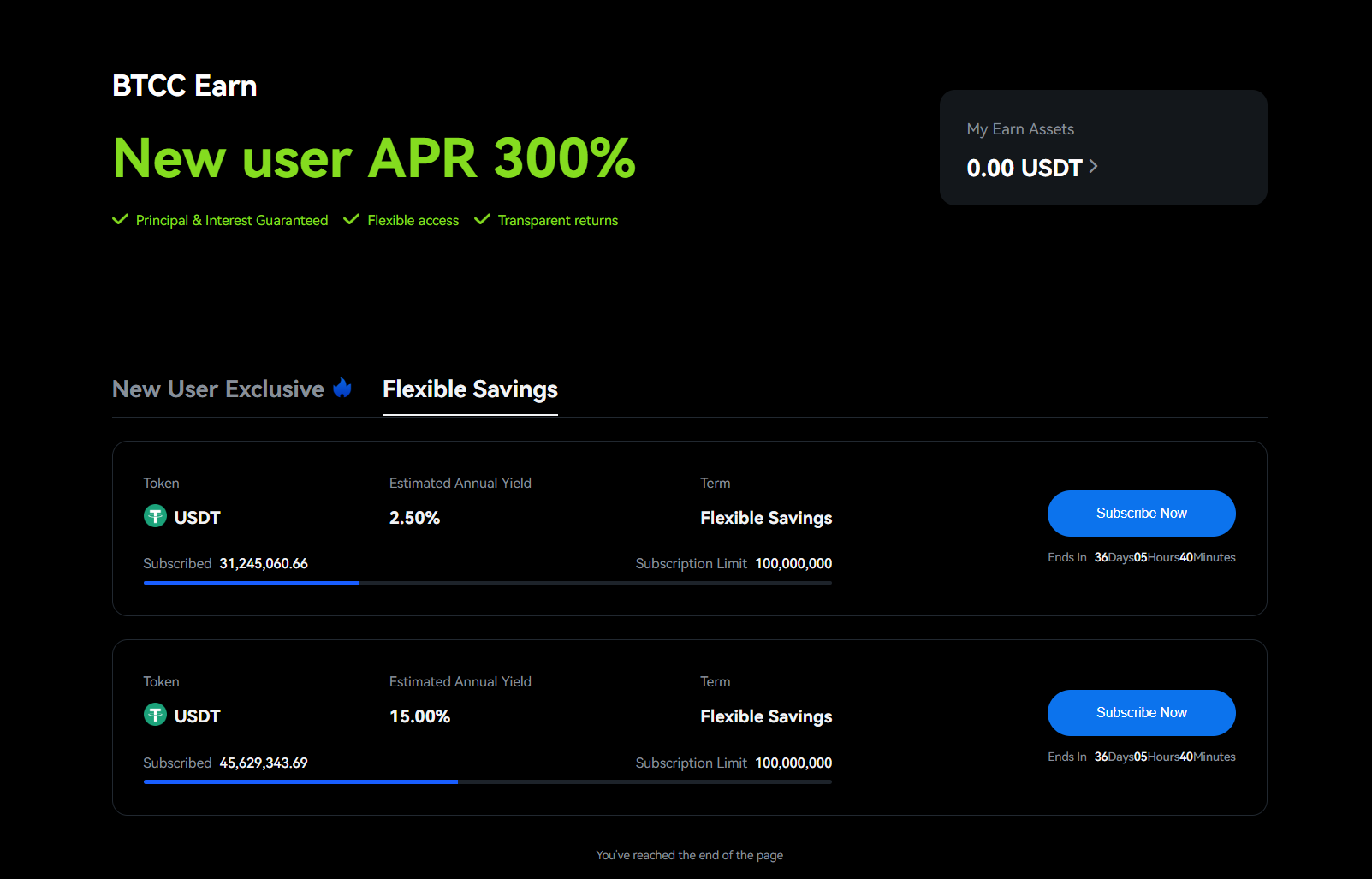
BTCC Earn is an exclusive campaign that allows users to earn up to 300% APY (Annual Percentage Yield) on their crypto. If you hold USDT, you can subscribe to the ongoing campaigns. Additionally, you can select between fixed and flexible saving campaigns (up to 20% APY).
Disclaimer: Bonus and APY (Annual Percentage Yield) figures are promotional campaigns and subject to rate changes, specific terms, and expiry dates. Always read the full campaign before participating.
BTCC vs Competitors: Side-by-Side Comparison
|
Feature |
BTCC |
Bybit |
Binance |
WEEX |
|
Founded |
2011 |
2018 |
2017 |
2018 |
|
US & Canada Allowed |
Yes |
No |
No (Binance.US only) |
No |
|
Trading Pairs |
500+ |
1,000+ |
1,500+ |
1,500+ |
|
Max Leverage |
500x |
200x |
125x |
400x |
|
Zero Hack Record |
Yes |
No |
No |
Yes |
|
Spot Fee |
0.2% maker / 0.3% taker |
0.10% |
0.10% |
0% maker / 0.10% taker |
|
Futures Fees |
0.02% maker / 0.06% taker |
0.02% maker / 0.05% taker |
0.02% maker / 0.04% taker |
0.02% maker / 0.08% taker |
|
TradFi Assets |
Yes |
Yes |
No |
Yes |
|
Copy Trading |
Yes |
Yes |
Yes |
Yes |
|
Demo Account |
Yes |
Testnet |
No |
Yes |
|
PoR 1:1 |
Yes |
Yes |
Yes |
Yes |
|
Trustpilot Score |
2.4/5 |
3.4/5 |
1.4/5 |
2.9/5 |
Comparison Verdict: BTCC is the clear winner for users in the USA and Canada who prefer full-regulatory compliance. The platform also offers the highest leverage (500x) and access to TradFi assets. However, Binance and Bybit offer lower fees and broader coin selection, but lack US regulatory approvals. Additionally, BTCC's 14-year zero-hack record surpasses all competitors listed.
What are the Limitations of BTCC?
In 2026, cryptocurrency users can access an unlimited number of exchanges. However, no exchange is perfect, and listed below are the limitations of BTCC as compared to its competitors:
- Higher Spot Trading Fees: BTCC charges 0.2% maker and 0.3% taker fees in spot trading, which are higher than those of exchanges such as Binance and Bybit. With frequent spot trades, users can face significantly higher costs.
- No Passive Earning Products: BTCC does not offer DeFi lending, staking, or yield farming. Traders who want to generate passive income will need to use a separate platform.
- No P2P Marketplace: Peer-to-peer (P2P) is a popular fiat on-ramp on leading cryptocurrency exchanges. However, this feature is missing from BTCC.
- No Trading Bots: BTCC does not offer bot automation for users looking to automate their trading strategies.
- Limited Altcoin Selection: Traders may struggle to find new project listings or early access to small-cap altcoins on BTCC.
Final Verdict – Is BTCC Worth Using in 2026?
Verdict: According to Trustpilot, BTCC has scored a rating of 2.4/5 based on extensive reviews by the crypto community.
To sum up, BTCC is a well-rounded cryptocurrency exchange that is ideal for traders seeking a diverse range of experiences in the crypto space. The platform stands out primarily in the crypto landscape for two reasons: its regulatory compliance in the USA and Canada, and its 14-year zero-breach security record.
BTCC offers best-in-class infrastructure for futures traders, with 500x leverage, over 400 trading pairs, and competitive maker and taker fees. For newcomers, it offers exclusive reward campaigns and a $100k virtual asset demo account. The addition of TradFi assets allows users to trade gold, forex, and tokenized stocks.
However, there are still areas for improvement on BTCC. The absence of P2P trading, staking, trading bots, NFTs, and high spot fees is where it trails its competitors. Traders who want to generate passive income may need to use a different platform.
Frequently Asked Questions (FAQs)
When was BTCC founded?
BTCC was founded in 2011, making it one of the oldest cryptocurrency exchanges in the world.
Is BTCC a beginner-friendly platform?
Yes, BTCC is a beginner-friendly platform, offering a free Demo account that lets users learn to trade cryptocurrencies without risking real money.
Is BTCC available in the US?
BTCC holds a crypto license in the US, issued by the FinCEN, ensuring it operates within the country’s regulatory framework.
Is BTCC safe?
Since its inception in 2011, BTCC has maintained a spotless security history with no hacks ever recorded. The platform implements robust security features, including Know Your Customer (KYC) and anti-money laundering (AML) policies.
Does BTCC offer a mobile app?
Yes, BTCC has a mobile app that is compatible with both iOS and Android devices.
Does BTCC support copy trading?
BTCC is a diverse cryptocurrency exchange that lets newcomers replicate the trading strategies of experienced futures traders.
Create your BTCC account today and unlock sign-up bonuses worth up to $30,000. Fund your account to receive a 10% deposit bonus on eligible deposits.
Disclaimer: All content on The Moon Show is for informational and educational purposes only. The opinions expressed do not constitute financial advice or recommendations to buy, sell, or trade cryptocurrencies. Trading involves significant risk and may result in substantial losses. Always seek independent financial advice before making investment decisions. The Moon Show is not responsible for any financial losses or decisions made based on the information provided.
Please view the full disclaimer at: https://themoonshow.com/disclaimer

BloFin Exchange Review – Key Features, Fees and Security
Choosing a cryptocurrency exchange is not easy. Traders look for the right mix of features, low...
Bybit Review 2026 – Best Derivatives Trading Platform?
Bybit remains one of the world’s leading crypto exchanges in 2026 with over 84 million users an...
WEEX Exchange Review 2026: High Leverage, No KYC, But Is It Worth the Trade-Offs?
Choosing a cryptocurrency exchange is never a simple decision. You need a platform packed with ...