
Is The Ethereum Narrative Broken? Inside the EF Brain Drain and the 250K ETH Whale Wall
Ethereum is locked in a multi-layered fundamental and technical crisis, driving the spot price down to $2,130, just above the critical $2,100 macro support floor. The ecosystem is facing severe headwinds from an unprecedented wave of internal departures, with senior researchers Carl Beek and Julian Ma marking the latest exits from the Ethereum Foundation. This internal strain coincides with a sharp critique from JPMorgan analysts highlighting stagnant decentralized finance growth and lagging spot ETF capital recovery. Backed by a massive 250,000 ETH influx into Binance exchange wallets, market sellers remain in complete control.
Key Takeaways
- Senior researchers Carl Beek and Julian Ma resigned from the Ethereum Foundation, bringing total prominent departures to eight in 2026.
- A new JPMorgan report warns that Ethereum will continue to underperform Bitcoin without an immediate rebound in organic utility and token burn mechanics.
- Exchange flow analysis identified a massive 250,000 ETH deposit hitting Binance, introducing persistent spot liquidation pressure that has driven the price down by ~7.5% this week.
- ETH is trading at $2,128, hovering just above the make-or-break $2,100 horizontal support zone after printing four consecutive weekly losses.
Brain Drain at the Ethereum Foundation
An escalating organizational crisis within core development layers is weighing heavily on market sentiment. The Ethereum Foundation has experienced an unprecedented wave of senior departures throughout 2026. The recent resignations of veteran research figures Carl Beek and Julian Ma have brought the yearly departure count to eight prominent individuals, following previous exits like Tim Beiko and Barnabé Monnot.
Developer circles link this exodus to strategic friction regarding a newly proposed organizational compliance framework. Internal reports indicate that the foundation introduced a mandatory values pledge centered around its updated core principles, specifically covering censorship resistance, open-source development, privacy, and security.
Outgoing researchers viewed this pledge as an unnecessary restriction on external research collaborations and private sector advisory roles. This operational disruption comes at a sensitive time as developers prepare for the upcoming Glamsterdam and Hegota upgrades, raising concerns that complex protocol milestones could face prolonged governance gridlock.
Get started on WEEX with a simple 40 USDT reward. Deposit 100 USDT, make your trade, and claim the bonus.
Institutional Critique and ETF Inflow Divergence
Compounding the organizational strain, Wall Street has issued a direct warning regarding Ethereum's structural market positioning. In an institutional report released earlier today, analysts at JPMorgan stated that Ethereum requires an immediate acceleration in organic network growth and decentralized finance adoption to reverse its persistent underperformance against Bitcoin.
The investment bank pointed out a glaring divergence in institutional capital allocation. While spot Bitcoin ETFs have successfully captured fresh capital and recovered over two-thirds of their aggregate springtime outflows, spot Ethereum ETF vehicles remain sluggish, reclaiming barely one-third of their respective capital drawdowns over the same period.
JPMorgan also raised critical economic concerns regarding the network's technical roadmap. The report noted that while the Glamsterdam upgrade focuses on drastically lowering layer-two execution costs, raw technical efficiency does not automatically translate into economic token demand. Analysts warned that slashing transaction fees without triggering an immediate, exponential explosion in transaction volume will actively harm the native token supply mechanics by severely reducing base-fee burn volume.
Whales Target Exchange Order Books
Immediate spot price action is being dictated by aggressive on-chain distribution. Blockchain tracking metrics have isolated a massive wave of wallet movements culminating in a 250,000 ETH influx directed almost entirely into Binance exchange accounts.
Exchange flow data reveals that a single cluster of large whale addresses, dormant since late 2024, initiated the transfers over a seventy-two hour window. Over 90% of this aggregate volume landed directly on Binance order books, presenting a massive supply wall that market makers have struggled to absorb.
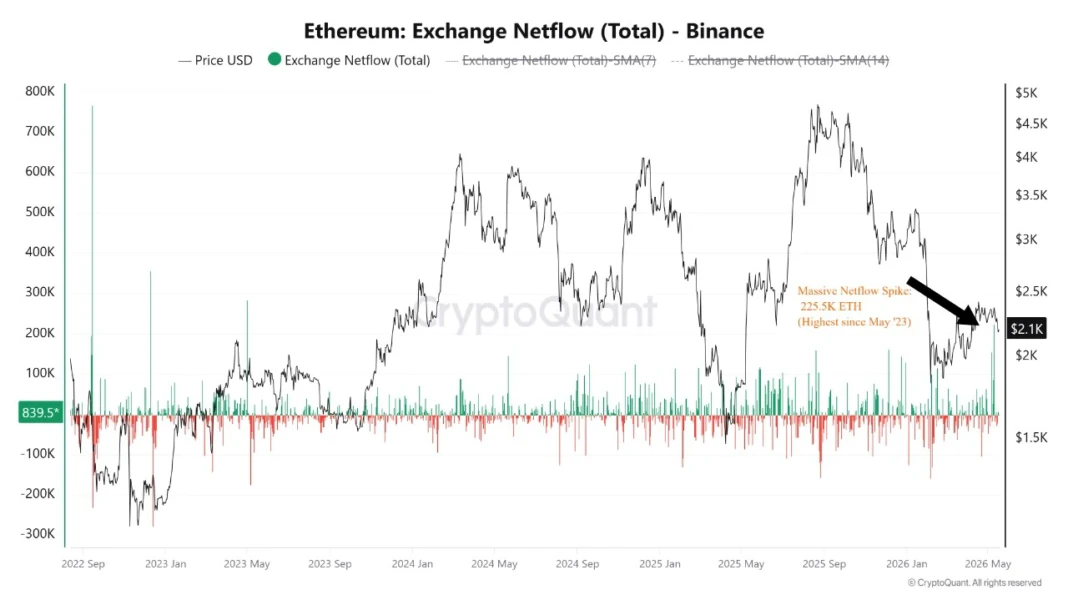
This centralized exchange deposit represents the largest concentrated inflow event observed since 2022, giving short sellers a clear mechanical advantage and forcing market bids lower as automated liquidity setups adjust to the incoming volume.
ETH Teeters Above the $2,100 Support Cliff
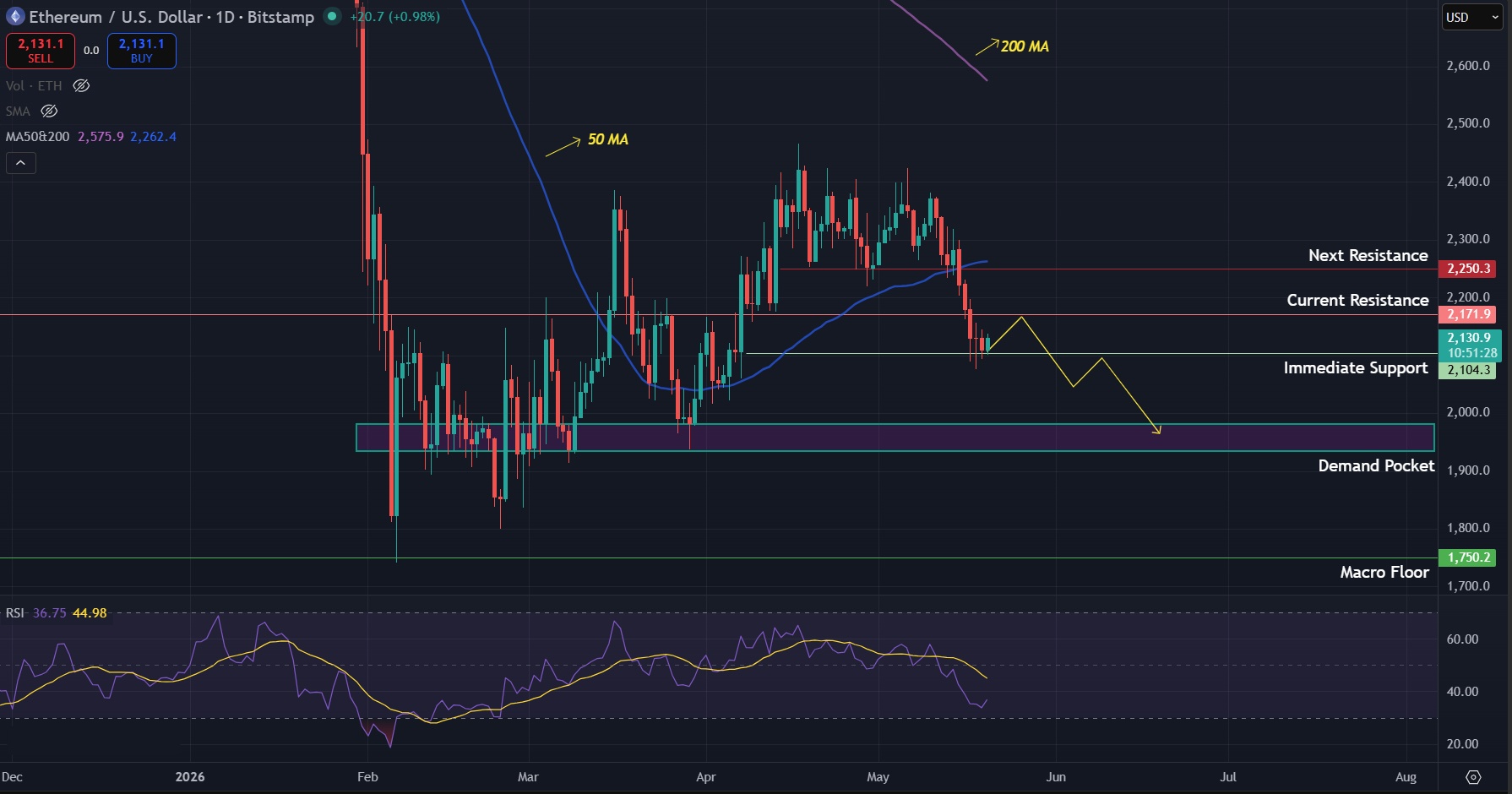
From a technical perspective, Ethereum's market structure is leaning quite bearish across multiple higher timeframes. The asset is currently trading at $2,130, marking approx. 7.5% decline over the last seven days and cementing its fourth consecutive negative weekly candlestick close.
This persistent slide has brought price action directly down to the make-or-break $2,100 horizontal support zone, which has served as a critical multi-month floor since late 2025. ETH is currently trading well below its declining 200-day Simple Moving Average, which sits overhead as major structural resistance at $2,335, confirming that the macro trend remains under firm bearish control.
When setting up a daily chart tracking this layout, immediate horizontal support rests firmly at $2,100, followed closely by a secondary structural demand pocket around the $1,950 region, while the macro floor sits at $1,750. On the upside, immediate horizontal resistance is located at $2,150, with major trendline resistance and the 50-day moving average converging near $2,240. The daily Relative Strength Index is currently registering a reading of 35, which shows heavy bearish velocity without entering traditional oversold territory, while volume expansion on down-days validates the persistent distribution.
What to Expect Next
- Bullish Case: For a recovery to materialize, bulls must defend $2,100 on a daily closing basis. If spot selling on Binance exhausts itself, a relief rally could push the asset back up to test immediate resistance at $2,150, opening a path toward $2,240.
- Bearish Case: If spot liquidations persist and the $2,100 support floor fails, a cascade of leveraged long liquidations will trigger. A decisive daily close below $2,100 shifts the short-term bias to heavily bearish, forcing a rapid flush down into the $1,950 pocket.
- Key Catalyst: Watch localized volume trends and order book depth on Binance over the next forty-eight hours to see if the remaining portion of the 250,000 ETH deposit is aggressively market-sold into the order books.
- Invalidation Criteria: A clean daily close below the horizontal $2,100 support floor completely invalidates the bullish consolidation thesis, confirming a structural trend breakdown and shifting the macro target lower toward the $1,700 demand zone.
Start trading on WEEX with a 100 USDT deposit and unlock 40 USDT back after completing your first trading step.
Why is Ethereum underperforming Bitcoin right now?
Ethereum's underperformance stems from soft institutional demand and stagnant on-chain utility. As highlighted by JPMorgan, capital inflows into spot Ethereum ETFs lag far behind spot Bitcoin ETFs, while the migration of activity to layer-two networks has reduced mainnet transaction fees and weakened the token burn mechanism.
What is driving the recent resignations at the Ethereum Foundation?
The departures of senior researchers Carl Beek and Julian Ma are tied to internal friction regarding a mandatory compliance pledge. Outgoing staff members argued this policy restricted their ability to pursue external research initiatives and private sector advisory roles within the industry.
How does the 250,000 ETH exchange inflow impact the market structure?
The massive deposit into Binance significantly increases immediate circulating spot supply available on order books. This concentration of liquid tokens creates a structural imbalance, forcing market participants to lower their bids to absorb the persistent selling pressure, pinning the spot price near macro support.
Disclaimer: All content on The Moon Show is for informational and educational purposes only. The opinions expressed do not constitute financial advice or recommendations to buy, sell, or trade cryptocurrencies. Trading involves significant risk and may result in substantial losses. Always seek independent financial advice before making investment decisions. The Moon Show is not responsible for any financial losses or decisions made based on the information provided.
Please view the full disclaimer at: https://themoonshow.com/disclaimer

Bitcoin and Ethereum Quarterly Returns 2026: Q1-Q3 Trends and Q4 Outlook
Quarterly returns for Bitcoin (BTC) and Ethereum (ETH) offer a simple way to measure how the tw...

LINK Breaks August High as Chainlink Expands Into Global Payments
LINK is holding above $13 on September 7 after gaining 9.9% in the previous session. The move c...

XRP ETF Inflow Streak Ends After $170M Run. Can Price Hold $1.31?
XRP is trading near $1.36 on September 3 after U.S. spot XRP ETFs recorded their first net outf...