
SOL Hits $90 as Tether's $147.5 Million Drift Rescue Changes the Narrative
The Solana ecosystem received a major liquidity injection on April 16 as Tether stepped in to lead a $147.5 million recovery fund for Drift Protocol. This move addresses the $285 million exploit that crippled the exchange earlier this month. The market responded to this stabilization effort by pushing SOL toward the $90 mark. While the asset has seen a 5% daily gain, technical indicators suggest a cooling period may be necessary before the rally can continue. Support now sits at the $85 level, which bulls must defend to keep the recovery narrative alive.
Key Takeaways
- SOL reached a local high of $90 on April 17 and currently trades at $89.50.
- Tether is anchoring the recovery with a $127.5 million credit facility while partners provide the remaining $20 million.
- The April 1 exploit is the largest DeFi hack of 2026 and has been linked to North Korean state-sponsored hackers.
- Drift will transition its core settlement layer from USDC to USDT as part of the deal.
- Institutional demand remains steady with Solana spot ETFs recording $15.5 million in fresh inflows.
Get started on WEEX with a simple 40 USDT reward. Deposit 100 USDT, make your trade, and claim the bonus.
Tether Steps In to Shield Solana from Contagion
The fallout from the April 1 Drift Protocol hack created a massive hole in the Solana DeFi landscape. When a flagship exchange loses $285 million in a matter of minutes, the primary fear is a "bank run" mentality that spreads to other protocols. Tether's decision to lead a $147.5 million rescue package on April 16 was the specific catalyst needed to break that cycle of fear.
This rescue was not a simple bailout but a strategic move to secure one of the network's most vital trading hubs. The hackers (identified by security firms as the North Korean group UNC4736) spent months infiltrating the protocol through social engineering. They eventually exploited the "durable nonces" feature on Solana to trick the team into authorizing what appeared to be standard administrative tasks. In reality, these signatures allowed the attackers to use a fake collateral token to drain legitimate assets. By the time the breach was detected, more than half of the protocol's total value had been moved off-chain.
The recovery plan focuses on long-term solvency rather than an immediate cash injection. The $147.5 million facility is tied to the future revenue of the protocol. This means that as Drift relaunches and generates trading fees, those funds will be diverted to repay affected users. A major condition of this support is that Drift must shift its entire settlement infrastructure to USDT. This move effectively replaces Circle's USDC as the primary stablecoin for the exchange and gives Tether a dominant footprint on the Solana network.
For the broader market, the news provides a sense of closure. Traders are no longer pricing in a total collapse of the Drift ecosystem. Instead, they are beginning to price in a structured recovery. This fundamental shift in the outlook for Solana is what drove the price action over the last 24 hours.
What SOL's Chart Is Showing Right Now
The price of SOL had been suppressed for weeks as the uncertainty of the Drift hack weighed on investors. Today's breakout through the $85 resistance level signals a shift in momentum. The price reached as high as $90.50 during the initial surge before finding heavy sell orders that pushed it back below a little, though bulls are testing the resistance once again.
From a technical perspective, the move is significant because it flipped a multi-week resistance zone into a support floor. However, the Daily Relative Strength Index (RSI) is now flashing overbought signals. This suggests that while the trend is positive, the market might be overextended in the short term. A healthy period of sideways trading or a slight retest of the $85 support level would likely strengthen the base for the next leg up.
If SOL can close the daily candle above $86, it confirms that the market has accepted this higher valuation. If it fails to hold that level, the recent pump might be viewed as a "relief rally" that lacks the sustained buying power needed to challenge the $100 psychological barrier.
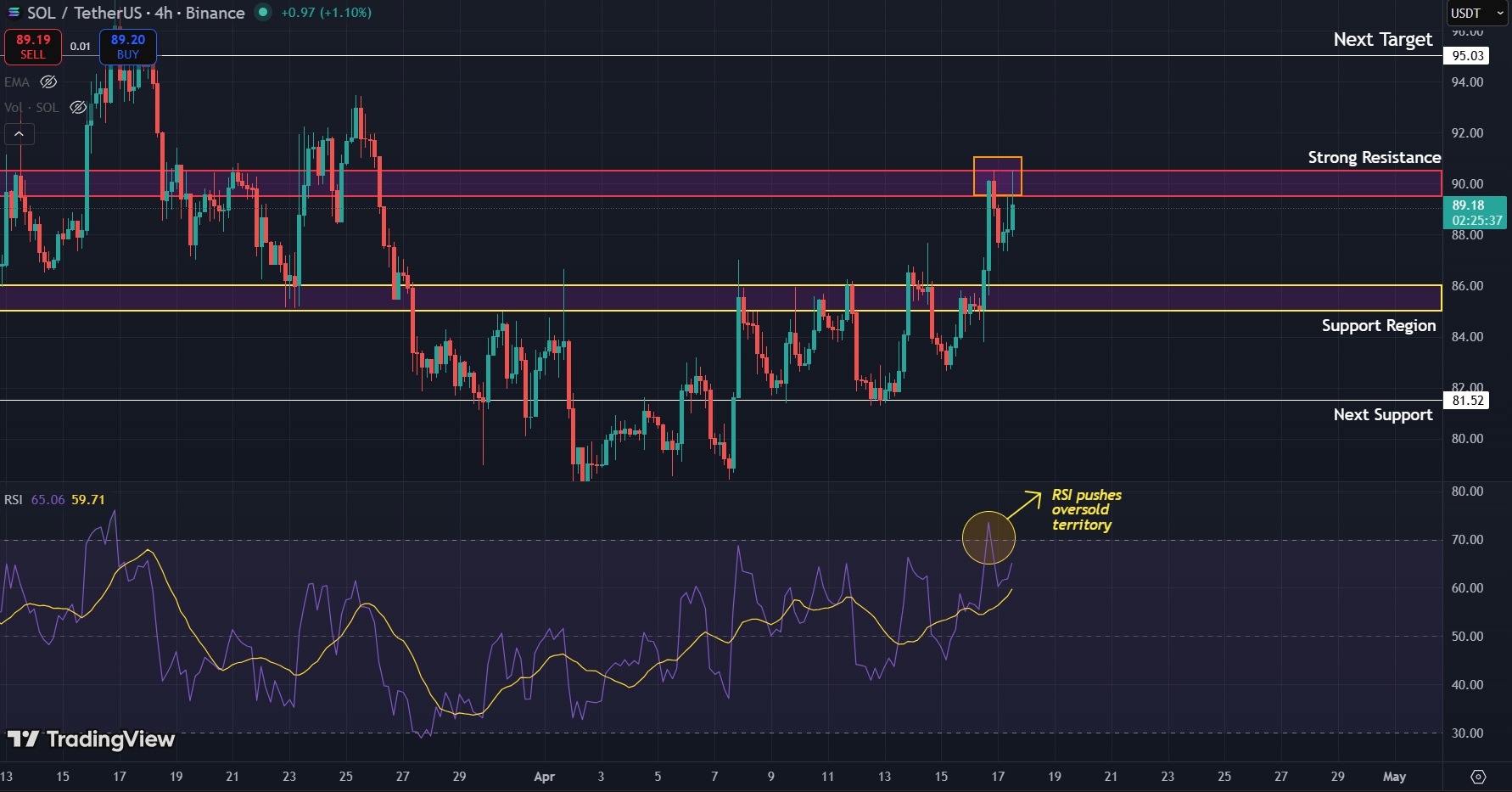
SOL/USDT daily chart, April 17, 2026. Price has cleared $85–86 resistance on the news catalyst; RSI is hovering around overbought.
Where SOL Goes from Here
- Bullish scenario: SOL holds the $85–86 flip zone on a daily close. If ETF inflows remain positive and Drift's relaunch timeline comes into focus without fresh complications, the next target range is $95. That's where price has found meaningful resistance for weeks.
- Bearish scenario: A daily close below $85 invalidates the breakout from this zone. The next clear support sits at $81.50. If sentiment around Drift's relaunch deteriorates (missed milestones, security audit failures, or further DPRK-linked fund movements getting flagged) downside could extend past that level.
- Wildcard to watch: Drift's relaunch date and whether independent security audits clear on schedule. The protocol stated that reopening is contingent on two audits completing, and any delay will directly pressure the recovery token value and likely SOL.
Start trading on WEEX with a 100 USDT deposit and unlock 40 USDT back after completing your first trading step.
Why is the Tether deal helping the price of SOL?
The deal removes the immediate threat of a total protocol collapse. By providing a funded path to recovery, Tether has stabilized the sentiment around Solana's DeFi sector. This allows investors to focus on growth rather than damage control.
What are the terms for the affected users?
Users who lost funds will be eligible for repayments funded by the $147.5 million credit facility and future protocol earnings. They will also receive recovery tokens that represent their specific claim on these funds.
How did the hackers manage to steal $285 million?
The attack involved a mix of social engineering and technical manipulation. The hackers tricked the Drift team into pre-signing transactions using the durable nonces feature. They then used a fake token to inflate their collateral and withdraw real assets like SOL and USDC.
Is the move from USDC to USDT permanent?
Yes. As a condition of the rescue package, Drift is adopting USDT as its primary settlement asset. This move is intended to provide deeper liquidity and align the protocol with the resources of the world's largest stablecoin issuer.
Are big investors still buying Solana?
Yes. Recent data shows that US Solana ETFs took in $15.5 million in a single day following the announcement. Total assets in these products are nearing the $1 billion mark, showing that institutional confidence remains high despite the recent exploit.
Disclaimer: All content on The Moon Show is for informational and educational purposes only. The opinions expressed do not constitute financial advice or recommendations to buy, sell, or trade cryptocurrencies. Trading involves significant risk and may result in substantial losses. Always seek independent financial advice before making investment decisions. The Moon Show is not responsible for any financial losses or decisions made based on the information provided.
Please view the full disclaimer at: https://themoonshow.com/disclaimer

Bitcoin and Ethereum Quarterly Returns 2026: Q1-Q3 Trends and Q4 Outlook
Quarterly returns for Bitcoin (BTC) and Ethereum (ETH) offer a simple way to measure how the tw...

LINK Breaks August High as Chainlink Expands Into Global Payments
LINK is holding above $13 on September 7 after gaining 9.9% in the previous session. The move c...

XRP ETF Inflow Streak Ends After $170M Run. Can Price Hold $1.31?
XRP is trading near $1.36 on September 3 after U.S. spot XRP ETFs recorded their first net outf...