Why Are Short-Term Bitcoin Holders Selling at a Loss Over the Past 9 Months?
Short-term Bitcoin holders have been realizing losses for the last nine months, not because of one long crash but three separate waves since November 2025. The STH-SOPR has stayed close to breakeven instead of dropping into panic territory, which is why this stretch has outlasted the loss-realization phases of 2018 and 2022. The significant level to watch is the $68,800 short-term holder cost basis, not the $65,000 BTC has been trading near.
Key Takeaways
- Short-term Bitcoin holders have been selling at a loss since November 2025.
- The losses have come in three separate waves, not one sharp capitulation event.
- On July 16, 2026, only 13.5% of short-term holder supply was in profit.
- Bitcoin short-term holder SOPR sat at 0.9997 on July 22, effectively breakeven, not the sub-0.95 that marks panic selling.
- The 2018 phase stayed loss-dominant for six months or more, and the FTX-driven loss phase of late 2022 resolved within about eight months.
According to on-chain data from CryptoQuant analyst Darkfost, short-term Bitcoin holders have realized losses for the past nine months. With an estimated cost basis of around $68,800, these holders have remained under pressure.
It is estimated that they are realizing around 4% losses as BTC tries to hold above the $65,000 level.
What's Driving the 2026 Crypto Loss Phase?
Several factors have contributed to the 2026 crypto loss phase. These factors include macroeconomic pressures, shifting market sentiment, and more. Unlike the 2018 bear market triggered by regulatory crackdowns, or the 2022 collapse driven by industry-specific failures like FTX, the current sell-off period is primarily a macro-driven event.
May 2026 U.S. CPI came in above target that prompted the Federal Reserve to maintain rates at 3.5%–3.75%. This increased the opportunity cost of holding digital assets. At the same time, U.S.-Iran tensions escalated, which shifted capital towards traditional assets and energy markets. The U.S. spot Bitcoin ETFs recorded 13 consecutive days of net outflows between mid-May and early June, exceeding $4.3 billion.
Currently, the STH-SOPR reading sits at 0.9997 rather than the sub-0.95 zone associated with panic selling. It points to why sellers have mostly been exiting close to breakeven and not fleeing at a loss. This is slow bleeding that takes longer to exhaust the supply of reluctant sellers than a single sharp flush does.
Three Waves of This Phase
The first, in November 2025, came from a broader risk-off shift. Short-term BTC holders capitulated as they had the least conviction. ETF inflows also reversed during this period, which removed a significant source of market demand. For 180 straight days, BTC had held above $100,000 before this break, and the speed of the decline came with $1.2 billion in liquidations and extreme fear readings. STH-SOPR, which measures whether coins moved by recent buyers sell above or below their purchase price, first dropped to about 0.97 and held below 1.0 for several weeks.
The second wave in February 2026 was a policy shock. The Supreme Court struck down the administration's earlier emergency tariff measures on February 20. After three days, the administration invoked Section 122 of the Trade Act of 1974 to impose a 10% global tariff, igniting fears of stagflation. BTC fell from $67,000 to around $64,000 within 48 hours.
The third wave arrived in June 2026, when SOPR of long-term BTC holders joined STH-SOPR below 1.0. Three forces converged: an unresolved US-Iran conflict, market rumors that Strategy could trim its Bitcoin treasury, and a Mt. Gox wallet movement that reopened fears of holders selling ahead of October’s repayment deadline. BTC fell around $65,000 during intraday trading with $1.86 billion in liquidation in 24 hours on June 3.
The Nine-Month Timeline
According to the available on-chain data, the following events are crucial:
- November 2025: The STH-SOPR falls to around 0.97, the first sustained break below 1.0.
- February 2026: The loss-dominant phase was confirmed when the market-wide 90-day realized profit/loss ratio drops below 1.
- June 2026: Short-term holder SOPR joins long-term holder SOPR below 1.0.
- July 16, 2026: Short-term holder supply in profit bottoms at 13.5%.
- Jul 22, 2026: Broader supply in profit recovers to 57.5% from a June 30 low of 46.2%. STH-SOPR sits at 0.9997.
Together, these events show that the nine-month streak is a result of repeated shocks rather than a single capitulation event.
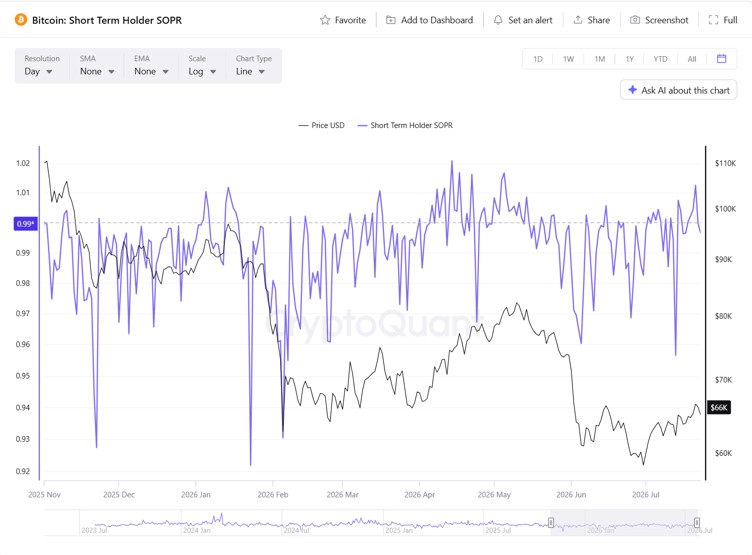
Short-term holder SOPR – Resource: CryptoQuant
2018 and 2022 Crypto Loss Realization Phases
The 2018 and 2022 crypto loss realization phases were critical periods of market capitulation.
According to a Yahoo Finance report, the 2018 Bitcoin bear market followed a collapse of the 2017 Initial Coin Offering (ICO) boom. Regulatory crackdowns, widespread liquidation, and fading real enthusiasm triggered a long-term market downturn. Much of the realized selling pressure came from retail investors forced to exit positions. BTC traded below its realized price for months as the market gradually flushed out speculations. The market-wide realized profit/loss ratio stayed below 1.0 for more than six months before a sustained recovery began.
The 2022 Bitcoin loss phase was driven by a combination of interest rate hikes and the collapse of prominent crypto firms, including FTX, Three Arrows Capital (3AC), Terra/Luna, and Celsius. Lending platforms, institutional funds, and other highly leveraged crypto firms were forced to liquidate billions of dollars in assets as margin calls rippled through the market. Bitcoin fell roughly 78% from its prior peak to about $15,500, and short-term holders carried around 35% average losses at the trough. The phase extended deeply into early 2023 before a baseline floor was built.
The Level That Actually Matters: $68,800
The average cost basis for short-term Bitcoin holders sits at $68,800 during the last nine months. This is the price that these buyers pay on average to buy BTC. This is not the price at which BTC is currently trading. As of July 22, BTC traded around $65,000, leaving most of these holders with unrealized losses.
Below the $68,800 level, most short-term buyers are underwater, and they are inclined to sell into any bounce. Once BTC trades above this average acquisition price, many short-term holders will return to profit. Historically, reclaiming the short-term holder cost basis has often improved market sentiment and marked a shift toward stronger price momentum.
Would The Streak End in 2026?
The exact timing of Bitcoin recovery cannot be predicted. BTC recovery depends heavily on institutional flow dynamics and Federal Reserve policy.
Additionally, it would be essential to see the 30-day average of long-term SOPR hold above 1.0, as it has been below that mark for 51 consecutive days as of late July. Another key factor would be the total BTC supply in profit to climb past roughly 64%, up from 57.5% recorded on July 22. Until these signals improve, short-term Bitcoin holders are likely to incur realized losses.
Frequently Asked Questions
What does realized loss mean in Bitcoin?
It means that BTC was sold for less than its purchase price, and the loss is locked in once it is sold.
Who are short-term Bitcoin holders?
These are investors who bought BTC within the last 155 days and react fast to price changes.
Why are short-term Bitcoin holders selling below their purchase price?
The leading reasons include fear of further losses, risk management, closing leveraged positions, and liquidity needs.
What is Bitcoin's cost basis?
It is the average price paid by a group of investors for their BTC and is used to judge whether that group is in profit or loss.
Please view the full disclaimer at: https://themoonshow.com/disclaimer

Strategy Buys $22.1 Million in Bitcoin, Lifting Holdings to 848,517 BTC
Bitcoin (BTC) treasury company Strategy bought 267 BTC for approximately $22.1 million between ...

JPMorgan Brings JPM Coin to Ethereum for 24/7 Institutional Payments
JPMorgan Chase & Co. launches its JPM Coin (JPMD) deposit token on Ethereum, extending its publ...

Bitcoin Rebounds Above $82,500 as Oil Falls and U.S. Stock Futures Rise
Bitcoin climbed above $82,500 during Asian trading on Monday, October 19, as falling oil prices...