
Top 10 Options Trading Strategies to Consider
Key Takeaways:
- Options trading strategies allow traders to profit from bullish, bearish, and sideways market conditions.
- The cryptocurrency market’s volatility makes strategies like strangle and straddle effective.
- Risk can be defined and controlled using spreads and hedging strategies.
- Strategies such as covered calls can help generate income and are useful in flat markets.
|
Strategy |
Market Outlook |
Risk Level |
Profit Potential |
Best Use Case |
Key Limitation |
|
Covered Call |
Neutral to Bullish |
Low to Moderate |
Limited |
Generate income from owned stocks |
Caps upside gains |
|
Married Put |
Bullish |
Low |
Unlimited |
Protect against downside risk |
The cost of the premium reduces returns |
|
Bull Call Spread |
Moderately Bullish |
Limited |
Limited |
Benefit from a moderate price increase |
Profit is capped |
|
Bear Put Spread |
Moderately Bearish |
Limited |
Limited |
Profit from the moderate price decline |
Limited gains |
|
Protective Collar |
Neutral |
Low |
Limited |
Lock in gains while limiting downside |
Upside is capped |
|
Long Straddle |
High Volatility |
High |
Unlimited |
Profit from large moves in either direction |
Expensive (two premiums) |
|
Long Strangle |
High Volatility |
Moderate to High |
Unlimited |
Lower-cost volatility play |
Needs a larger price movement |
|
Call Butterfly Spread |
Neutral |
Low |
Limited |
Profit from low volatility |
Requires a precise price target |
|
Iron Condor |
Neutral |
Limited |
Limited |
Income in range-bound markets |
Loss if price moves significantly |
|
Iron Butterfly |
Neutral |
Limited |
Limited to Moderate |
Profit when the price stays near a specific level |
Narrow profit range |
Options trading is one of the most versatile trading methods in the cryptocurrency industry. It is a high-stakes financial activity in which traders get the right to buy (call) or sell (put) an asset at a set price within a specific timeframe. The traders are under no obligation to buy or sell that asset at a specific price before expiration. However, combining options trading with strategies can help traders take advantage of the volatile cryptocurrency markets and improve their risk-to-reward ratio.
In this blog, we will discuss the top 10 options trading strategies that you should consider if you are interested in them.
Let’s begin!
What is Options Trading?
Options trading is a type of trading where you buy or sell contracts called options. In this trading method, you will get the right but not the obligation to buy or sell an asset at a fixed price (strike price) before a specific date (expiration). Key concepts of options trading include:
- Call Option: A contract that gives traders the right to buy stock at a set price, usually when the price is expected to increase (bullish).
- Put Option: A contract that gives traders the right to sell a stock at a set price, usually when the price is expected to decrease (bearish).
- Premium: It is the fee that buyers pay the sellers to acquire an options contract.
- Strike Price: It is the predetermined price at which the asset can be sold or bought.
- Expiration Date: It is the date by which the option to buy or sell must be used, or it will expire.
Traders often use options to speculate on price movements or to hedge (protect) their existing investments. This makes options riskier and more complex, since they can expire if the market doesn’t move as expected.
Start trading on Bybit today and get 10% off fees PLUS up to $30,000 in bonuses! Sign up today and start saving while you earn. This exclusive offer won't last - claim yours now!
Top 10 Options Trading Strategies
- Covered Call
- Married Put
- Bull Call Spread
- Bear Put Spread
- Protective Collar
- Long Straddle
- Long Strangle
- Long Call Butterfly
- Iron Condor
- Iron Butterfly
Covered Call
The covered call is one of the simplest and most widely used options trading strategies, especially among traders who already hold crypto assets. In this strategy, a trader owns an asset, such as Bitcoin (BTC), and sells a call option against it at a higher strike price. The goal is to generate income through the premium received from selling the option.
This strategy works best in a neutral to slightly bullish market, where the trader does not expect a significant price surge. If the price stays below the strike price, the option expires worthless, allowing the trader to keep both the asset and the premium. However, if the price rises sharply above the strike price, the trader’s upside is capped since they may have to sell the asset at the agreed price.
While it offers a steady income opportunity, the trade-off is limited profit potential during strong bull runs.
Here is an example to help you understand the covered call strategy better:
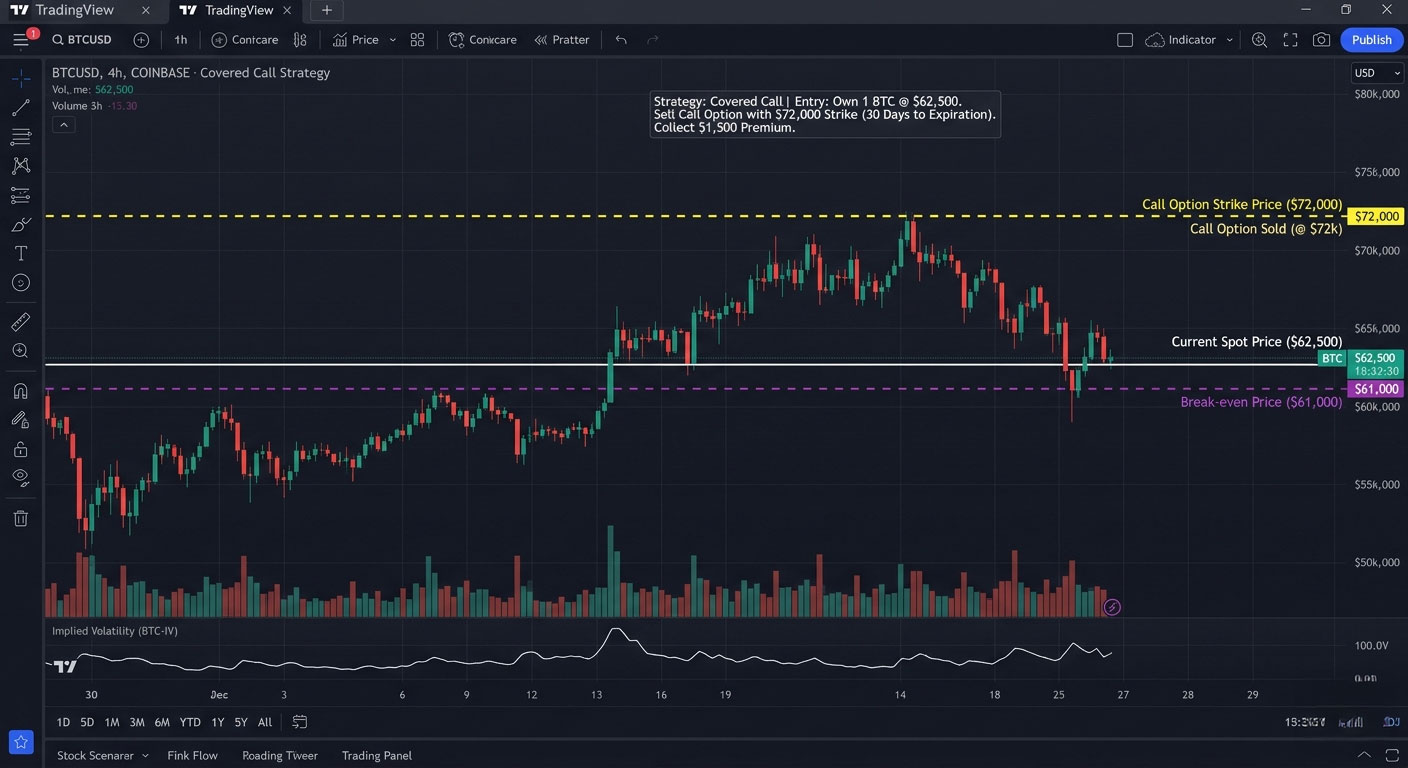
Explanation: Consider the scenario in which you own 1 Bitcoin (BTC) at a current market price of $62,500 and sell a call option with a $72K strike price. By doing this, you collect a $1,500 premium, which lowers your effective break-even price to $61K while capping your maximum potential profit if Bitcoin rises above the strike price.
Protective Put (Married Put)
A protective put is essentially an insurance policy for your crypto holdings. In this strategy, a trader buys an option while simultaneously holding the underlying asset. The put option gives the right to sell the asset at a predetermined price, while protecting against downside risks.
This strategy is particularly useful in volatile market conditions, where traders want to maintain exposure to potential upside while limiting losses. If the market drops sharply, the put option increases in value, offsetting the loss in the underlying asset. However, the cost of purchasing the put (the premium) reduces overall profitability. Despite this cost, many traders consider it a good option for the peace of mind it provides.
Here is an example to help you understand the protective put strategy better:
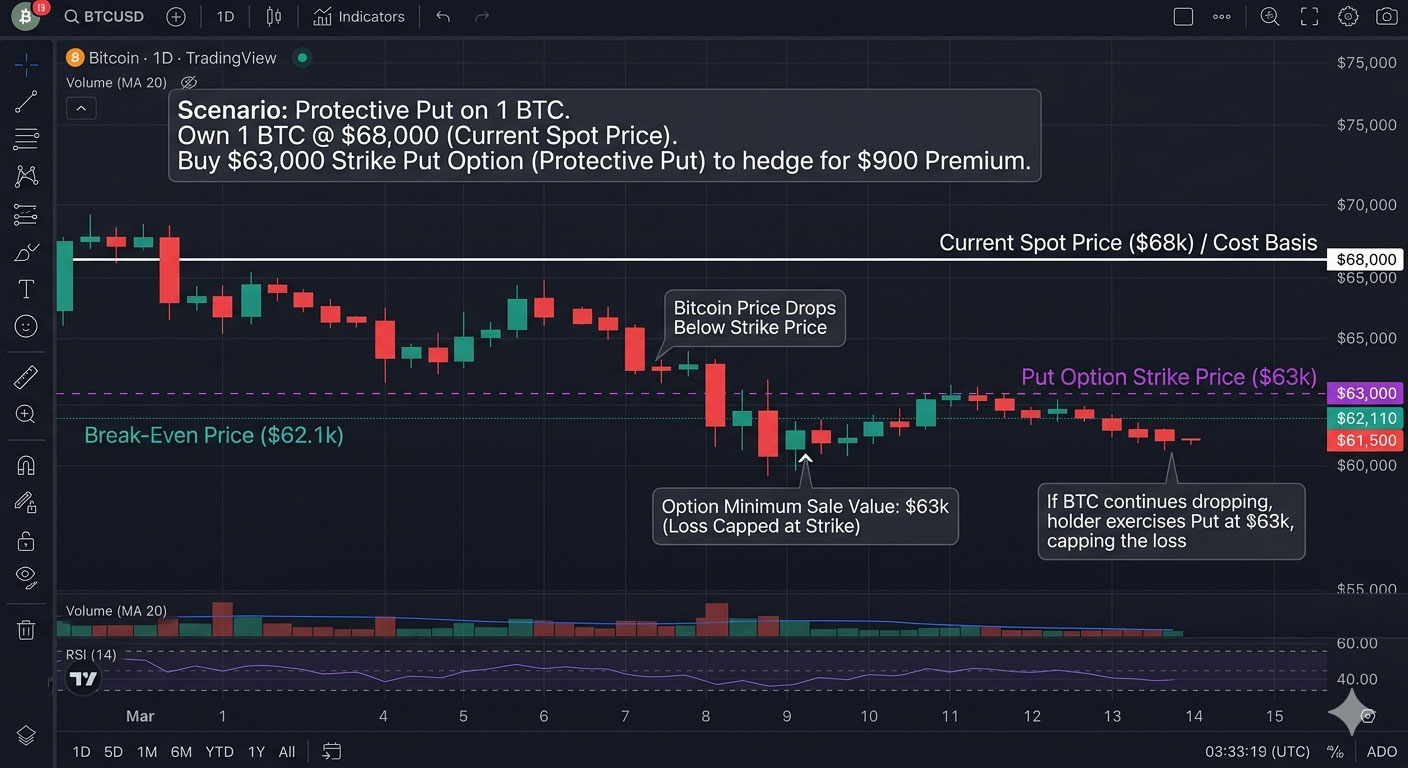
Explanation: Consider a scenario where you hold 1 Bitcoin at a spot price of $68K and pay a $900 premium to buy a put option with a $62K strike price. This strategy establishes a price floor at $63K, ensuring your maximum loss is limited even if the market crashes. Your effective break-even point for the trade is $68,900, including the cost of the protection.
Bull Call Spread
The bull spread strategy is designed for traders who expect a moderate increase in price rather than a sharp rally. This strategy involves buying a call option at a lower strike price and simultaneously selling another call option at a higher strike price. By selling the higher strike call, the trader reduces the overall cost of entering the position.
However, this also limits the maximum profit that can be achieved. The strategy strikes a balance between risk and reward, making it appealing for traders who want controlled exposure to bullish movements. In crypto markets, where price swings can be extreme, this strategy helps reduce the impact of overpaying for options premiums.
Here is an example to help you understand the bull call spread strategy better:
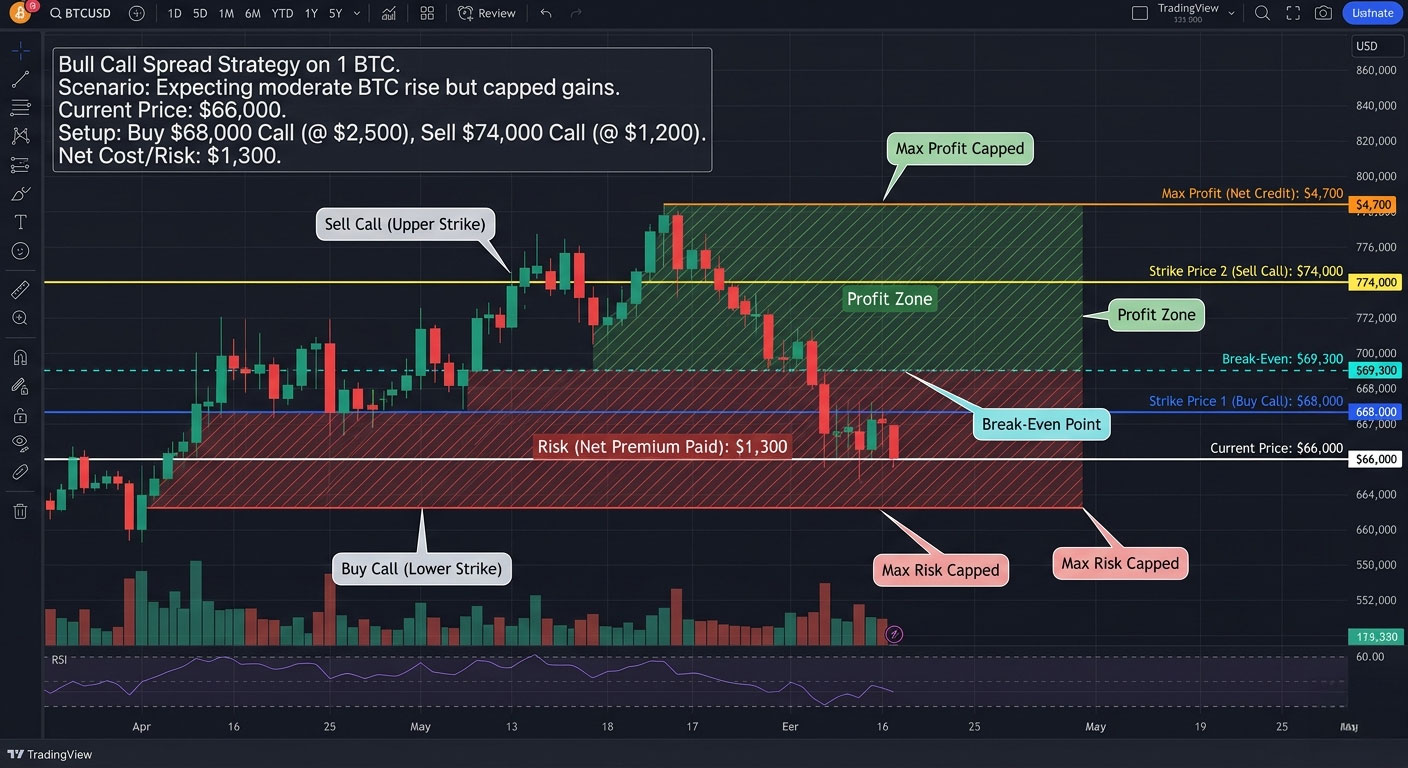
Explanation: Consider the scenario in which you expect the price of Bitcoin to rise moderately and execute a bull call spread by buying a $68K call while selling a $74K call to offset the cost. This setup limits your maximum risk to $1,300 net premium paid and caps your potential profit once the price exceeds the higher strike. Your trade reaches its break-even point if Bitcoin hits $69,300 at expiration.
Bear Put Spread
The bear put spread is the bearish equivalent of the bull call spread and is used when traders anticipate a moderate decline in price. It involves buying a put order at a higher strike price and selling another put option at a lower strike price. This structure reduces the cost of buying the put while also capping the maximum profit.
This strategy is particularly useful in crypto markets during correction phases, where prices are expected to decline but not crash dramatically. It allows traders to profit from downward movement while maintaining a defined risk profile, making it a more conservative bearish strategy compared to shorting.
Here is an example to help you understand the bull put spread strategy better:
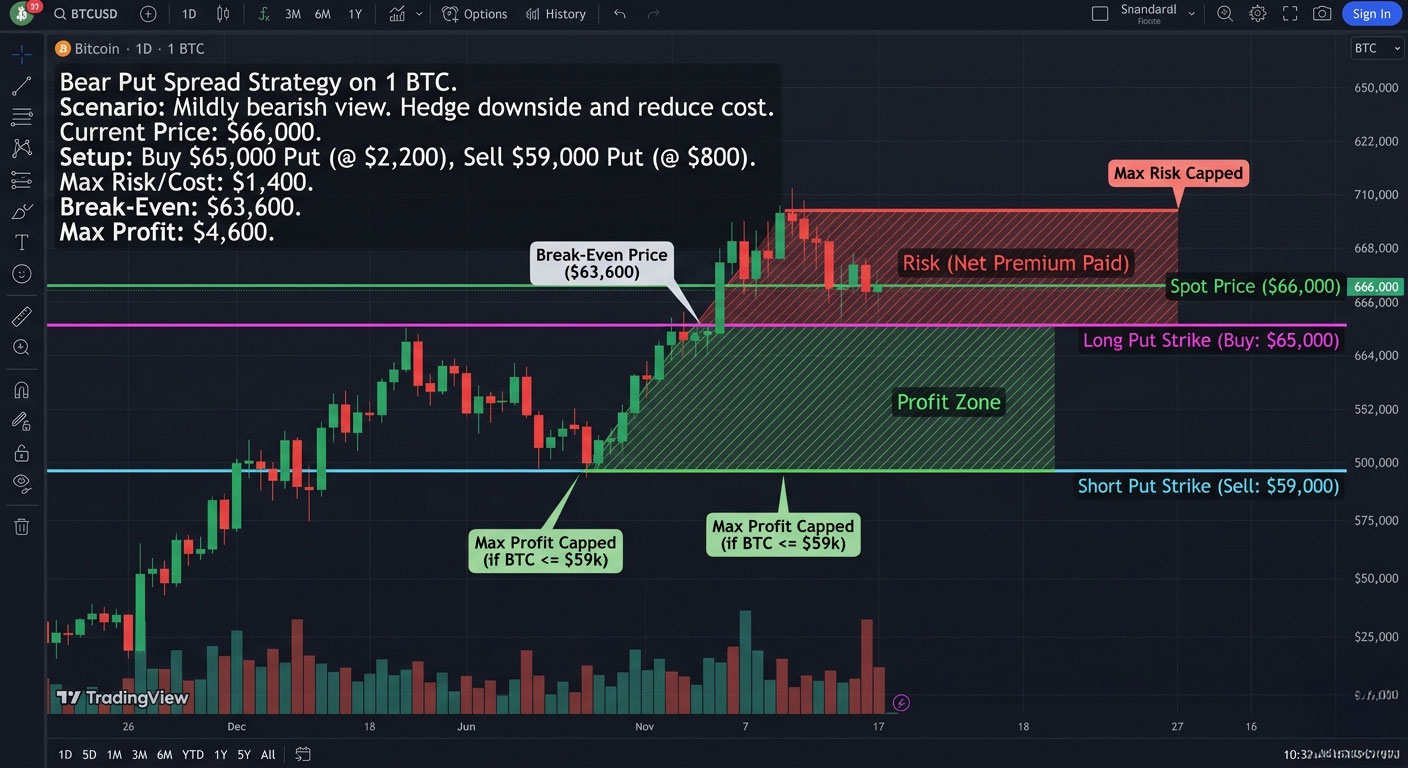
Explanation: Consider the scenario in which you expect Bitcoin (current price $66K) to decline and buy a $65K put while simultaneously selling a $59K put to reduce the total cost of the trade. This strategy caps your maximum risk at the $1,400 net premium paid and secures a maximum profit of $4,600 if the price falls to or below the lower strike. The position becomes profitable once Bitcoin drops below the break-even price of $63,600.
Protective Collar
The protective collar combines two strategies, i.e., covered call and protective put. This creates a balanced risk management approach for traders who want to secure their trades. In this, a trader holds the underlying crypto asset, buys a put option for downside protection, and sells a call option to offset the cost of the put.
This strategy is ideal for traders who want to lock in gains or protect existing positions without spending too much on premiums. While it limits potential losses, it also caps potential profits due to the short call. In volatile market conditions, protective collars are often used by institutional traders or long-term investors who want to preserve their holdings while maintaining market exposure.
Here is an example to help you understand the protective collar strategy better:
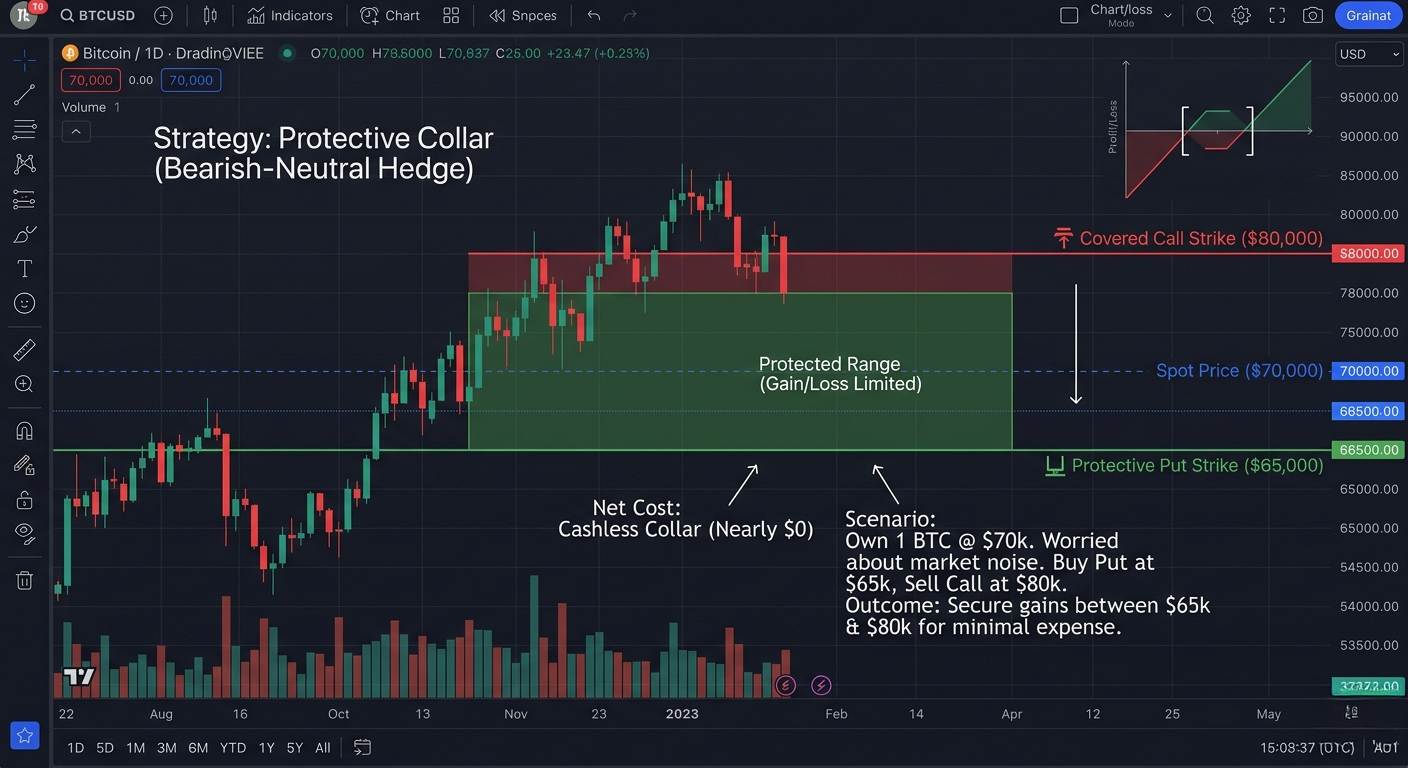
Explanation: Consider the scenario in which you own 1 Bitcoin at $70K and fear volatility. To protect gains and reduce costs, you buy a $65,500 put (your floor) and sell a $80K call (your ceiling). The income from the call nearly funds the put, effectively capping your range between $65K and $80K for a very low net expense.
Important Reads: The Ultimate Guide to Emotionless Options Trading
Long Straddle
The long straddle is a volatility-based strategy that allows traders to profit from large price movements in either direction. It involves buying both a call option and a put option at the same strike price and expiration date. This strategy is especially effective during major global events, such as regulatory announcements or macroeconomic developments that could significantly impact crypto prices.
Since one of the options will gain value if the price moves sharply, the potential for profit is substantial. However, the cost of buying two options makes this strategy expensive. The price movement must be large enough to cover the premiums paid for both options.
Here is an example to help you understand the long straddle strategy better:
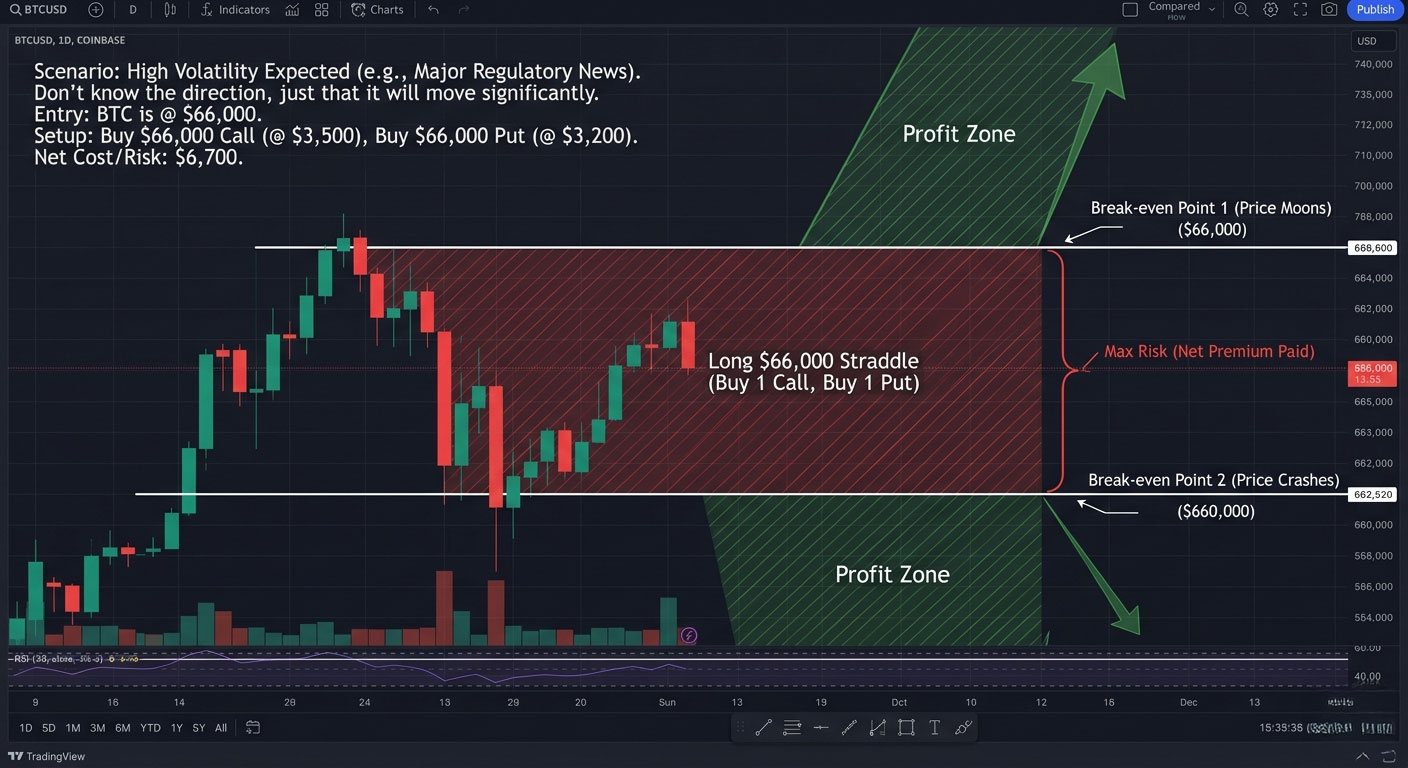
Explanation: Consider a scenario in which you expect Bitcoin to move significantly due to an upcoming event, but are unsure of the direction, so you simultaneously buy a call and a put option at the same $66K strike price. This strategy requires a total net premium of $6,700, which represents your maximum risk if the price remains flat. You only achieve profit if the price of Bitcoin moves strongly in either direction to exceed the combined cost of both premiums at expiration.
Long Strangle
The long strangle is similar to the long straddle but uses different strike prices for the call and put options. Usually, the call option is purchased above the current price, while the put option is purchased below it. This makes the strategy more affordable than a straddle, as the options are out of the money (meaning the market price hasn’t reached the “bet” price yet).
However, it requires a large price movement to become profitable. Crypto traders often use this strategy when they expect volatility but are unsure about the direction of the movement. It provides flexibility while keeping initial costs lower, making it a popular choice in uncertain market conditions.
Here is an example to help you understand the long strangle strategy better:
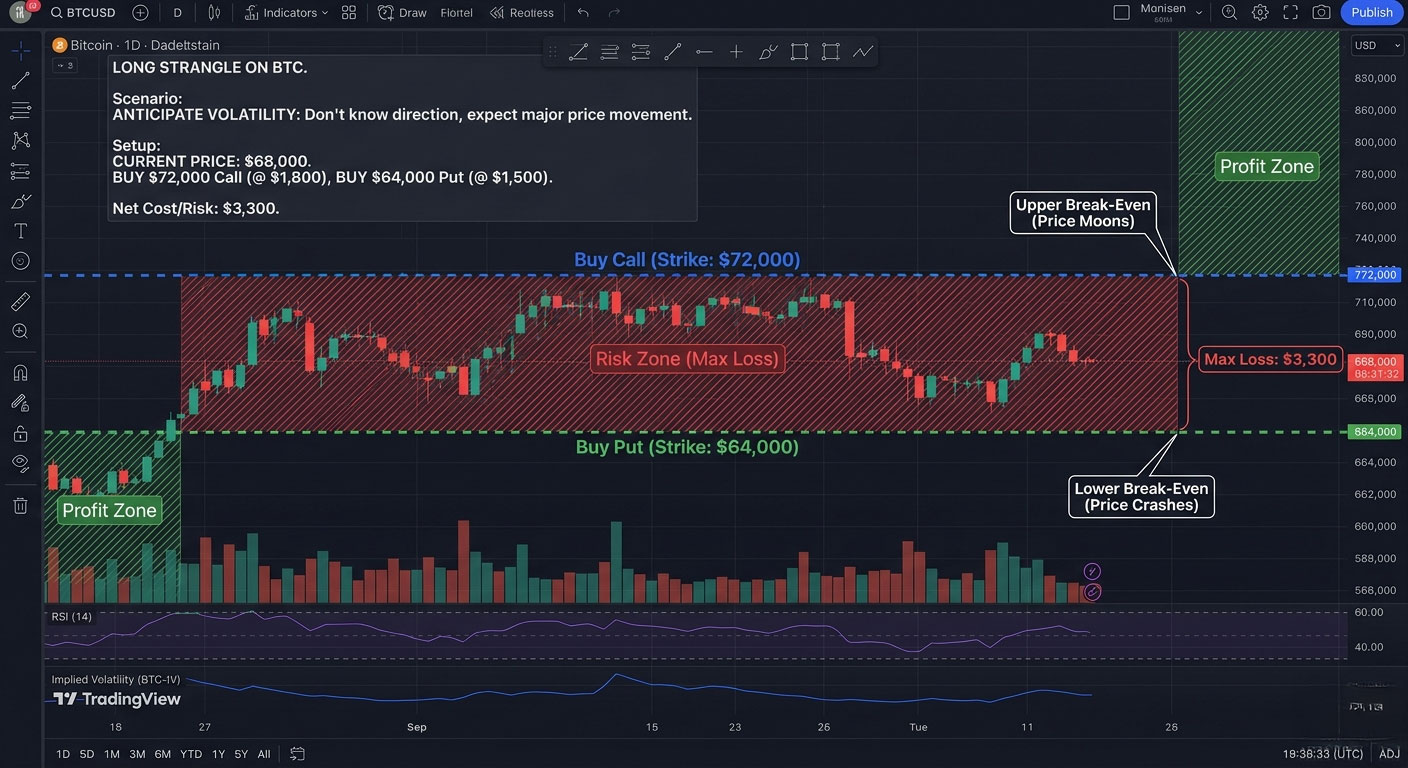
Explanation: Consider a scenario where you anticipate high volatility but want to lower the entry cost than a long straddle, so you simultaneously buy an out-of-the-money call at $72K and an out-of-the-money put at $64K. This setup limits your maximum risk to the $3,300 net premium paid and requires a massive price swing in either direction to reach profitability. You only see a return if Bitcoin’s price moves beyond the upper or lower break-even points, which are stretched further apart due to the out-of-the-money strikes.
Butterfly Spread
The butterfly spread is a more advanced strategy that generates profits when the price of the underlying asset remains close to a specific level. It involves combining multiple options contracts at different strike prices to create a position with limited risk and limited reward. This strategy is best suited for low-volatility environments, where the traders expect minimal price movement.
In crypto markets, such conditions are less common but can occur during consolidation phases. The butterfly spread strategy requires precise execution and timing, as profits depend on the asset price staying within a narrow range until expiration.
Here is an example to help you understand the butterfly spread strategy better:
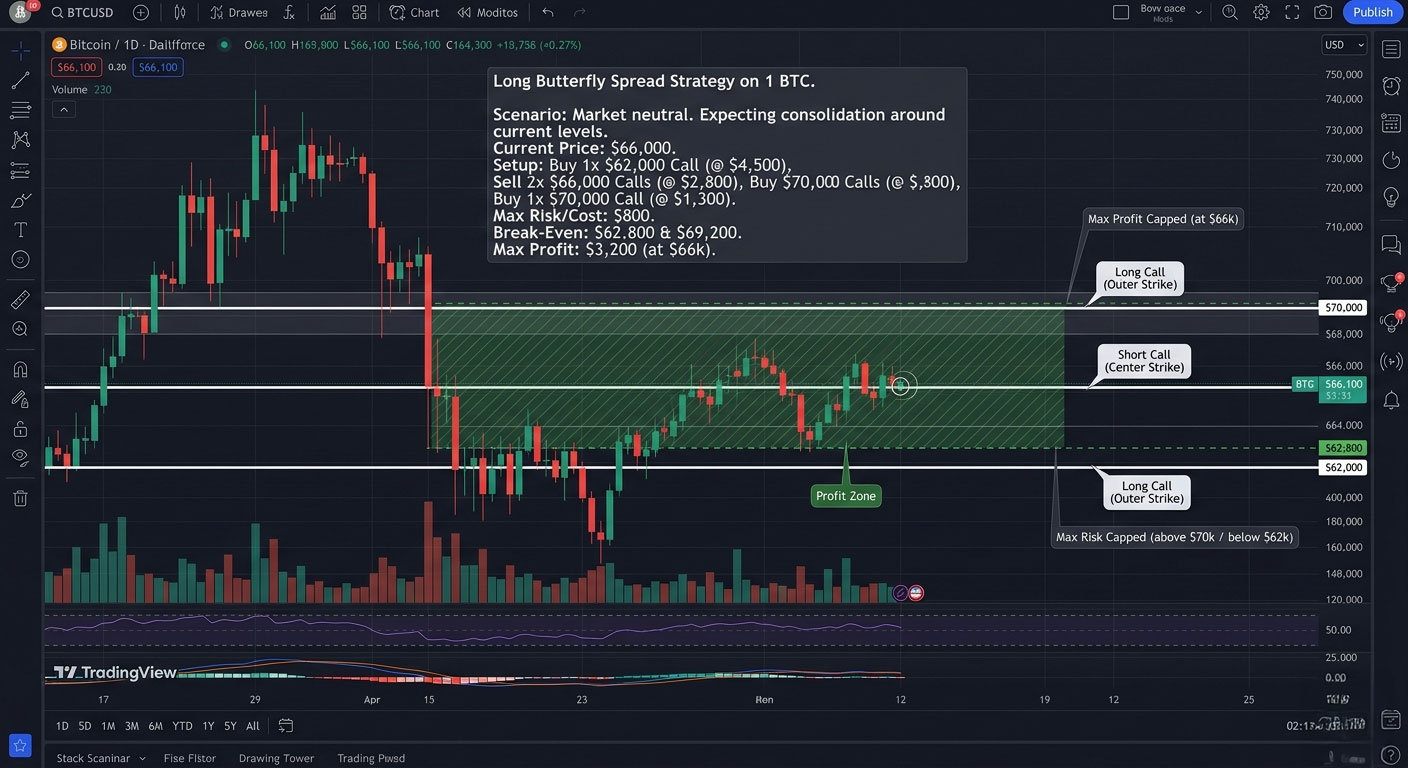
Explanation: Consider the scenario where you believe Bitcoin (current price $66K) will remain stable around this price for the next month. To capitalize on this, you execute a long butterfly spread by buying one $62K call, selling two $66K calls, and buying one $70K call. This position creates a strict range centered on $66K, with a next cost of $800 (max risk) and a max profit of $3,200 if Bitcoin expires exactly at the $66,000 target.
Iron Condor
The iron condor is a popular neutral strategy that generates income in a sideways market. It combines a bull put spread and a bear call spread, creating a range within which the traders generate profit. As long as the asset price remains within this range, all options expire worthless, and the traders keep the premium collected.
This makes the iron condor an attractive strategy for consistent income generation. However, if the price moves significantly outside the range, losses can occur. In crypto trading, where volatility is high, careful range selection is critical for success with this strategy.
Here is an example to help you understand the iron condor strategy better:
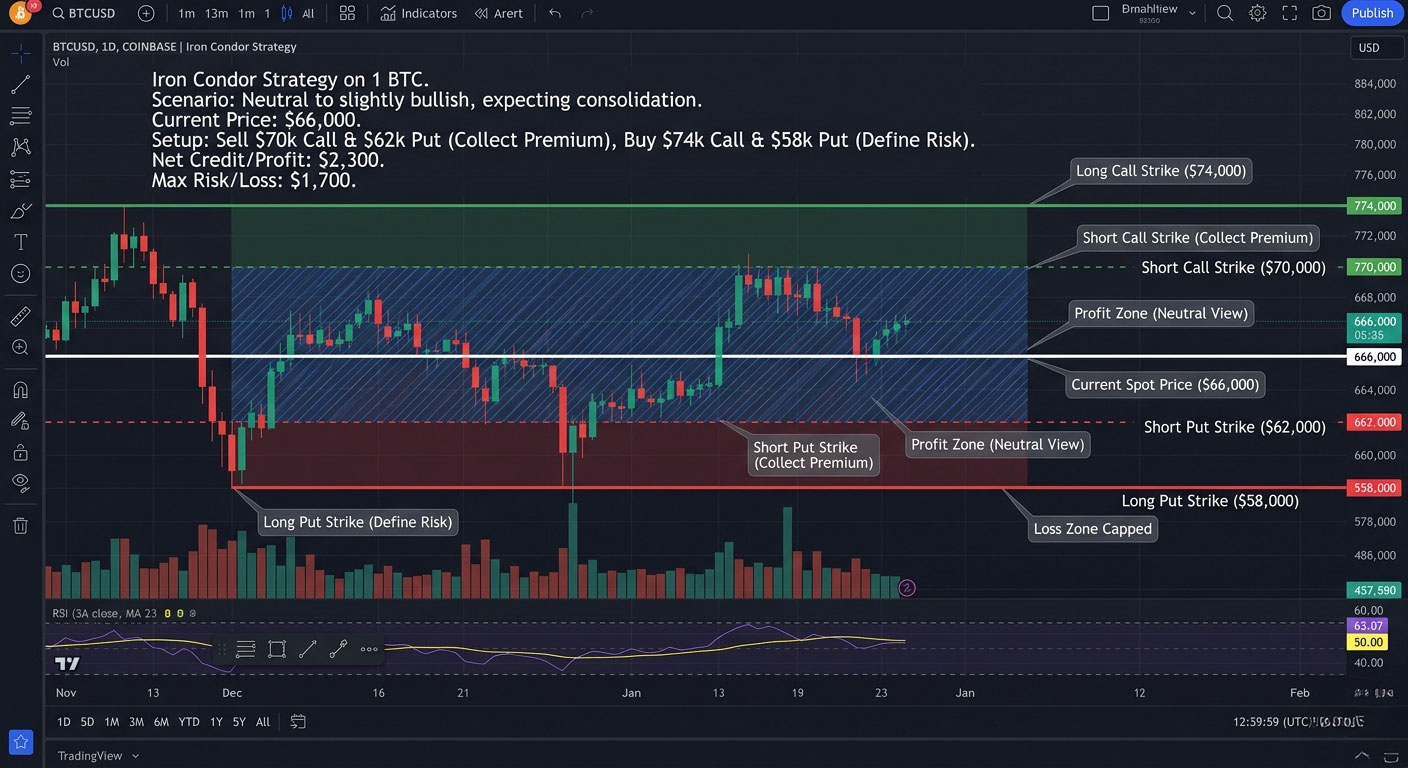
Explanation: Consider a scenario in which you believe the price of Bitcoin will remain stable at $66K and trade sideways within a specific range for the next few weeks. To capitalize on this low volatility, you execute an iron condor by simultaneously selling a $70K call (collecting a premium), selling a $62K put (collecting a premium), and then defining your risk by buying a $74K call and a $58K put. This setup guarantees a net credit of $2,300 (max profit) if Bitcoin stays between $62K and $70K at expiration, with a capped maximum risk of $1,700 if it breaks out in either direction.
Iron Butterfly
The iron butterfly is a variation of the iron condor, but with higher premium collection and a tighter profit range. It involves selling both a call and a put order at the same strike price while buying protective options at a higher and lower strikes. This strategy is designed for markets with very low volatility, where the traders expect the price to remain stable.
While the potential profit is higher than that of an iron condor, the risk is also more concentrated if the price moves suddenly. Crypto traders use this strategy less frequently due to the market’s volatility, but it can be effective during periods of consolidation.
Here is an example to help you understand the iron butterfly strategy better:
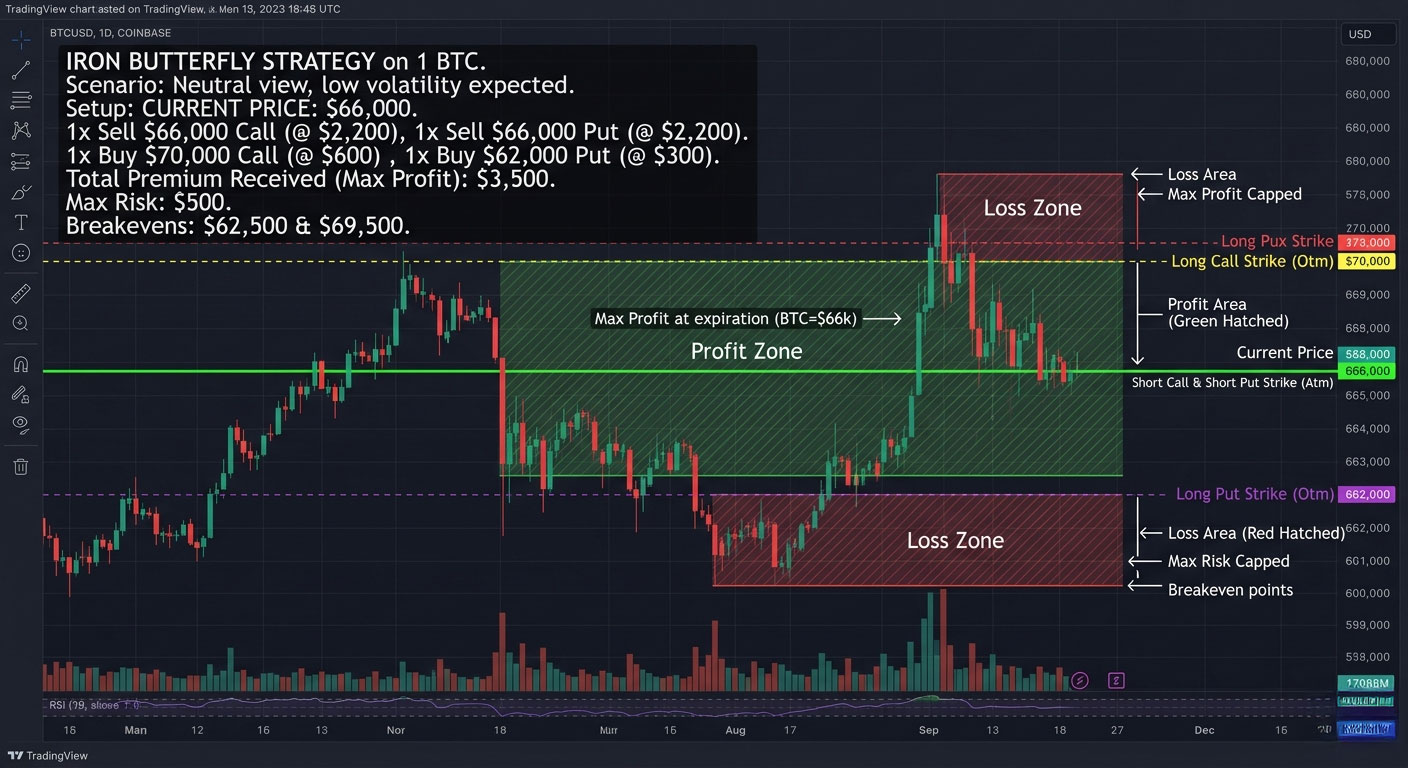
Explanation: Consider the scenario in which Bitcoin is currently priced at $66K, and you expect minimal price movement before expiration. To execute an iron butterfly, you simultaneously sell one at-the-money $66K call and one $66K put, then define your risk by buying one out-of-the-money $70K call and one $62K put. This position generates a very high net credit of $3,500 (max profit), if Bitcoin expires exactly at $66K, with your total risk capped at only $500 (max risk) in either direction.
Final Takeaways!
Options trading strategies provide traders with flexible ways to navigate bullish, bearish, and volatile crypto markets while managing risks effectively. From beginner-friendly approaches like covered calls to advanced strategies such as iron condor and butterfly spreads, each method serves a unique purpose depending on market conditions. By understanding these strategies and applying proper risk management, traders can improve their decision-making and maximize potential opportunities in the crypto market.
Double your advantage on Bybit: 10% off trades + $30,000 up for grabs! Sign up now and claim these exclusive rewards. Offer expires soon!
FAQs
What are options in crypto trading?
Options are contracts that give traders the right, but not the obligation, to buy or sell a cryptocurrency at a predetermined price before a specific date.
Which strategy is best for beginners?
Covered calls and protective puts are often considered beginner-friendly due to their relatively simple structure and defined risk.
Can options trading reduce risk in crypto?
Yes, strategies like protective puts and collars are specifically designed to hedge against downside risk.
What is the most profitable options strategy?
Profitability depends on market conditions, and no single strategy works best in all scenarios.
Are options trading suitable for a highly volatile market like crypto?
Yes, many strategies, such as straddles and strangles, are specifically designed to benefit from volatility.
What is the main risk in options trading?
The main risks include losing the premium paid, time wastage, and unexpected market movements.
Do options expire worthless?
Yes, if the market does not move in the anticipated direction, options can expire with no value.
Disclaimer: All content on The Moon Show is for informational and educational purposes only. The opinions expressed do not constitute financial advice or recommendations to buy, sell, or trade cryptocurrencies. Trading involves significant risk and may result in substantial losses. Always seek independent financial advice before making investment decisions. The Moon Show is not responsible for any financial losses or decisions made based on the information provided.
Please view the full disclaimer at: https://themoonshow.com/disclaimer

How to Buy Bitcoin for Beginners – A Step-by-Step Guide
When you are new to crypto, buying Bitcoin (BTC) can feel complicated. In practice, the process...

How to Choose a Crypto Exchange in 2026: Fees, Security, Regulation
Over the years, cryptocurrency exchanges have evolved considerably. What first began as simple ...

All-time Highs: A Detailed Guide for Crypto Traders
All-time high is the highest price an asset hits since it starts trading. To learn more about A...